JOHN F. KENNEDY
(John Fitzgerald Kennedy)


He was right. Even the vaunted Southern Filibuster was broken by the strategy and tactics Johnson and Senator Humbert Humphry, the Floor Leader for the 1964 Civil Rights Bill.

This poster's distribution before the JFK murder, has fed numerous conspiracy theories that right wing extremists were behind the assassination.


Truman didn't quite think that JFK was quite up to the Presidency in 1960.

Kennedy was initially very opposed to a civil rights march on Washington and seemed very annoyed to the Blacks in attended. But when faced with the reality of the fact that the March was going to take place and he could not prevent it, he turned around and did everything he could do to protect the marchers and enable the historic event.

As late as 2005 Saudi Arabia was officially listed by the State Department as trafficking in women for sexual exploitation and domestic servitude.

Kennedy was dining with Time Magazine publisher Henry Luce soliciting support for JFK's presidential candidacy. Luce observed that JFK to obtain the Democratic nomination would have left-of-center domestic policies. Luce was right and the father, wrong.

Derogatory description of John F. Kennedy.


As a young Senator JFK had called for Algerian freedom from French rule. The French ambassador was not even upset.

Adlai Stevenson's dovish foreign policy views were not appreciated by some hawks. When John F. Kennedy appeared on the national political scene there were some derogatory comparisons.
Referring to the JFK-Nixon debate where the TV camera showed Nixon sweating: See Don Hewitt {603411} and Richard Joseph Daley {599089}

His debating opponent, Dan Quayle, compared himself to John F. Kennedy:

President Kennedy was known for his personal activity at all levels of the State Department. Particularly exasperated at one point, he asked the assistant secretary what was wrong with the department.

Bonnano claimed that JFK's father, Joseph P. Kennedy, 1888-1969, had made a deal with Mafia leaders that if they supported JFK's bid for the presidency, the elder Kennedy was to keep federal pressure off of organized crime. After Joseph P. Kennedy had a stroke and became disabled, Attorney General Robert Kennedy moved against organized crime.

He was explaining why his candidate, Earl Warren, refused to debate his opponent, incumbent governor Olsen, in 1942. Later he was one of the Nixon advisors who was vehemently opposed to Nixon debating Kennedy in the 1960 presidential election.

Commenting on the JFK assassination:


President Jimmy Carter had little use for diplomatic protocol. JKF’s Chief of Protocol tried to persuade him to give more attention to it. When Carter explained that he just didn’t see how it would help him achieve his objectives, the Ambassador observed: The President never sought Biddle’s advice again.


President-elect Kennedy had asked the poet to write and present a poem for the inaugural.
President-elect Kennedy had asked the poet to write and present a poem for the inaugural.

Grandfather of President John F. Kennedy

the CBS makeup woman assigned to the debate Nixon’s reply was: “And I’d be dead now,” reflecting the belief that Lee Harvey Oswald just wanted to kill a President. See Russell Baker {593945} and Richard Joseph Daley {599089} on Nixon’s appearance.

President Kennedy's father, Joseph P. Kennedy, was U. S. Ambassador to Great Britain when Neville Chamberlain appeased Hitler, leading to World War II. The elder Kennedy opposed war with Germany. During the 1960 Democratic convention Johnson and JFK were rivals for the nomination:

JFK bested LBJ for the 1960 Democratic presidential nomination. Clare Booth Luce asked LBJ if he would consider the second spot on the ticket. Shortly thereafter Johnson became Kennedy's running mate and was elected. At the inaugural ball, Luce reminded LBJ of his earlier conviction.
The President was under intense attack political and personal over the Vietnam war:
Johnson had assumed the Presidency upon the assassination of John F. Kennedy.
The Civil Rights Bill of 1964


After John Kennedy's assassination, columnist Mary McGrory said, "We'll never laugh again." Moynihan, then Assistant Secretary of Labor, said:

These lines were cited later, after JFK's death, by Jacqueline Kennedy, 1929-1995, in describing her husband's administration.

the assassination of John Kennedy 3 days earlier
Sorenson was hired for the future president.


It is the quotee’s thesis that these leaders and many others adopted deliberate affectation to their dress for the dual political purpose of easy public recognition and fitting an image of individuality but short of deviance.

Kennedy had never been at the left wiing of the Democratic Party. His father, Joseph Kennedy, was known to all Irish Catholic politicans and disliked by most. He had supported big finance and business and was no great friend of labor. He was fired by FDR for publicly supporting Hitler before WWII and urging non support of England. He badmouthed FDR and Eleanor Roosevelt--Democratic icons. President Truman had to be stopped by a Secret Service agent from throwing the elder Kennedy out the window of a Boston hotel. He was a nasty man who threw his money around. But Senator Kennedy himself had never said a word criticizing Joeseph McCarthy or comdemning McCarthism and his other exceses leaving the criticism to other Democrats and even Republicans. (His silence was at the advice of his father.) Ribicoff a strong liberal knew Kennedy well and felt that Kennedy would not be constrained by his father's views, and that Kennedy was a true liberal at heart and would demonstrate that if elected President.

The CIA had attempted to employ the Mafia to assassinate Fidel Castro, the strongman of Cuba, and Castro found out about it. He then warned that U. S. leaders could be assassinated in retaliation. Although LBJ appointed the Warren Commission to investigate the JFK assassination and the commission concluded that Castro and Cuba had nothing to do with it—Oswald was a gunman acting alone. Johnson privately never believed that but only confided his believes to his closest confidants lest there would be public pressure to retaliate against Cuba and Johnson had no hard proof—just a suspicion.


Governor George Wallace had “interposed” himself and state police to prevent the Alabama Federal Court’s Desegregation Order of the State University.
After JFK’s assassination, many of his appointees who were liberal Democrats, were concerned that LBJ was a Southern conservative and might not want to serve in a conservative administration. Johnson satisfied Heller and all of the other Kennedy appointees who he asked to stay on. Actually, Johnson was more liberal than JFK, and proved it during his Presidency.

A highly respected intellectual, Schlesinger, had joined the John Kennedy Presidential Campaign. The announcement produced a slew of news stories. A Boston Globe reporter called Schlesinger’s wife, a respected intellectual figure in her own right, and asked if she was also supporting Kennedy in the Democratic Primary. She told him that she was supporting Stevenson, not Kennedy and a story with that information appeared the next day. This was embarrassing for the JFK campaign and particularly for Robert F. Kennedy, JFK’s younger brother who was the campaign director. He read the Boston Globe article, made a copy and wrote this famous quotation in the margin and sent it to Schlesinger. Historically it was unusual for the wives of public figures to hold public views different from their husbands. This was the main reason the story was news for the Boston Globe. But there were always women who maintained an independence of thought and political views, though in 1960, they were far fewer than today when this has almost become typical. However, Robert Kennedy, like Schlesinger and JFK himself had married very strong, accomplished women and they were not threatened by their wife’s independence. Hence the humorous questions Kennedy wrote.

Nixon was a very aggressive campaigner, with a great flair for smearing opponents. Kennedy had been an intellectual, Ivy League gentlemen type and his brother, his campaign manager, wanted JFK to get down in the mud with Nixon. He was more assertive than usual and didn’t back down, but he did not go for the low blows that had been readied for him.
Lee Harvey Oswald, the assassin of President John F. Kennedy, had purchased the killing rifle from an ad in the NRA Magazine, The American Rifleman. Congress was debating new gun control legislation that would restrict mail order gun sales. The NRA supported the modest gun control legislation as they had earlier {623081}. . The legislation passed with very heavy support. , the NRA would shift far to the right and would no longer support any reasonable gun legislation whatsoever, regardless of how reasonable.

JFK was running for the Presidency and was Roman Catholic. There was a great deal of anti-Catholic prejudice in the country with many people fearing that a Catholic President would mean Papal control of the United States. Peale was the most influential American clergyman of the day, and while he did not overtly oppose the Kennedy candidacy, he did state that he thought the election of a Catholic would profoundly change America. Kennedy won by a thin margin, but none of the events that the anti-Catholics feared, came to pass.

Kennedy was a Roman Catholic and there was a great deal of anti-Catholic prejudice in the country then. Al Smith, the only Catholic who had run for the Presidency, was defeated with almost all his opposition coming from anti-Catholic forces appealing to the then popular prejudice that if a Catholic became President, the Pope and the Vatican would be running America. Richard Nixon, a master politician with few scruples, cleverly kept raising the religious question in the voters minds by saying that he would not make Kennedy’s religion and issue of the campaign. Kennedy barely won.
He was JFK’s speech writer.

The “talk” was some Protestants concerned that JFK, a Catholic, was a candidate for the presidency.

She had used a number of different designers for her wardrobe until she was criticized for having no consistent theme and look. It was decided that she should select one as her fashion consultant and she choose Cassini and had to tell the others that they were no longer needed. See {592752} for a John Adams related quote.

The Shah was a great conspiracy theorist. This quotation is very important in America as there is a conservative cadre which has believed this for many years. Many see the Trilateral Commission as this powerful force. The Shah’s quotation, they take as evidence for their fantasy.


McNamara stated that the Cuban Missile Crisis was more politically required than defense required. The Russians had nuclear missiles at the time that could reach the United States and didn’t really need missiles in Cuba to threaten America. Public opinion and the Republican Political doctrine persuaded President Kennedy that independent of safety and military factors, nuclear missiles in Cuba was a major political problem. See his comment to the President and the Other Officials dealing with the crises—{631968}.

The CIA has never denied this, and it seems to be corroborated in that none of the CIA reports to the Presidents ever mentioned the failures and there is no CIA official who ever claimed that they informed either of the Presidents. In particular, when Kennedy initially went along with the ill-fated CIA Bay of Pigs invasion plan not realizing that the CIA had a dismal record of major misjudgments and failures of covert operations.

Ironically, the Republican Presidents who had no business experience did much better with the American economy—Nixon, Eisenhower, and Reagan than the Republican businessmen. And the one Democrat who was a successful businessman—Jimmy Carter—presided over a terrible economy. The key variable seems to be business experience which gives leaders a false sense of being able to control things more than is real and develops an empathy with a narrow slice of the electorate—other businessmen—who are much more interested in short term profits rather than the health of the economy as a whole.
This quotation was documented by an FBI illegal wiretap of King and his associates. The illegal wiretap had been insisted upon by FBI Director J. Edgar Hoover who was a racist and somewhat of a paranoid about communists. However, Attorney General, Robert F. Kennedy personally approved the illegal wiretap.

Most Americans do not believe the official explanation of the Warren Commission that Oswald acted alone. However, Kerry was the first of very few high government officials who would express this opinion in public. The fact that Oswald himself was then assassinated in the Dallas Police Station denied any information from him. Then were many foul ups of the investigations that most analysts of the assassination believe were foul ups or cover-ups of other wrong doing. Examples were: Parts of Kennedy’s brain was missing and the autopsy notes were burned by the naval physician who did the autopsy before anyone could see them; the FBI and CIA both lied to the Warren Commission, President Johnson, and Attorney General Robert Kennedy; Both the FBI and the CIA had files on Oswald; the CIA had tried to assassinate Fidel Castro before including paying the Mafia to do it (The efforts were bungled and Castro found out about most; Oswald had w few weeks earlier tried to assassinate the right wing John Birch Society fanatic, General Edwin Walker and the CIA and FBI missed that.); Shortly before the assassination Walker and his fanatics printed and distributed a “Wanted for Treason” poster accusing President Kennedy of selling out America. (See {635732}.)
The Texas authorities bungled the investigation, and the President under pressure, appointed the Warren Commission to conduct the investigation. That commission did poorly as well as they were lied to by both the CIA and the FBI. The autopsy report disappeared. The forensic photos of the dead president were not shown to anyone but Judge Warren; even the chief investigator—Arlen Specter—was not allowed to see them. Conspiracy theories have abounded ever since.

sending American troops to Vietnam

The University of Alabama was one of the best college football teams and most people thought of Coach Bryant as singularly focused on football and nothing else. However, this quotation illustrates the degree of penetration and awareness that occurred when JFK was assassinated.

This quotation illustrates the extreme paranoia and irrationality of many of the ultra-conservative, right wing extremists of the day. It also has three of the classic ultra right wing conspiracy scenarios that are still claimed by the most extreme rightists: American leaders are giving U. S. Sovereignty to the United Nations; Many American leaders are anti-Christian and appoint more; civil rights is a communist idea and civil right demonstrations (riots) are inspired and/or controlled by communists.

Kennedy was a relatively new president and the Bay of Pigs Operation was prepared and planned by the CIA under the Eisenhower Administration. The president assumed that the intelligence was correct and there would be an uprising of the Cuban people when as soon as the landing took place. That was all wrong and the Cubans actually supported Castro and the operation was a disaster. Kennedy never trusted the CIA after that.

Johnson tasked Clark with finding out what the FBI knew of this story. The story was true. Worse, the CIA had hired members of the Mafia to do the assassination. (The Mafia resented Castro as he ended the Gambling Mecca that Cuba had been when his revolution succeeded. Before the Castro revolution, he Mafia got a “piece” of the profits from each Cuban casino for “protection.”) It might have been that the Kennedy Assassination was retaliation by Castro. However, the CIA withheld this from the Warren Commission and Robert Kennedy never revealed it even though he was a member of the Commission and the Commission had security clearance. See {637465}.

See {637464} for the trigger for the FBI to write this report. It was the report that verified that the CIA had hired the Mafia to assassinate Fidel Castro which President Johnson had heard but the CIA never revealed it to Johnson or the Warren Commission investigations JFK’s assassination. The full document was kept secret and was not yet declassified in 2014 when this quotation was entered in the collection.

3rd Earl Russell of Kingston. The main reason for the secrecy was that the FBI had made some serious blunders in tracking Oswald before the assassination, and failed to apprehend him when he was involved in another attempted assassination, and no one thought this negated the single assassin theory so J. Edgar Hoover was able to keep the Bureau’s incompetence secret. However, the CIA, even with the secrecy lied to the Commission to cover up their blunder in having hired Mafia organized crime figures to assassinate Fidel Castro. The attempts failed but Castro threatened to retaliate, and this possibility was never discussed by the Warren Commission as they did not have the information much less the public. Because of the secrecy, many people have been suspicious of the lone assassin conclusion that the commission had reached as they assumed venality rather than incompetence.

Zacharia read the quotation which the audience was sure was another of the many Republican attacks on Barack Obama’s foreign policy and his decision making. The Republicans came up with the same type rhetoric that they did in earlier years with Democratic Presidents starting with Harry Truman. There have always been some politicians and pundits who regard any President (or other leader) who takes time to gather facts, hear alternative views, consider and reflect upon them, and then reach a decision as week and indecisive—an intellectual. To them, a real man—a real leader—listens looks at an issue before him and shows decisiveness by not vacillating and making his decision relatively quickly. To them if it took that much time and thought to reach a decision the President is not confident that his is the right decision and that shows weakness. Of course, every senior leader knows that if the decision reaches him, there is no clear good solution. If there were, it would have been decided at a lower level. Ideologues however don’t like to acknowledge complexity.


Oswald was the assassin of President John F. Kennedy.

The JFK autopsy was very sloppily handled. So much so that the president’s brain had been removed and was missing at the time of the investigation and has never been located. That in itself is so hard to believe that it was just incompetence. The Texas criminal justice structure was not very sophisticated.

There was no way of reopening the investigation into the assassination without the public finding out that the CIA and FBI both had deliberately misled the Warren Commission and the House Investigating Committee in the original investigation. Nixon and other politicians who likely knew of the scandal did not want the confidence of the public eroded in this important agencies, and that was probably his motivation for the turn down rather than trying to cover up facets about the assassination itself.

talks toward normalizing relations with Cuba One of the many alternative theories about the assassination of President Kennedy, was that it was done by fanatic Cubans who resented Kennedy for not sending more military assets to support the Bay of Pigs operation, for not supporting the Cuban militants to make another invasion attempt. If they had found out that Kennedy was secretly negotiating with Castro, they would have seen this as a betrayal. Attwood had secretly met with the Cuban Government Representatives and was to have briefed President Kennedy, but the president was assassinated first. His death ended the mission to normalize Cuban relations, so if that was the motivation for an assassination, the Cuban exiles might have been successful in derailing relations with Cuba. However, there has been no direct evidence found for this speculative theory.
Agar’s books were favorites of John F. Kennedy who got the idea for Profiles in Courage from a courageous political story that Agar had written. But Kennedy in his 1960 Presidential campaign against Nixon used this Title as a Campaign Slogan. Norman Rockwell had created a wonderful political painting for a Kennedy campaign poster. The title of the Painting was “A Time of Greatness”

The President was referring to the fact that most Arab governments constantly attacked Israel with an end of “wiping them off the face of the map” or “pushing them into the sea.” When Palestine was partitioned into Jewish and Arab states, the Israelis developed their part into a modern industrial democracy with the highest standard of living and political freedom in the Middle East despite having to fight off repeated Arab attacks who resented the fact that non-Arabs controlled any land of the area and that their dictatorships and monarchies were always embarrassed by the success of this “foreign” and “European” force in their midst.
In 1961 the President intervened in a labor dispute in the steel industry with the "understanding" that the steel companies would not raise their prices after the settlement. As soon as there was a settlement prices were raised:. The President "persuaded" the steel executives to rescind the increases.
Kennedy said that he was quoting Dante. However, he or his speechwriter, got the quote wrong. In the Devine Comedy, Dante had a hot place in hell for the neutral, but the hottest place was reserved for traitors. Many people since then use this quote and attribute incorrectly to Dante because Kennedy’s version is the only one with which they have come in contact.
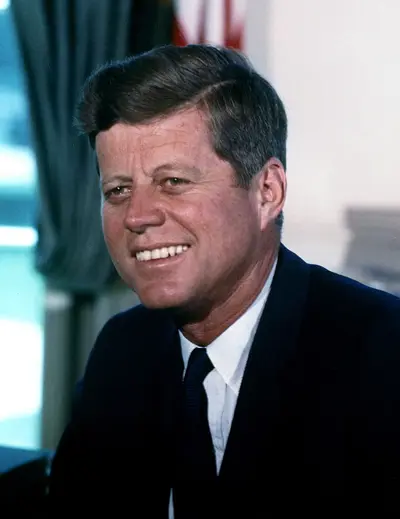
- Born: May 29, 1917
- Died: November 22, 1963
- Nationality: American
- Profession: President
John Fitzgerald Kennedy, often referred to by his initials JFK, was an American politician who served as the 35th president of the United States from 1961 until his assassination in 1963. Kennedy served at the height of the Cold War, and the majority of his work as president concerned relations with the Soviet Union and Cuba. A Democrat, Kennedy represented Massachusetts in both houses of the U.S. Congress prior to becoming president.
