Richard B. Russell Jr. Quotes
We could have beaten John Kennedy on Civil Rights. We can’t beat Lyndon Johnson. He’s a man who understands power and how to use it. He’ll tear your arm off at the shoulder and beat you over the head with it, but he’ll get the votes. We’re going to lose to Lyndon Johnson.
Richard B. Russell Jr., 1897-1971, U. S. Senator (Democrat, GA), Remark to Senate colleague who was also trying to block Johnson’s Civil Rights Act, 1964, Quoted by Robert Caro, CNN Global Public Square, June 23, 2014
Sourced by: Eigen's Political and Historical Quotations

He was right. Even the vaunted Southern Filibuster was broken by the strategy and tactics Johnson and Senator Humbert Humphry, the Floor Leader for the 1964 Civil Rights Bill.


Humphrey was the Mayor of Minneapolis then.


Johnson had proposed an extremely strong civil rights bill. Most Washington insiders assumed that he would gain favor amongst fair minded whites and Blacks for making the attempt, but then he would compromise with the Southerners, and water down the bill to something that had little or no teeth. His staff were trying to learn from Johnson, which aspects of the bill he was willing to compromise on assuming that the President could never get Congress to pass the bill in its original form. They were really surprised at the President’s answer and assumed that he could not do it. They were more surprised when he did drive the bill through Congress without any substantive compromises. It was the most powerful and effective Civil Rights legislation passed since Reconstruction a century earlier.


Pickering referred to Jefferson as the “Negro President” because he believed his presidential power rested on the shoulders of slavery.
The President wanted Anderson to relay his message to other Republicans which he did. At that time the Southern racists were almost all members of the Southern bloc of the Democratic Party. Most Republicans were then advocates of non discrimination. By 2010 virtually all the racists, nativists, neo Nazis, anti Catholics, and anti Semites had gravitated to the Republican party if they were still active in politics. Reasonable Republicans were embarrassed as reasonable Democrats had been before the shift which resulted from passing the Civil Rights Act of 1964.

Hoover and the FBI were supposed to be enforcing Federal law. However, they could not find any criminal activity on the part of Martin Luther King Jr. They regarded the Civil Rights Movement as a revolutionary threat to the nation. See {620621} and {74219} . So the FBI in an incredible abuse of power, had a meeting of its top officials to plan a strategy for destroying King as a Negro leader in America. We look back on this era where officials who were never elected by anyone, and having no authority from an elected official, took it upon themselves to decide who leaders in America would be.


The following year most of the Southern Democrats joined the Republican Party in Protest over the Civil Rights Act. Reagan began to have national political ambitions and therefore flip flopped and stated that he would never have voted for the Civil Rights Act. This made him acceptable later as a conservative.


Arkansas Governor Faubus ordered the national guard to prevent Black students from integrating Central High School in Little Rock. President Eisenhower was a man of action and not rhetoric and his lack of firm public statements overlooked an opportunity to use the Presidential “bully pulpit” and exercise his moral leadership and authority. Armstrong was irate at Eisenhower for appearing to do nothing and say nothing. See {615852}. When Eisenhower did enforce the court order and used Federal troops, Armstrong sent him this congratulatory telegram. His reference to walking into the schools was in support of many who suggested that the best thing the President could have done was to personally take one of the Black students by the hand and walk into the school with him or her. With the mood of the Southern racists, such an act was potentially very risky for the President and it is not known whether of not the President and his staff ever considered such an act.


Goldwater was not a racist personally, however he opposed the Civil Rights Bill of 1964 against the leadership and majority of the Republican Party, and he initiated a “Southern Strategy” whereby he invited the racists of the South who were furious that Democrat Lyndon Johnson had abandoned them and ended legal segregation forever, to leave the Democratic Party. They did, and while they and the hard core of ultraconservative Goldwater republicans were not enough to overcome the public disapproval of the callous strategy and Goldwater’s nuclear positions. However, the coalition that Goldwater had assembled formed the base of a new Republican Party which gave Ronald Reagan strong majorities, and in the early 21st century the Goldwater coalition of Southerners, Goldwater conservatives gained control of the Republican Party and purged most of the moderates and polarized American politics ending even the traditional bipartisanship in Foreign Affairs.

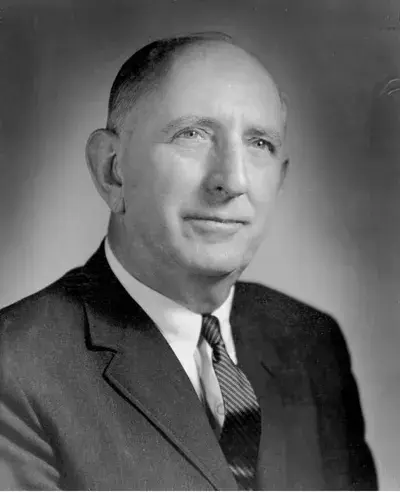
Richard Brevard Russell Jr. was an American politician. A member of the Democratic Party, he served as the 66th Governor of Georgia from 1931 to 1933 before serving in the United States Senate for almost 40 years, from 1933 to 1971. Russell was a founder and leader of the conservative coalition that dominated Congress from 1937 to 1963, and at his death was the most senior member of the Senate. He was for decades a leader of Southern opposition to the civil rights movement.
