RONALD REAGAN
(Ronald Wilson Reagan)


President Reagan had given one of his classic, optimistic speeches that connected so well with most of the public. In it he used the Winthrop Puritan metaphor of the "shining city on the hill"—an example that the world will look to in his description of America. His administration was the beginning of a long ear where the upper class grew wealthier and the standard of living of the poor actually decreased a little, which then evolved to the stage where the 1 percent accelerated their increase in wealth and even the middle class stagnated. Cuomo sounded the warning.

Agnew had to resign as vice president when he was convicted to taking bribes and committing fraud as the Governor of Maryland. Some find Gold's analogy difficult to fathom.

Actually starting in the Obama Administration, his ship and a NOAAA Government Research ship both were surveying the new undersea areas, However, it would take 20 such ships to do the job in the next decade–so vast was the new territory that we now have.

The role of a sitting president is always raised at election time. This is typical of the answer that the White House Press Secretary provides. See {583495} for another example.

Owens had just retired after 24 years in Congress. When Reagan began his campaign the majority of the racists of the South were furious that their party, the Democrats, had passed the Civil Rights Act of 1964 ending legal segregation and racism of the South. Reagan implemented a “Southern Strategy” by using code words that endorsed Southern racism and this swung the formerly Democratic “Solid” South to the Republican side changing the balance of power for years. Although Reagan was not himself racist and was a very popular President there were many who never forgot his pandering to the racists to get elected to begin with.

At the time it was not known that the President was suffering from the early symptoms of Alzheimer's Disease.


At the time she had little perspective on the masterful techniques of President Reagan. He mentioned God frequently and by doing so established an image amongst religious fundamentalists. But he gave them anything but lip service for most of their issues: abortion, censorship of pornography, elimination of birth control in schools or funded by the government, stronger divorce laws, etc. Actually Reagan rarely attended church in his entire life and was himself divorced.

This quotation tells us more about Nixon than Reagan. The latter was known for his extraordinary affability. Even his political enemies enjoyed and sought out his company. Nixon in contrast, no one liked to be around on a personal basis. His inner circle pandered to him to ingratiate themselves and jockey for power and influence but few liked him. Reagan and FDR are at the top of most people’s Presidential affability list while, Nixon fights it our with a few fro last place. Often brilliant at politics, Nixon’s people skills and his interpersonal perceptions were terrible.


Referring to President Ronald Reagan:

Describing his interaction with Oliver L. North:


Later made more famous by being quoted by President Ronald Reagan in facing down Congress over legislation by threatening the use of the veto.

Characterizing President Ronald Reagan in the midst of the Iran-Contra scandal:

A similar joke involving Judge G. Harold Carswell was popular in 1970. See Roman Hruska


During the Reagan presidency, many suspected that Nancy Reagan had profound influence on Ronald Reagan's actions.

Mondale lost by a landslide. Reagan won and raised "revenue enhancers."


Referring to his dispute with the United States over U. S. accusations of Libyan sponsored terrorism. Libya eventually paid $2 billion in compensation to victims of their airline bombing.

A little over a decade later, it was the conservative President who was condemning Saddam Hussein for gassing his own people and justified the Iraq War in part over that. And in 2007 Saddam having been toppled from power, he was tried for this crimes against humanity with the major charge being his gassing of the Iraqi Kurds. He was hanged for the “liberal hate speech” which had turned into conservative hate speech, but was a correct accusation regardless of which political pole was making it. There were few issues where most Americans were as unanimous as Saddam’s guilt in the gassing of the Kurds with Limbaugh and Saddam’s relatives being about the only people who saw it as propaganda.

One of the reasons that Reagan was so popular and effective was the he was positive and civil in his public and political relations. Although he was clearly conservative, he worked very well with the Democrats in Congress and in the state. The Republican Party after Reagan had become totally negative and offered nothing positive and specific. Lack of comity and much nastiness had become the Republican legislative style and on Radio and TV the nastiness rivaled that of McCarthyism. Conservatives like Graham who were civil and polite to Democrats and everyone else, were actually castigated and attacked by other Republican leaders and spokespeople.

In this case, the Speaker of the House attacked the President of his own party for being willing to conduct disarmament discussions with the Russians. He implied that the outcome could be the appeasement of the Russians just as British Prime Minister Neville Chamberlain appeased Hitler in 1938 in Munich, giving the German Fuhrer the “green light” to take over Europe. The Conservative Caucus went even further and explicitly called it “appeasement”. Reagan however always talked about military strength and power, and provided plenty of money for the military and weapons a few of which were boondoggles but he was a very cautious American president in authorizing military force. And he not only was willing to discuss arms control and reductions and enter into treaties for disarmament, much to the distress of the hawks of his own party. Few American Presidents have so well balanced the use of diplomacy with the threat of military force as well as Reagan.

The Republican party had lurched so far to the right, that a Republican like Reagan could never win the nomination even though he could likely win a national election.


Reacting to a proposal to rename Angeles National Forest for President Ronald Reagan:

In a way, this 1952 prediction presaged Ronald Reagan
Ronald Reagan’s media expert, Michael Deaver, developed a new approach to Presidential appearances. He realized that if the President made a 5 or 10 minute speech at an event, the Evening News would choose one or two 10-15 second excerpts, and that was what the vast majority of the country would see. Therefore, he reasoned, the words spoken meant relatively little. It was the image what would last in people’s memory. Therefore, he worked hard to concentrate on getting the right background for the President’s appearance. The Statue of Liberty, a naval ship, a factory at work. The set of images that people would have of the President in these different appearances would define the President in the minds of most people. Deaver would be more concerned that the TV camera’s showed the background scene he had planned (rather than a strange angle or just a close-up of the President’s face) than he would be about which words—sound bytes—the TV station would select. Hence Baker’s observation that words were less important than the TV images.

{625555} is a Russian Proverb conveying the same idea.

This true statement hurt Reagan somewhat but not enough to defeat him. At the time, only a small percentage of Americans had any experiences yet with what became one of the most popular programs in American history. Reagan, once in office never repeated any of his early anti-Medicare statements and ironically, in the 8 years of the Reagan Presidency, Medicare became extremely popular.

Ronald Reagan was then very successful in politics and a master of television.

There were really no American national interests involved in the Civil War in Lebanon. A conservative like Reagan could simply withdraw while if a liberal Democrat did the same thing, he would be castigated by the right for showing weakness and inviting attacks on our diplomats, troops, and citizens all over the world. There were a few ultra conservatives who objected to Reagan’s decision and several, decades later, blamed this “weakness” as the facilitator of subsequent terrorist attacks on our embassies, and even 9-11.

While the President and his wife were an exceptionally close couple, there was not a good relationship with their children. They were the only presidential couple whose children had no part in their White House lives whatsoever. Critics of Mrs. Regan who gave effusive advice on how to bring up children observe that not only were her ideas (ie Just Say No) silly, but she and Ron were not very good parents themselves regardless of their espousal of “family values”.

Bush was Reagan’s Vice President, but had little influence on top level appointments. Bush would have been particularly helpful with this appointment as he had previously served as a very successful CIA Director. Others also disagreed with this Regan appointment. See {637469}. See {637470}, {613419} and {623500} for Casey quotes that support Bush’s judgment


He was not referring to economic corruption but intellectual and moral corruption. Regan who appointed many excellent key officials picked a very unfortunate choice to lead the CIA. William J. Casey had many faults and weaknesses—See {637472}, {636743} and {637469}. But the worst of his damage was imposing his ideology on the agency and having the intelligence analysts shape their intellectual product to conform with a particular world, political, and religious view. See {634408}. This became acceptable and as future administrations took power their ideologies were considered by the CIA professionals and reports were edited and shaped accordingly. Reform was instituted by some of the future CIA directors but there were precedents from the Casey days for years. One particularly bad manifestation of this intellectual corruption occurred when Vice President Richard Cheney imposed a neocon world view on the agency with a pliant CIA director and the agency gave the President a totally inaccurate assessment of Iraq nuclear capability and intention which triggered the disastrous Iraq war, made all the worse when there were not only no nuclear weapons in Iraq as had been reported, but there was not even a single laboratory trying to develop nuclear weapons or even nuclear power.

This quotation is important as it provides a major counter-example to the ideological political belief that tax cuts and deregulation produce economic growth. Sometimes they do, but other times they do not. Ironically the greatest periods of growth in the last half of the 20th century included some of the highest rates of taxes. At other times high taxes curtailed growth. As with many political ideologies, they are really not principles or laws of nature or economics, but political preferences.

Ronald Reagan who had always preached “never attack a fellow Republican” challenged Ford, a sitting President.


The phrase “city upon a hill” was first used by John Winthrop in 1630 which is probably taken from Matt. 5:14-16 “a city that is set on a hill.” See related quote. It was then used in a speech by President Kennedy with attribution to Winthrop. President Reagan used it without the attribution and embellished it by adding the adjective “shining” which many people thought was in the original Puritan statement. The Reagan video and audio clip has been so viewed so many times that people think the phrase originated with Reagan.
This is a wonderful example of a good rhetorical technique. He focuses the attention on the unborn by observing that all his opponents on this point have already been born. Of course, he and all his supporters on the point—those who are against abortion—have already been born also. So what would the unborn say? Well that no one could know nor can any one know if the unborn have any thoughts must less thoughts on the subject of abortion.
Closest reference to this quote is during remarks at a Fundraiser for Gov. James R. Thompson, Jr., in Rosemont, Illinois August 12, 1986 where he said: “When [Jim O’Grady] was at the White House, Jim said to me, "The great Democratic Party of my father's and grandfather's time just doesn't exist anymore. Mr. President, I didn't leave the Democratic Party, the Democratic Party left me. That's why I switched parties." And I said, "Jim, join the crowd.”” http://www.presidency.ucsb.edu/ws/?pid=37732
Communism only works in Heaven, where they don’t need it, and in hell, where they’ve already got it.
Sometimes quoted as “Socialism only works in two places: Heaven where they don't need it, and hell where they already have it.”
Statement made during televised debate with Walter Mondale, October 21, 1984 (see citation).
Statement made in response to Jimmy Carter's technical arguments about the economy at a Teamsters convention in Ohio.
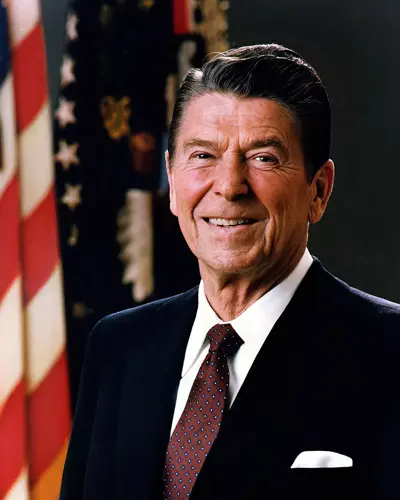
- Born: February 6, 1911
- Died: June 5, 2004
- Nationality: American
- Profession: Former President of the U.S., Former Governor of California, Politician, Actor
Ronald Wilson Reagan was an American politician who served as the 40th president of the United States from 1981 to 1989 and became a highly influential voice of modern conservatism. Prior to his presidency, he was a Hollywood actor and union leader before serving as the 33rd governor of California from 1967 to 1975.
