GEORGE WASHINGTON

In the French & Indian War, Braddock had organized a military expedition to destroy some of the forts that the French had constructed. (See {37008}.) Braddock and the other military officers thought that the force Braddock had organized would be overwhelming and easily accomplish the objective. Benjamin Franklin was one of the only Colonial leaders who expressed concern about the expedition–{583427}. This was one of the first battles for a promising young officer named George Washington who had two horses shot out from under him.

Duche had given the first prayer in the First Continental Congress {583741} and was an early patriot. However, he was captured by the British and pressured to write to Washington asking him to stop the fighting. John Adams wrote to his wife: “Mr. Duche I am sorry to inform you has turned out an Apostate and a Traytor. Poor Man! I pitty his Weakness, and detest his Wickedness.”

King Philip was the great Indian leader of the time.

He was part of the Congressional Delegation that had been appointed to welcome the newly elected first President George Washington to New York City, then the first capitol of the nation. The delegation met Washington on the New Jersey shore of the Hudson River and escorted him with a large flotilla of official and unofficial boats across the Hudson River to the Manhattan shoreline where this huge crowd had gathered. The tremendous crowd worried some of the Congress who thought there might be too much respect and obedience to the President—that he might be viewed as a monarch or worse, view himself as one. The authority and respect paid to the president was in political dispute for the first three presidential terms until Thomas Jefferson defeated John Adams and the Federalists.


In modern times most presidential nominations are confirmed by the Senate but the earliest precedents were contrary. In addition to this nomination being rebuffed by the Senate, Washington’s very first nomination—the tax collector of the port of New York – then the most important fiscal position in the United States – was turned down by the Senate. See 37,152.


After Adams took the oath of office, he wrote to his wife Abigail about Washington's great satisfaction at leaving office:

the Vice Presidency, under George Washington
George Washington had been appointed by the Continental Congress as Commander in Chief of the Continental Army but was politic about keeping Congress informed and not appear to be usurping authority. He asked Adams for an opinion of whether his authority reached beyond Boston to include the defense of New York City. Adams had been a member of the Congress that appointed Washington. Adams reply has been used as precedent for the broad authority of the President as Commander in Chief by those claiming broad Presidential power since.


This was a favorite quotation used frequently by George Washington


Reacting to charges that Federal troops at the celebration of George Washington's birthday in Washington DC, would be viewed unfavorably by Virginians, Buchanan wrote:


In 1872 a proposed Constitutional amendment was debated throughout much of the country. The proposed “Christian Amendment” to the Constitution, recognized the Bible, God, and made Christianity the state religion requiring religious tests of public officials including belonging to an organized Christian Church. “Deists” as used then referred to people who had a general belief in a Supreme Being but did not belong to any formal or organized church.

Membership on the Supreme Court was not always considered an honorable position. Chase corresponded with President Washington about a possible appointment urging him to keep the correspondence secret.

Writing about congressional investigations such as those carried out by the House Un-American Activities Committee:

This phrase is used to this day in describing our first President.

Benjamin Franklin or George Washington

See {71716}, {59589}, {55885} for more of Lee’s criticisms of Washington.


the Confederate States of America

The broad charter given Washington is a model that all American military commanders have envied since.
The tavern was named after George Washington.

pointing to a full length portrait of Washington, This point of view was typical of the Whig position, the supposed opposition to the Democrats who favored slavery. The abolitionists and radicals had no where to go politically and that gave the opening for the Republican Party. Abraham Lincoln, for example, was a Whig and joined the new radical Republicans.

The Continental Congress had treated the army poorly throughout the war with few provisions, erratic pay, and little understanding of the reality of the war effort. He addressed the senior officers of the army urging that the army not disband as Congress had ordered until there was some assurance that they should be reasonably treated and that they would not become public charges. Many had lost everything they owned, not being able to tend their farms or businesses; others were wounded and permanently handicapped. The officers did not follow Armstrong and instead followed the lead of George Washington and returned to civilian life in good faith, but as Armstrong had predicted, Congress did little to compensate the army. Despite his urging disobedience to Congress, once the Constitution was ratified and the government became more stable, Armstrong received several major Presidential appointments and was confirmed by the Senate which he had so castigated.


The tale that Dolley Madison personally removed the Washington painting still persists to this day. She probably asked the staff do so if they could, but she had to escape and the staff collected as much as they could before the British reached the White House.


Paine had been imprisoned in France for his political writings. After inspiring the nation in the Revolution, he was not a very popular figure in America, being regarded as an atheistic, rabble-rouser. The President distanced himself from the situation and did nothing to secure Payne's release.


By the end of George Washington’s Second term, he and Thomas Jefferson, his Secretary of State, were at odds. Jefferson became concerned at the Federalist policies and directions and their pro British and anti French tilt and became a leader of the attack on the Federalists after John Adams assumed the Presidency. Since Washington was the leading Federalist of his time, Mrs. Washington felt that Jefferson’s attacks on the Federalists were insulting to her husband. Washington had died in 1799, and Adams and the Federalist Party was on their last legs. When Jefferson came to give his condolences, he was on the verge of destroying Washington’s party, and Martha Washington believed that Jefferson had written some material that had attacked her husband’s policy. While Jefferson never attacked Washington by name—no one did—Mrs. Washington felt that there was too much innuendo and implied criticism from Jefferson’s strong attack on the Federalists. In the final analysis, when Jefferson won the presidency, the Federalists were so badly trounced, the party died and most of the nation agreed with Jefferson.

The American sense of exceptionalism of the democratic republic we created and the almost messianic duty to extend freedom and democracy throughout the world is actually relatively new in American history. For most American existence, the sense of the desirability of spreading the American freedom was held from the very beginning, but it was very much inhibited by American isolationist tendencies and entanglements on other nation’s affairs.


This is a particularly memorable quotation for several reasons. First the address was given by a young senior student who would later be a member of Congress, a effective abolitionist, and the author of various pieces of legislation that vexed the South. What is even more memorable is that the oration was given at an Ivy League College Official Graduation. The Ivy league schools, despite their reputation for intellectual freedom, generally were very adverse to any discussion about the slavery issue as it would cause too much passionate contention. See {621346} for an example at Harvard. In addition, Brown University was in Providence RI, where the economy depended in substantial part on slavery. The Co-Founder of Brown was himself a slave trader {622028}. This was one of the early American anti-slavery orations.
Madison was the first Presidential Speech Writer.


Von Stuben brought a formal discipline and organization to the American army and is referred to as “The Father of the U. S. Army.” Beaumarchais was a leading dramatist as well as a secret agent and his communiqués were doubtless the most flowery in the history of espionage and spying.

There are almost 200 different inscribed commemorative stones that were placed in the Washington monument at its original construction. These were sent from all over and were cemented into the inside and are still visible. However this particular stone roused the ire of the strong anti-Catholic element who violently opposed the concept that a Pope’s gift or anything from the Church would “blaspheme” the hallowed memory of George Washington. At the time, this Pope held temporal power in Italy as well as religious, and there was paranoid fear that with so many Catholics coming to America, they would want to turn over control of the American government to the Pope. A group of right wing Know Nothings broke into the warehouse and stole the Pope’s stone before it could be cemented into place. They then smashed it into pieces and spread the pieces in the Potomac River. The Know Nothings also managed to get control of the Washington Monument Society and then Congress cut off Federal Funds for the construction. When control had been wrested from the Know Nothings, the construction continued. However, the anti-Catholics had kept the Catholic stone out of the structure. In the1980s, the Papal gift stone was reproduced and placed in the Washington Monument with the other commemorative stones.

He was absolutely right. Actually Lincoln has surpassed Washington. Most historians regard Lincoln as the greatest of the American Presidents.

We are so accustomed to thinking about George Washington as a great military leader that it is surprising to see contemporary comparisons where Washington was found wanting or second. Actually Horatio Gates was a brilliant tactical general and a great leader of men—many think far better than Washington, but the genius of Washington was his strategic and political grasp of the situation. Essentially, with exceptions like the Battle of Trenton, Washington lost almost all the battles he fought as a tactical general. He realized early on that he did not have to win battles; he just had to prevent losing them so badly that he could not continue the fight. The insurgent wins as long as he can still fight. The British could not win unless they eliminated the ability of the revolutionists to fight. But Washington won the last battle at Yorktown, and that is the one that counted. Rush ran the hospitals for the Revolutionary Army and talked to many officers and enlisted men, and also observed much of the British military practices.
General Howe was the Commander of British Troops in the American Revolution. The early American Army was neither professional, experienced, or well officered. Execution as a means of punishment was much more common than in the larger, professional British army. Rush ran the hospitals for the Revolutionary Army and talked to many officers and enlisted men, and also observed much of the British military practices.
Mali was then virtually a failed state where some mid level military seized “control” but had no other objective than to stay in control with no vision of what the country should be. Meanwhile there were several tribal groups that wanted autonomy. International Islamists whose only interest was in instituting Sharia Law and groups of smugglers, kidnappers and other criminals. The military had insufficient skill and power to control the other factions. The political groups lacked enough common vision, military resources and skill or common ethnicity to control or to even defend themselves against the International Islamists who could take over areas of the country but became rapidly unpopular with the traditional secularist leaning Mali Muslims. French and Africa forces rolled back the International Islamists, and there were calls for elections among Americans and other Nations but Lattemont urged caution in relying on elections at this stage of development of a country.


This quotation about George Washington is one of the best complements ever paid to any political leader.

Marie Joseph Paul Yves Roch Gilbert du Motier. The Barbary Pirates had an incredible extortion racket going in the Mediterranean. If nations would pay them an annual sum each year, they would not attack and seize merchant ships of that country and sell the ships and goods while holding the sailors for ransom.

During the American Revolution, conditions were very difficult for Washington’s soldiers who were ill armed, ill clothed, and ill fed while they were paid irregularly. At one point morale was so low that some of the soldiers revolted. Smyth observes that Washington and Congress disciplined the mutineers very mildly, especially when compared with the way the British would deal with such things. The British Governor Clinton tried to take advantage of the mutiny and the poor morale by announcing that all of Washington’s troops who wished could obtain amnesty and join the British forces where the pay and conditions were much better. Professor Smyth found it fascinating that none of the Americans would join the British and he credits it to the wise and mild discipline policies of Washington and Congress as well as the general perception of the justice of the American cause among the American troops.
Smyth was one of the leading historians in England in the first half of the 19th century. His title was Professor of Modern History at Cambridge University. One of his areas was the American Revolutionary War where he was very critical of the English policies and implementation of the war which he thought was needlessly provoked by the Parliamentary majority at the time. He was a great admirer of George Washington and considered him one of the great men of all time.’
This quotation shows Washington's amazing tolerance for the times.
Washington was very unhappy with militia even from his native Virginia. See also {613030} This quotation is very important because the common belief is that all Americans in Colonial America were skilled with a gun and that there was a strong gun ownership culture. Many people quote {613057}. However, that was not the case as this and other research has shown. Less than one quarter of the Virginia militia had any weapon. Guns were expensive and only a minority of Americans could afford them. Despite the image of sharpshooters, and there were some, most guns were very inaccurate in the hands of most men.
This quotation is sometimes used to show that Washington thought religion important. Most of the founding fathers thought religion both important and potentially dangerous. They had observed Europe tear itself apart over religious differences. Note that Washington uses the words “religious principles” as opposed to “religion” or “religious prescriptions” or “religious doctrine.” The founders were not hostile to the concept of religion—even Jefferson and Franklin saw potential values in religion and religious institutions. They were hostile, however, to letting any particular sect dominate the religious environment of the nation. Nor did they want any of the religions controlling or operating the civil government. See {625616}.
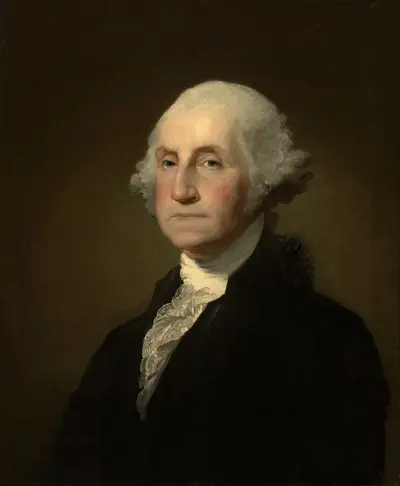
- Born: February 22, 1732
- Died: December 14, 1799
- Nationality: American
- Profession: President
George Washington was the first President of the United States (1789-97), the Commander-in-Chief of the Continental Army during the American Revolutionary War, and one of the Founding Fathers of the United States. He presided over the convention that drafted the current United States Constitution and during his lifetime was called the "father of his country".
