NATHANAEL GREENE
(Nathaniel Greene)
He had just lost another battle.
Washington and Green won very few battles as the strategy was, like many revolutionary movements, simply to avoid losing and being wiped out—the strategy that finally won the war.
The notion that all the Americans fought bravely in the American Revolution is a myth. George Washington and his other generals were constantly frustrated by some of the state militias which complained often, sometimes mutinied, and frequently ran from battles as in this example of the North Carolina Militia. The federal troops, trained by Washington and his officers, with longer enlistment periods than the militia fought much better and together with the French, won the war.
There is a , romantic American myth about the Militiamen in Colonial and Revolutionary America—the citizen soldiers who would leave their farms and rise to the military necessity of the day. However, not only were the militia very hard to muster to duty, but most actually didn’t own or have experience with firearms, and the prevailing opinion of knowledgeable military leaders from George Washington on down was that the militia were not very good soldiers. See {613015}, {613016}, {613022}, {613027}, {621987}, {621988}, {613030}, {613033}, & {613056}
In revolutionary America, not only were the colonists divided into revolutionists and loyalists to Britain, but among the revolutionists, there was no uniformity of manners, ideas, norms, beliefs or any other element of politics and unity. The great challenge to America and one of its great strengths is its diversity which is not a consequence of recent immigration, but has been a characteristic of the American body politic even in the Revolutionary War. Even English was not spoken by everyone as there were French, German, Scandinavian and other immigrants who had settled in the frontier and rarely came into contact with people other than those of their own family and community. The notion of a specific American culture to which which some today believe that we should return, never existed to begin with.
Without a Constitution and a body of Federal Law, it was unclear during the American Revolution what a soldier should d if given an order that conflicted with the law. At the WWII Nuremberg War Crimes Trials, “obeying orders” was not a defense if the orders were illegal and against humanity. American law and military regulations require that a member of the armed forces refuse to obey an illegal order.
History is replete with instances of military coups. In the final analysis, in every country at all times, there is no force in a society that could cope with a military which decides to act on its own. The Founding Fathers were very conscious of this reality and history, hence the firm civilian control of the military in America.
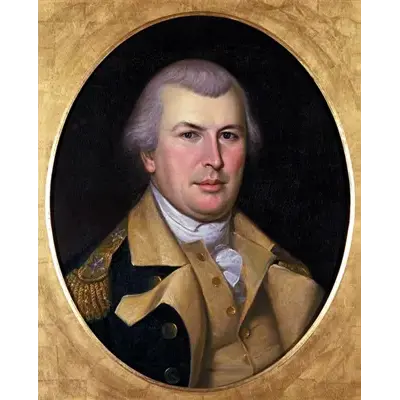
Nathanael Greene was a major general of the Continental Army in the American Revolutionary War. He emerged from the war with a reputation as General George Washington's most talented and dependable officer, and is known for his successful command in the southern theater of the war.
