JOHN ADAMS
(John Adams Jr.)

Adams was on the pompous side. The first Congress was early mired in much process and to relieve the boredom Tucker and a few others wrote various barbs pointed at the Vice President. See {44533} for another by Congressman Page.

Congress had diminished Adams authority to deal with the French and sided with Benjamin Franklin and the French Foreign Minister. Mrs. Adams lobbied members of Congress. Years later First Lady Lady Bird Johnson would echo a similar sentiment. See {605230}.

John Adams, 2nd President of the U.S.

After Adams took the oath of office, he wrote to his wife Abigail about Washington's great satisfaction at leaving office:
Upon learning that his son, John Quincy Adams, had been chosen President of the United States, the former President remarked:

First ladies have often advised as to campaign tactics and strategy. In 1824 it was considered unseemly to actively campaign for the presidency. Adams did and won. Advice continued

Adams, after his presidency, served in the House of Representatives for many years. He collapsed at his desk in the House and died in the Speaker’s office.


See {592770} for Adams perception of his own character.

Because the early nation's government was still in a state of becoming, foreign powers were hesitant to do business and conclude treaties with the newly-formed United States of America:

The treaty was The Treaty of Paris which ended the Revolutionary War.

After John Quincy Adams lost his bid for a second Presidential, he ran for the House of Representatives from his native Massachusetts and served there till his death at his desk. He is the only President to be elected to Congress after his Presidency, He was always an eloquent speaker, and he got better with age. Hence the “old man eloquent.”

Adams had argued in the first Senate for titles for the U. S. Executive Officers. Adams was portly. Izard’s joke stuck and the “title” follows Adams into his Presidency and throughout his career.

In 1827 John Quincy Adams and Andrew Jackson were potential presidential rivals. Many people and newspapers were openly critical of Jackson since his wife Rachel did not have a finalized divorce when the Jacksons were married. Jackson supporters started 'retaliating' with the story that Adams and his wife had engaged in pre-marital sexual relations. Jackson stopped this.

In the 1824 presidential election Jackson won a plurality of popular and electoral votes but not a majority. The election was thrown into the House of Representatives where Speaker Henry Clay cut a deal with John Quincy Adams who had finished second. Adams became President and Clay, Secretary of State.

See {592811} for Adams response.
President John Adams, in the last days of his office made a series of Federal appointments. His opponent, upon taking office, was on the horns of a dilemma.
Timothy Pickering of Salem, MA, had denigrated Jefferson as an original thinker, quoting a letter from President John Adams that the Declaration of Independence contained no new ideas but merely reiterated "what had been hackneyed in Congress for two years before." Jefferson's reply is contained in this letter:

Adams also had a poor opinion of Jones: {592712}

While France was in the midst of a violent revolution, the American debate was on the power and prestige of the Presidency. Then Vice President John Adams was a proponent of a strong executive. Most others were not.

The issue of when a government report is a report and who in the executive branch controls it has long been a contentious one. In an early dispute, Secretary of State John Quincy Adams suggested to the President that a statement he was about to make conflicted with one of Adams' reports:
This quote is noteworthy that Jefferson thought that the President had too little power while the King of Poland was known the world over as having a very weak King.

Jefferson was the leader of the Republican faction of the nation against the Federalists who had passed the leadership from Washington to John Adams. Adams was somewhat pompous and strove for respect, titles, pomp and circumstance preferring “His Excellency” to “Mr President.” The Federalists strove for stability and order above all. Jefferson itemized the different subgroups and interest groups of the American population who supported the Federalist and a government that was close to the British system, It was a classic split with the wealthy, established, and conservative forces lined up against change and completing the transition to a radically new form of government. The respect the electorate had for Washington kept the Federalists in power for the first three Presidential Elections, but now Jefferson had Adams as the face of Federalism—a much easier target than George Washington. Despite all the power—religious, economic, financial, and governmental—all lined up against the Democratic Republicans, Jefferson over the next four years took his case to the people, who in 1800 voted against the Federalists so overwhelmingly, that the Federalist Party was wiped out in America and Jefferson and his followers dominated American politics for the next two Presidential elections.

Hayes was a Civil Service reformer. After the presidency of John Quincy Adams, Andrew Jackson and subsequent Presidents fired large numbers of public servants—even minor poitions and replaced them with supporters. Hayes stopped that practice and initiated civil servce reform.

Hamilton was a major political foe of John Adams who wanted to be vice president in 1788. In one of the first "pragmatic" compromises in presidential politics Hamilton supported Adams:. If Adams does not become vice president. i.e. support the opposition party
Adams bitterly blamed Jefferson personally for his failure to win reelection for a second presidential term. See {629219}. Jefferson tried to argue in this quotation that the issues of the election were so great that it was irrelevant who the candidates of the two parties were. In actuality, both were right. The issues were huge, but it was Jefferson who was the most effective critic of the Federalist program and philosophy. Adams had become a bit of a pompous ass as President and this didn’t help his own cause. He and the Federalists believed that the President needed to be treated with great respect and have many of the trappings of monarchy so he would be a credible leader. Jefferson was completely opposite in philosophy and personality. Note that Jefferson, trying to be positive with Adams, tells him in effect, “The Federalists were such right wing ideolo, that if I had been running against any other Federalist candidate I would have won by a much larger margin, but you at least were able to moderate the extreme views so my task was much harder.” Years after this, the two men reconciled.


When the Republican leadership in 2008 stated that the Republican’s primary objective was to prevent the re-election of Barack Obama, it was not the first time that American politicians admitted that their major objective was to cripple an administration. This quotation shows a very early example. See {592642} for Adams view of Senator Randolph.


Marie Joseph Paul Yves Roch Gilbert du Motier. The Barbary Pirates had an incredible extortion racket going in the Mediterranean. If nations would pay them an annual sum each year, they would not attack and seize merchant ships of that country and sell the ships and goods while holding the sailors for ransom.

Referring to John Adams with whom he did not always get along:
See {640847}, {640845} & {640846}. The capitalization is exactly as Adams wrote it. Note the omission of a capital letter for “congress” for whom he and many others had little respect even then.
The treaty, which was also ratified by the Senate, was actually drafted by Joel Barlow, the U. S. Consul in Tripoli. It was the first official statement of the United States on its religious basis or lack thereof.
This famous quotation was only partly original. The most famous part, "Facts are stubborn things" was earlier used by the French Writer, Alain René Le Sage in Gil Blas
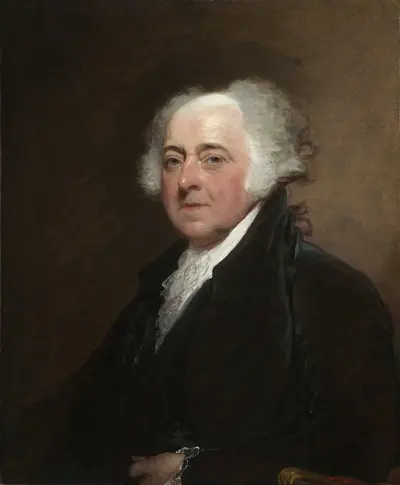
- Born: October 30, 1735
- Died: July 4, 1826
- Nationality: American
- Profession: US President, Stateman, Lawyer, Author
John Adams Jr. was an American statesman, attorney, diplomat, writer, and Founding Father who served as the second president of the United States from 1797 to 1801. Before his presidency, he was a leader of the American Revolution that achieved independence from Great Britain, and he served as the first vice president of the United States. Adams was a dedicated diarist and regularly corresponded with many important figures in early American history, including his wife and adviser Abigail Adams and Thomas Jefferson.
