ANDREW JACKSON

While Jefferson appreciated Jackson’s military prowess, that was about all.


Jackson was a great champion of equality and equal rights, but for whites only. He had no problem with Negro Slavery and had a major bias against Indians. He was the only U. S President to refuse to obey a decision of the Supreme Court when he forced the removal of the Cherokee Indians from their lands and forced them to the Oklahoma Territory.

President Andrew Jackson had been censured by the Whig Controlled Senate for withholding documents related to his defunding of the Bank of America. When the Democrats gained control of the Senate, they voted to erase history by expunging the original censure from the records and journals of the Senate. This is one of the worst examples of naked partisan politics in American history. In all of American History there have been two Congressional censures of American Presidents. This was one. See {620951} for the other.

Biddle was the loser in his fight with Jackson who was reelected for a 2nd term. He then withdrew federal deposits from Biddle's bank and persuaded not to renew Biddle's charter. That was the end of a single national bank in America.

In April 1832, Black Hawk led his warriors into Illinois to recapture their ancestral lands. The attempt was thwarted by American Army and Navy forces, and Black Hawk surrendered. Several months later he was sent East to meet with President Andrew Jackson. At that meeting, Black Hawk told the President:

The United States government had for many years deposited all its funds in a single private bank, the Bank of the United States. In 1833, President Andrew Jackson, without any congressional authorization, ordered the federal deposits to be distributed among state banks instead. The Senate was furious and passed the first resolution of censure of a President in United States history:. Carried by a vote of 26 to 20. Four years later a pro-Jackson Senate majority voted to expunge the resolution.

The Senator was particularly discouraged when a majority voted to change the Senate record of four years earlier and expunge a censure resolution against President Andrew Jackson:

Describing events in the battle of Talishatchee, where Tennessee soldiers under General Andrew Jackson wiped out every one of the adult male Red Stick Creek Indians in the settlement in retaliation for their massacre of the population of Fort Mims:

The British were about to attack New Orleans in the War of 1812 with an invasion force of their best professional soldiers. The Americans needed all the help they could get and Claiborne and the Military commander, General Andrew Jackson, came up with this idea to try and get the pirates and smugglers pardoned if they would fight against the British. They did and General Jackson with his augmented army routed the British in the last battle of the war. (It was actually fought after the war was over, but the word that the peace treaty had been signed had not yet reached either side.)

Jackson's Secretary of War, John Henry Eaton, 1790-1856, had been having an affair with a married woman with a proclivity toward promiscuity. Her husband committed suicide and Eaton married her causing one of the great scandals of American history. It split Andrew Jackson's cabinet and ended with Jackson, who supported Eaton, replacing the entire cabinet except the Postmaster General. Vice President John C. Calhoun's chances for the Presidency died as he and Jackson broke over this scandal.


He was an admitted smuggler and although called a “pirate” by some, he had always operated at a Privateer operating under official letters of Marquee. However his smuggling operation was run out of an area in Louisiana where he had about 3000 men which he called the “Kingdom of Barataria”. In the war of 1812, this letter proposed that he bring his men to fight along side of Andrew Jackson’s troops against the British who seemed overwhelmingly superior militarily. His offer was accepted and he and his men were a critical part of the American rout of the British.


The bill passed, but Jackson, true to his word, vetoed it.
He did indeed kill the Bank of the United States by exercising the Presidential Veto on the legislation renewing the Bank’s government charter. The Bank was privately owned but handled all the fiscal functions for the Government and holding the United States deposits. The Bank owners and executives were not supports of Jackson and opposed him on many issues. Jackson thought it outrageous that a private bank, not under the control of the people or the representatives of the people, should have a monopoly on the banking functions of the United States. Vetoes were very unusual then. All the presidents before Jackson together vetoed only 12 laws. Jackson himself vetoed 13 including the Bank of America.
In 1832 the Supreme Court held that the state of Georgia could not remove Creek and Cherokee Indians from lands that had been guaranteed to them by a federal treaty. The president disagreed with the court, then headed by John Marshall:. Marshall could not do so without the executive. The Indians were illegally removed to Western lands.
He said this as he threw them out of his White House office.
The words are those of President Andrew Jackson. See {604550}. After occupying New Orleans, General Butler infuriated the Confederate Sympathizers with this act. Jackson was the hero of the Battle of New Orleans and an unapologetic slave owner. The Southerners had erected a magnificent statue of their hero Jackson on horseback in a major section of the city. Butler, then ordered that the Jackson quotation be chiseled in the stone base. The townspeople were furious that this Union General would make up words and attribute them to Jackson; however, when they finally realized that Jackson had actually said those words they felt even more humiliated. There are still a few Southernors who consider this terrible insult to the Confederacy, and of course that is just what Butler intended.
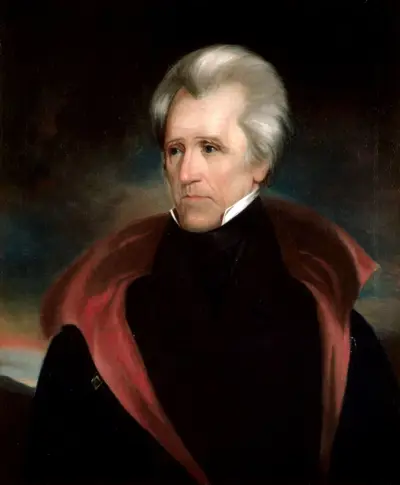
- Born: March 15, 1767
- Died: June 8, 1845
- Nationality: American
- Profession: President
Andrew Jackson was an American lawyer, soldier, and statesman who served as the seventh president of the United States from 1829 to 1837. Before being elected to the presidency, Jackson gained fame as a general in the United States Army and served in both houses of the U.S. Congress. An expansionist president, Jackson sought to advance the rights of the "common man" against a "corrupt aristocracy" and to preserve the Union.
