Andrew Jackson Quotes
My only two regrets in public life is that I did not hang John C. Calhoun and shoot Henry Clay.
Andrew Jackson, 1767-1845, 7th President of the United States (Democrat, TN), Quoted by Jon Meacham, Speech, Jimmy Carter Presidential Library, November 17, 2008
Sourced by: Eigen's Political and Historical Quotations


Yitzhak Rabin was the extremely popular President of Israel. At the time of his assassination his party controlled the Knesset (Parliament) and he was moving to make a two state solution to the Palestinian-Israeli problem. An ultra Orthodox Jewish fanatic shot Rabin so what there would be no settlement that would give up Israeli control of Judea and Samaria—the Biblical lands that literal believers in the Bible know that God consecrated that land for the Jewish People. To make a settlement compromise was needed on both sides and Rabin was strong enough to persuade most of the Israelis to take that risk. His successors never had the trust and confidence of the Israeli people that Rabin had as he had led the Israeli armed forces to victory and had also proved that he was a brilliant politician on domestic affairs. The unity that Rabin was able to create among Israelis has never been duplicated by any Israeli politician since.


Buchanan us considered by most historians to have been the worst or one of the worst Presidents of the United States. At this point, he was a lame duck president with Abraham Lincoln, the President Elect soon to take office. This speech, just encouraged the South more than ever and helped to bring about the Civil War. His vacillation and lack of any leadership on the slavery question exacerbated the polarization that was tearing the nation apart.

The critic observed that the South would not give up their slaves voluntarily and that and that vigorous abolition pressure on the South would lead to war and asked Angelina if she would want a civil war. Grimke’s response was predictive of what happened—the most terrible was in U. S. History to end the most terrible cruelty and persecution in American history. Note that she herself was willing to die to end slavery. See {629094}.


More new technology was deployed in the Civil War than any other war in history and Moltke did not realize that the classic European military tactics were obsoleted. However, neither did most of the Southern Generals and many of the Union Generals. Lincoln, Grant and Sherman were the ones who developed strategies and tactics to function in the new world of warfare.

Phelps was a Copperhead Democrat who was a virulent racist, an enemy of Lincoln and supported McClellan against Lincoln in 1864. His extreme disrespect for the President and his racism was not appreciated in Vermont, and Phelps not only failed to help McClellan but destroyed his own credibility in his home state of Vermont. Phelps had been practicing law in New York City where there was a large Copperhead, racist and anti-Lincoln part of the population there.

And so they were. However, Calhoun had already concluded which alternatives the South would take. See {635930}


After the Civil War and Reconstruction, the American nation was still bitterly divided intelelctually, socially, emotionally and poliotically. In an effort to bring more unity to America, most of the power stucture and the influentials of the nation began to avoid those issues that would divide North and South and try and promote a narrative that both sides might be able to live with. And this is what Zeitz describes in this quotation. America went through a period of Revisionist History that even in the 21st century was held by many people. It wasn't until the middle of the 20th century that the real history and narrative of the Civil War and Reconstrution emerged from the few academics who had all along criticized the fabricated narritive that did unify the country at the cost of historical accuracy and truth. Many scholars point out that the price that America paid for this unity was the Jim Crow era and a century of legalized racism. Much of the nation was built on the labor of Negro slaves and the victims of the slavery era, also bore the brunt of American unity and reconcilliation.

Oates was a Confederate Colonel during the Civil War. His statement almost started a brawl as the Memorial Dedication was a joint North-South participation event. Northern politicians, officers and men were outraged and rose to their feet with several mounting the rostrum to refute Oates intemperate remarks. However, like Southern politicians of the 1960s, they produced a lot of redneck support with such extreme statements. The main reason this quotation is important is that most politicians of North and South wanted to get the animosity of the Civil War over with and to do so sponsored these memorial events where both sides could celebrate and remember the bravery of men fighting and dying for their cause. The photographs of former enemies shaking hands which the newspapers ran frequently, would give the impression that by the 1880s the hatred and animosity of the Civil War was behind the nation. However, that was not at all true. Most veterans of both sides maintained their hatreds throughout their entire lives. Even their children carried the hatred into the next generation. Politicians were expected to not open the scabs of the old wounds in public, but many like Oates found political utility in not doing so. The moral outrage of many in the North remained until WWII when regional unity genuinely transcended the Civil War. See {639364} for a Northern example with no political motive but with uncontrollable moral outrage.

In modern times, many have complained at the disrespectful way critics refer to the president of the United States. The long for the civility of the past. As this editorial shows, uncivil criticism of the president is nothing new.
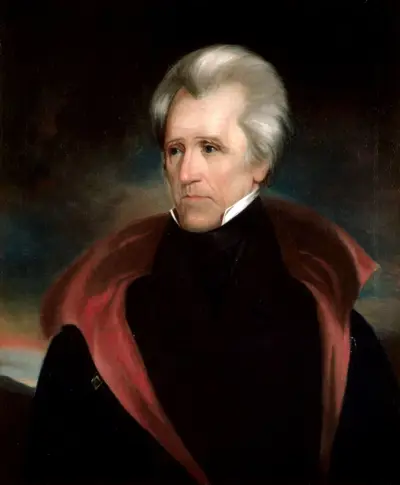
Andrew Jackson was an American lawyer, soldier, and statesman who served as the seventh president of the United States from 1829 to 1837. Before being elected to the presidency, Jackson gained fame as a general in the United States Army and served in both houses of the U.S. Congress. An expansionist president, Jackson sought to advance the rights of the "common man" against a "corrupt aristocracy" and to preserve the Union.
