Andrew Jackson Quotes
The safety of the republic being the supreme law, and Texas having offered us the key to the safety of our country from all foreign intrigues and diplomacy, I say accept the key... and bolt the door at once.
Jackson, Andrew. Letter to Aaron V. Brown. 12 Feb. 1843. The Papers of Andrew Jackson, edited by Sam B. Smith et al., University of Tennessee Press.


This is a very important quotation in that there are some who believed—then and now—narrowly that self defense is limited to responding to only physical attacks on the United States per se. Kellogg made it clear that it includes attacks on the United States and any of its possessions. Most important it allows response to any “danger” to the United States. By this definition, for example, if Saddam had been developing weapons of mass destruction in the Iraq war, the pre-emptive attack would have been self-defense. Since the claim of weapons development was bogus, it was not self defense. The key variable a reasonable danger. Nations determine that by what others do and say. In 2011, if Iran were developing nuclear weapons the U. S. could attack as an act of self defense because the Iranian highest level officials have called for “death to the United States”. When they just had the intention to harm us, there was no danger. But when they add the means to harm us to the intention, that is a danger. Likewise other nations may act in self defense if a potential enemy threatens to endanger them and has the means to carry out the threats or desires.


Earlier in the Arab-Israeli conflict United Nations troops were stationed at the borders to prevent either side from attacking the other. The Arabs mounted a major attack and the United Nations troops ran and did not fight. Ever since then, Israel policy was never to depend on any other than Israel to defend the country and the people.

to send troops to Cuba The problem in Cuba was not even a crisis for America. But the precedent became the beginning of a huge change in the balance of power between the President and Congress. Together with his huge popularity, Roosevelt could do almost anything and have public support, but the war powers—the authority to send American troops into harm’s way—started their profound shift from requiring the President to ask Congress to declare war and the President acting unilaterally which had become common by the 21st century.


After the attack on Fort Sumter, the South Sent “diplomats” to negotiation with the Government. Unfortunately for all, the South really was not open to negotiations as they only had two predetermined positions they would agree to: The first was that the Government should guarantee the perpetual right of states to have slavery if they wished and that fugitive slaves would be returned by the non-slave states. The second was that the Union should recognize the Confederacy as an independent nation and have peaceful relations between the two. The first was impossible to deliver even if the Union would agree to continue slavery, there was no way that the Federal Government could enforce the return of fugitive slaves from many northern states where they were free the second they set foot in the state, and the Northern states demanded States Rights and not being forced to return Fugitive Slaves forcing the Southern States to oppose States Rights when it came to Fugitive Slaves while favoring it for slavery itself. The Federal government could not enforce the Dred Scott Decision under the pro-South Buchanan administration. And Lincoln and most of the Northern Politicians would not accept a complete dissolution of the Union. There are no other possibilities the South would accept and there was really nothing to negotiate.

One major problem at the time was that the Soviet Union was supporting and instigating revolutions in many parts of the world. When most nations of the UN wanted to provide peace keeping troops to quell the conflict, the Russians would veto and block the effort, Vandenberg wanted the UN to change the rules regarding the veto. The original right of veto for the major nations was originally included at the insistence of the United States and many Americans did not want to give it up or have any exceptions lest there be more. The Russians at that time also did not want to give up any of their veto powers. Another method that Vandenberg wanted to solve the Russian peacekeeping blockage problem was for America to engage in more collective security pacts so that action could be taken without UN Security Council unanimity by going around the UN.


See {627882} for one of the incidents that caused international repercussions. Thailand is a totally food self sufficient country and so is not subject to foreign pressure as much as if it were a food importer and not an exporter.


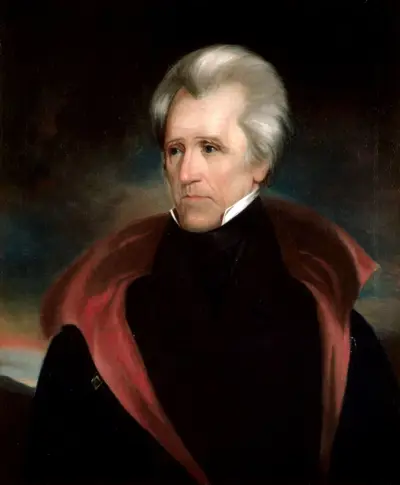
Andrew Jackson was an American lawyer, soldier, and statesman who served as the seventh president of the United States from 1829 to 1837. Before being elected to the presidency, Jackson gained fame as a general in the United States Army and served in both houses of the U.S. Congress. An expansionist president, Jackson sought to advance the rights of the "common man" against a "corrupt aristocracy" and to preserve the Union.
