Kofi Annan Quotes
A nation has the right to defend itself, but when it comes to the broader issue of peace and security, the legitimacy rests only with the Security Council.
Annan, Kofi. Interview with BBC News. BBC, 16 Sept. 2004.

The United States should be One major problem at the time was that the Soviet Union was supporting and instigating revolutions in many parts of the world. When most nations of the UN wanted to provide peace keeping troops to quell the conflict, the Russians would veto and block the effort, Vandenberg wanted the UN to change the rules regarding the veto. The original right of veto for the major nations was originally included at the insistence of the United States and many Americans did not want to give it up or have any exceptions lest there be more. The Russians at that time also did not want to give up any of their veto powers. Another method that Vandenberg wanted to solve the Russian peacekeeping blockage problem was for America to engage in more collective security pacts so that action could be taken without UN Security Council unanimity by going around the UN.


One major problem at the time was that the Soviet Union was supporting and instigating revolutions in many parts of the world. When most nations of the UN wanted to provide peace keeping troops to quell the conflict, the Russians would veto and block the effort, Vandenberg wanted the UN to change the rules regarding the veto. The original right of veto for the major nations was originally included at the insistence of the United States and many Americans did not want to give it up or have any exceptions lest there be more. The Russians at that time also did not want to give up any of their veto powers. Another method that Vandenberg wanted to solve the Russian peacekeeping blockage problem was for America to engage in more collective security pacts so that action could be taken without UN Security Council unanimity by going around the UN.


An earlier version was written by Congressman Louis L. Ludlow, 1873-1950—see his quotation about it—{39681}. The proposed amendment was narrowly defeated.


3rd Earl Russell of Kingston. The military weak nations agreed with him, but the militarily strong ones did not—especially America and England which had the Atomic Bomb when others did not.


Actually it was the United States which insisted in the veto which required consensus of the great powers of the time. It was Russia which ended up using it far more often than any other nation.

While to Madison the principle that “war is better than tribute” was “settled policy”, there were many who disagreed. See {640867} as an example.


The speech was the 50th Anniversary of the Speech that Secretary of State Byrne had given there exactly 50 years ago. It was referred to as the “Speech of Hope” and announced the Marshall Plan.


There were many who thought that the Russians would view the Mutual Security Act as aggressive and they might respond with some kind of aggressive retaliation and this could lead to war. Others felt that containment would reduce the likelihood of war.

Germany had demanded that Belgium allow German troops to cross Belgium to the French frontier. However, King Albert was concerned that this would be a de facto German occupation of Belgium and asked for help. The British tried diplomacy but things were out of anyone’s control and the First World War ensued.
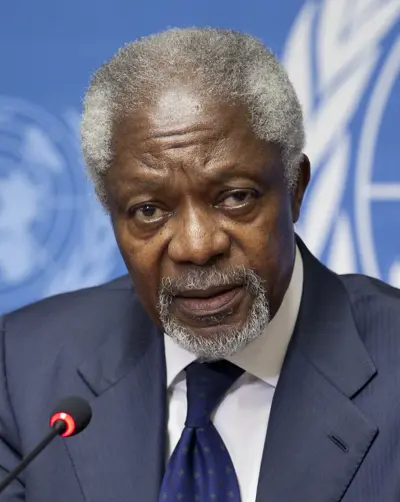
Kofi Atta Annan was a Ghanaian diplomat who served as the seventh Secretary-General of the United Nations from January 1997 to December 2006. Annan and the UN were the co-recipients of the 2001 Nobel Peace Prize. He was the founder and chairman of the Kofi Annan Foundation, as well as chairman of The Elders, an international organization founded by Nelson Mandela.
