Martin Jenkins Crawford Quotes
Diplomacy has failed. The sword must now preserve our independence.
After the attack on Fort Sumter, the South Sent “diplomats” to negotiation with the Government. Unfortunately for all, the South really was not open to negotiations as they only had two predetermined positions they would agree to: The first was that the Government should guarantee the perpetual right of states to have slavery if they wished and that fugitive slaves would be returned by the non-slave states. The second was that the Union should recognize the Confederacy as an independent nation and have peaceful relations between the two. The first was impossible to deliver even if the Union would agree to continue slavery, there was no way that the Federal Government could enforce the return of fugitive slaves from many northern states where they were free the second they set foot in the state, and the Northern states demanded States Rights and not being forced to return Fugitive Slaves forcing the Southern States to oppose States Rights when it came to Fugitive Slaves while favoring it for slavery itself. The Federal government could not enforce the Dred Scott Decision under the pro-South Buchanan administration. And Lincoln and most of the Northern Politicians would not accept a complete dissolution of the Union. There are no other possibilities the South would accept and there was really nothing to negotiate.
Martin Jenkins Crawford, 1820–1883, U. S. Congressman (Democrat, GA), Confederate Congressman (GA), Confederate Commissioner for Negotiations with the United States, April 6, 1861
Sourced by: Eigen's Political and Historical Quotations


Greek invaders were marching on Istanbul


While to Madison the principle that “war is better than tribute” was “settled policy”, there were many who disagreed. See {640867} as an example.

Clinton was one of the leaders of the anti-war movement of the day. He even ran for President on the new “Peace Party.” New England, New York and many people in the Atlantic states thought the war of 1812 absurd. In reality, while the law was good for American morale and national pride, the casualties we suffered and the cost was far greater than what we were losing in our dispute with England. In actuality, France (under Napoleon) was offending America and seizing our shipping more than England. Note that Clinton was advocating negotiation even AFTER we would be attacked. This is in a way the complete opposite of the George W. Bush doctrine of preemption—attacking a hostile state BEFORE it has attacked us so as to prevent the casualties of an attack. The Bush doctrine was a great blunder in its only implementation—Iraq did NOT have the weapons of mass destruction that Bush and his administration claimed they had to justify the preemptive war.


He was contrasting this with the Supreme Court decision in Bush v. Gore, where by 5 to 4, the Supreme Court made George W. Bush President. Bryer wrote a dissent and the majority of Americans wanted Gore. Yet, the people of America accepted the unpopular decision with which the majority disagreed. The alternative is settling such disputes in the streets with violence. So Bryer strongly advocates the upholding of Supreme Court decisions, even if unpopular and even if wrong as he felt Bush v. Gore was.

There were more than 100 million of his gun distributed over the world and his invention has been the instrument by which more people have been killed than any other weapon.


1st Earl of Kingston. Foreign Minister at this time. This decision was a terrible blow to the South who had been trying desperately to obtain diplomatic recognition for the Confederacy from England and other world powers.


A variant of this quotation was used by Admiral of the German Navy. See {609658}.


14 years after this statesmanlike speech, Davis flip flopped on this principle and became a firebrand and agitator and hawk for secession and war. It was the Southern upper class that controlled the politics of the South and were the ones who would suffer the greatest economic loss if the Union had continued in the direction of refusing to return runaway slaves and other abolitionist activity. Although many Southerners volunteered to fight for the confederacy, there were not enough and Davis, who in earlier years would not war unless there was genuine demand of the people, for the Civil War, the South had to resort to conscription. The North did as well.
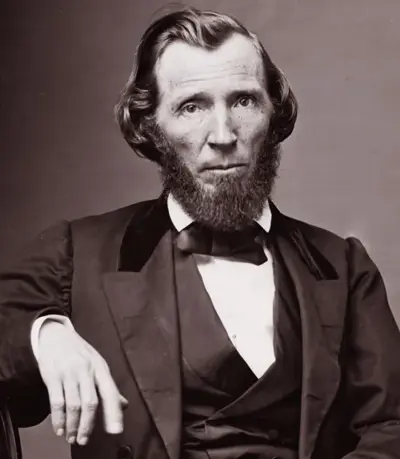
Martin Jenkins Crawford was an antebellum U.S. Representative and a representative to the Provisional Confederate Congress during the American Civil War from the state of Georgia.
