JEFFERSON DAVIS
(Jefferson Finis Davis)

After the Confederate defeat at Roanoake Island, Norfolk, VA, in January, 1862:

Of her husband, Jefferson Davis, President of the Confederate States of America:


Houston was deposed on March 18, 1861, because he refused to take an oath of allegiance to the Confederate States

Johnson was a tailor by occupation, and was frequently derided as unfit for high public office. Jefferson Davis, one of his detractors, came in for his share of reply invective.
When Jefferson Davis accepted the presidency of the Confederacy, Johnson observed:


Morgan had just left his appointment at Annapolis and traveled to the then Confederate capital, Montgomery, AL to volunteer for the Confederate navy.

He was Chancellor of the Exchequer at the time of this speech. Gladstone was certain about most of his views on foreign policy but correct on only some with many blunders on his watch. This view was very important for the Confederacy as it was a prerequisite to diplomatic recognition. The latter never came.

The Confederate War Department was directly giving instructions to other officers in his command. Jackson was about to resign. Lee had not yet been given command of all the Confederate forces, and one of his great contributions was to be a buffer between Jefferson Davis and his War Department vis a vis the Senior Confederate officers. See for another example of the friction in the Confederacy.

As in almost every war, there were disagreements between the Confederate Generals and the civilian authorities. See {633934} for another Civil War Southern example.
Historically, this quotation shows the desperate condition of the 1863 food supply in the Confederacy. The most profitable crops were cotton and tobacco. However, Davis and other Southern leaders had to urge patriotic Southerners to abandon those crops in favor of foodstuffs and fodder for the military and their horses. Some did but many did not.
Southern secession and the Civil War This is one of the major quotations with which historians rebut the revisionist view that the Civil War was about States’ Rights or other economic factors.
Ironically, events later supported the truth of his statement. He was wrong about the parties however. It was the South who denied liberty to a very large part of their population, and it was the “unconquerable will” of the enslaved Negroes that eventually prevailed. It is hard for most of us in modern times to understand why Davis and other Southerners saw themselves as having freedom curtailed over an economic factor—chattel slavery—and not see that the institution of slavery was a total denial of freedom to a huge part of their population. See England’s Dr. Johnson XXXXX for a classic contemporary statement of this contradiction.
The sedition to which Senator Davis objected was proposal of Senator John P. Hale's proposal to outlaw pro-slavery mobs in the District of Columbia who attacked abolitionists and their newspapers.
Southern secession and the Civil War This is one of the major quotations with which historians rebut the revisionist view that the Civil War was about States’ Rights or other economic factors.
Note the perception of Davis, typical of Southerners at the time, that Southerners were being excluded from California. The logic was this: California had many opportunities in land, gold, and other natural resources. Since California had a Constitutional provision against slavery, no Southerner could enter the new state with his slaves without fear of their being set free. If Southerners bought land or wanted to hunt for gold, they could not bring their slaves to do the heavy work. Therefore, they were excluded from the economic growth of the state. The idea of the whites doing the heavy work themselves of traveling without their family slaves was so foreign to the aristocratic planter class, that it was never considered by them as a possibility. Therefore, they were excluded. However, many of the lower class Southerners of all races saw great opportunities in California where they could compete on an equal footing even though they had no slaves or land.
This is a very important quotation historically. There are a few historians and many politicians who claim that the rebellion of the South in the Civil War was motivated by a number of principles having little or nothing to do with slavery, while most historians have found that slavery was the only major issue. This quote further supports that view. This is the only Union General Officer would be executed if captured by the South. What crimes did he perform to warrant such exceptional treatment? He issued an order Emancipating the Slaves of the Southern Department of which he was the Commanding General. See {619331} . Lincoln quickly countermanded the order, but the act of freeing slaves was to the Southern government so heinous that it deserved the death penalty.
The Confederacy was looking to develop sympathy for the their cause, even within the Catholic Church which many Southern Protestants were very prejudiced against. Davis, himself, however, had attended Catholic schools as a youth and almost converted to Catholicism. Reading this letter today we are fascinated by the fact that Davis could ensure the Pope that “everyone” in the Confederacy could enjoy “temorial” rights and also the “free exercise of his religion.” Blacks, a very large proportion of the Southern population, could of course enjoy neither. Davis did not even cover himself by saying :every citizen”. He said “everyone” an absurdity even then, but Jefferson, an otherwise intelligent man, was so prejudiced that he did not consciously realize that he was lying to the Pope whom he respected greatly.
Most of the experienced Southern Military officers were graduates of West Point and elementary and secondary Northern Military Schools, and the South if it were to be independent, would have to have a parallel structure.
Davis was rehashing the South’s reasons for secession. In this clever metaphor, he alludes to the States as the “creators” and the “creature” as the national government.
14 years after this statesmanlike speech, Davis flip flopped on this principle and became a firebrand and agitator and hawk for secession and war. It was the Southern upper class that controlled the politics of the South and were the ones who would suffer the greatest economic loss if the Union had continued in the direction of refusing to return runaway slaves and other abolitionist activity. Although many Southerners volunteered to fight for the confederacy, there were not enough and Davis, who in earlier years would not war unless there was genuine demand of the people, for the Civil War, the South had to resort to conscription. The North did as well.
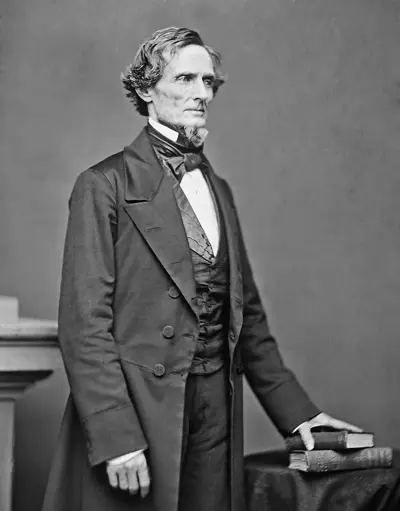
- Born: June 3, 1808
- Died: December 6, 1889
- Nationality: American
- Profession: Leader
Jefferson Finis Davis was an American politician who served as the president of the Confederate States from 1861 to 1865. As a member of the Democratic Party, he represented Mississippi in the United States Senate and the House of Representatives before the American Civil War. He previously served as the United States Secretary of War from 1853 to 1857 under President Franklin Pierce.
