Stonewall Jackson Quotes
With such interference in my command I cannot expect to be of much service in the field
The Confederate War Department was directly giving instructions to other officers in his command. Jackson was about to resign. Lee had not yet been given command of all the Confederate forces, and one of his great contributions was to be a buffer between Jefferson Davis and his War Department vis a vis the Senior Confederate officers. See for another example of the friction in the Confederacy.
Thomas J (Stonewall) Jackson, 1824-1863, Confederate General January 1862
Sourced by: Eigen's Political and Historical Quotations

As in almost every war, there were disagreements between the Confederate Generals and the civilian authorities. See {633934} for another Civil War Southern example.

George Washington had been appointed by the Continental Congress as Commander in Chief of the Continental Army but was politic about keeping Congress informed and not appear to be usurping authority. He asked Adams for an opinion of whether his authority reached beyond Boston to include the defense of New York City. Adams had been a member of the Congress that appointed Washington. Adams reply has been used as precedent for the broad authority of the President as Commander in Chief by those claiming broad Presidential power since.


This quotation was an attack on President George W. Bush who had argued to a nation hostile about the Iraq War that the decision on whether to continue the war should be determined in large part by the report that was to be given by the commander of our forces In Iraq, General David Petraeus. He reported that he thought we should give the situation some more time and effort, and that was the policy decision. Clark and others thought this was not fair to Petraeus whose job it was not to make the policy but to implement it. It was perhaps the only time in history where a President abdicated a major war policy decision to a field officer. The President even argued to Congress that they should all wait for the General to return to Washington. He argued that he made the decision; he just wanted to hear the General’s recommendation. Most believed that he could have obtained that without the General returning to Washington to talk to Congress and the American people.

The President told McNamara that if the administration does not send the troops the Generals want, they will be blamed for any military failures that occur. If they do send all the troops that the Joint Chiefs wanted, they would be going far beyond the limits that the Defense Secretary recommended and the President would have preferred. JBJ felt he really had no political choice. He authorized the wanted troops further escalating the war. See his special assistant’s question about that decision in {617151}.


The leadership of the Ottoman Empire had become corrupt and degenerate


The economy of Poland was in dire straits as the President resigned:

During the Civil War, General Joseph Hooker castigated the President and called for a dictator to assume power:


Few high ranking officers, or officials of civilian organizations, take the responsibility for subordinates not understanding instructions.

He fought in Algeria and other counterinsurgencies and then studied them. He wrote the classic book on counterinsurgency warfare. After all the mistakes the U. S. made after the successful invasion of Iraq, his book and doctrine were very influential in the change in strategy and tactics that turned the Iraq War in our favor.


Rush ran the hospitals for the Revolutionary Army and talked to many officers and enlisted men, and also observed much of the British military practices. These suggestions were discussed but never passed as regulations. They are fascinating insights into the problems of the general officers of the time who were generally selected for their socioeconomic status rather than other qualifications. Note the drunkenness limitation for a commanding general was proposed to be limited to only 1 allowed bout of drunkenness every 24 hours. It was, he thought, totally unrealistic to require generals to be always sober when on duty. With the mediocre quality of senior officers, Washington had to depend on foreigners like Lafayette, Von Steuben and others. And Generals who were leading attacks out in front of their men like Benedict Arnold immediately became heroes and one of the reasons he ended up as a traitor was that he thought that he was badly treated relative to the “society” Generals who would not accept him and denigrated his exploits when they themselves had never been close to a battle front.

Most people are surprised that Lee suggested his being replaced when his army lacked military success. Strategically, he had a hopeless task. The incompetence of General McClellan and other Union Generals is the only reason that the war lasted as long as it did. However, Lee got about as much as any military commander could have given the greater manpower, industrial production, communications and transportation of the Union to say nothing of the much superior technology.
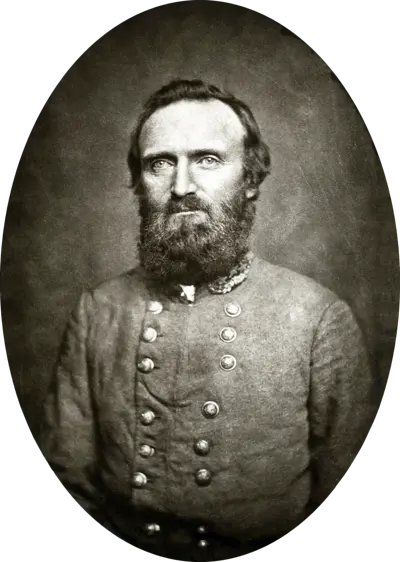
- Born: January 21, 1824
- Died: May 10, 1863
- Nationality: American
- Profession: Soldier
Thomas Jonathan "Stonewall" Jackson served as a Confederate general (1861–1863) during the American Civil War, and became one of the best-known Confederate commanders after General Robert E. Lee. Jackson played a prominent role in nearly all military engagements in the Eastern Theater of the war until his death, and had a key part in winning many significant battles.
