Jefferson Davis Quotes
The evils of war must fall upon the people, and with them the war-feeling should originate. We, their representatives, are but a mirror to reflect the light, and never should become a torch to fire the pile.
14 years after this statesmanlike speech, Davis flip flopped on this principle and became a firebrand and agitator and hawk for secession and war. It was the Southern upper class that controlled the politics of the South and were the ones who would suffer the greatest economic loss if the Union had continued in the direction of refusing to return runaway slaves and other abolitionist activity. Although many Southerners volunteered to fight for the confederacy, there were not enough and Davis, who in earlier years would not war unless there was genuine demand of the people, for the Civil War, the South had to resort to conscription. The North did as well.
Jefferson Davis, 1808-1889, U. S. Congressman & U. S. Senator (Democrat, MS), U. S. Secretary of War, President, Confederate States of America, Speech in Congress, 1846
Sourced by: Eigen's Political and Historical Quotations


After the attack on Fort Sumter, the South Sent “diplomats” to negotiation with the Government. Unfortunately for all, the South really was not open to negotiations as they only had two predetermined positions they would agree to: The first was that the Government should guarantee the perpetual right of states to have slavery if they wished and that fugitive slaves would be returned by the non-slave states. The second was that the Union should recognize the Confederacy as an independent nation and have peaceful relations between the two. The first was impossible to deliver even if the Union would agree to continue slavery, there was no way that the Federal Government could enforce the return of fugitive slaves from many northern states where they were free the second they set foot in the state, and the Northern states demanded States Rights and not being forced to return Fugitive Slaves forcing the Southern States to oppose States Rights when it came to Fugitive Slaves while favoring it for slavery itself. The Federal government could not enforce the Dred Scott Decision under the pro-South Buchanan administration. And Lincoln and most of the Northern Politicians would not accept a complete dissolution of the Union. There are no other possibilities the South would accept and there was really nothing to negotiate.


At the time of this speech virtually the entire world believed that. However world attitude changed markedly after the administration of George W. Bush and the United States invasion of Afghanistan after September 11 and the Iraq War which was for regime change.


King George did not want to give up the American Colonies and claimed the loss at Yorktown was just a loss of a single battle. The English soldiers had controlled New York, Charlestown and other places and American Tories wanted to fighting to continue. The French were having major problems elsewhere and the states were all broke from the war effort. Hamilton urged Clinton to offer all the New York offers and soldiers half pay tp be available to fight against the other ex-colonies represented in the Continental Congress.


In 1852, when the national debate on slavery was raging, Stowe’s book, Uncle Tom's Cabin, was published and within 16 months had sold a million copies. Its mass media effect developed a ground swell against slavery as well as over 30 rebuttal books. Many credited her book with the consciousness raising that was necessary to support the North and alarm the South.

Theodore Roosevelt was the Presidential nominee. Johnson was a leader of some members of Congress some of whom were extreme isolationists and some of whom were Nazi sympathizers and Hitler admirers. When the Japanese attacked Pearl Harbor later that year, Germany, fulfilling its treaty with Japan, declared war on America, Johnson’s group no longer mattered. Before WWII most Republicans were opposed to Defense Spending and accused the Democrats of being war hawks. After WWII, they flip flopped and became more hawkish than the Democrats who they accused of being soft on defense for years thereafter. See {631380} for President Roosevelt’s different view.

This quotation is important for two reasons. First, it shows that there was a very hostile environment in Europe well before the assassination of the Archduke of Austria that “triggered” WWI. Second, that the Germans were racist before Hitler ever came on the scene. The Emperor demagogued the issue and took it to new extremes, but the evil was there. To the Germans, the Slavs and Russians were a lesser form of humanity than the Germans. The Austrians were threatening to attack Serbia and Russia. The Austro-Hungarian Empire, ruled many ethnic Slavs, Russians and Muslims—the lower forms of humanity—and long before Hitler, Wilhelm and other leading Germans thought that the Germanic Peoples should rule that part of the world as the lesser “races” were not fit to rule.


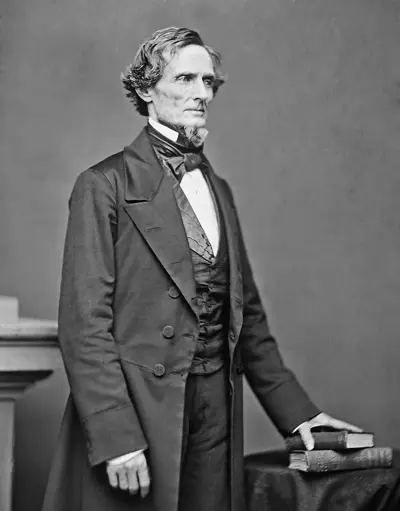
Jefferson Finis Davis was an American politician who served as the president of the Confederate States from 1861 to 1865. As a member of the Democratic Party, he represented Mississippi in the United States Senate and the House of Representatives before the American Civil War. He previously served as the United States Secretary of War from 1853 to 1857 under President Franklin Pierce.
