Jefferson Davis Quotes
Slavery existed before the formation of this Union. It derived from the Constitution that recognition which it would not have enjoyed without the confederation. If the States had not united together, there would have been no obligation on adjoining States to regard any species of property unknown to themselves.
Davis, Jefferson. The Rise and Fall of the Confederate Government. Vol. 1, D. Appleton and Company, 1881, p. 83.

In June of 1850, a bipartisan group of Southern politicians met in Nashville, TN for the purpose of organizing strategy and tactics to ward off and defeat the growing aggressiveness of Northern politicians and other leaders in trying to abolish slavery. They issued an address to the people. This is one of the clearest statements of the position of most of the Southern Politicians on the increased efforts to abolish or curtail slavery. They felt that a deal had been made by the founding fathers and the first Congress not to deal with the slavery issue, and that deal must be honored in perpetuity. Most Northerners agreed that a deal had been made, but it was not binding forever—that a Congress could not limit the scope of a future Congress except via a Constitutional Amendment. The deal on Slavery was a deal not to address it for a while. It was not a deal to accept the Southern point of view. And none of it was written into the Constitution because opinion was even then split and a majority could not be mustered for a compromise that would write legal slavery into the Constitution. But many Southerners believed that its absence implied that it could not be addressed by the government. They demanded the right of their states to choose slavery if they so wished. Time was not on the side of the South and the Southerners who insisted on State’s Rights regarding slavery opposed States Rights for Northern States who wished to disallow fugitive slaves to be returned to owners. The more fugitive slaves there were, the more hypocritical the Southern position became as they needed Federal preemption on the issue of Fugitive Slaves, else slavery would end by escape and non-return of slaves.


The Federal Fugitive Slave Act required all in free states to assist owners of escaped slaves to return them to their owners. In 1854 a Missouri slave owner tracked his escaped slave to Wisconsin and the Federal officials incarcerated the slave pending his return. A Wisconsin mob broke the slave out of jail and helped him escape to Canada. Sherman M. Booth, Publisher & Editor of the Wisconsin Free Soil Democrat was convicted under the Fugitive Slave Act for aiding the escape. Smith’s opinion overturned the Fugitive Slave Act on the grounds that it had usurped state’s rights. The Supreme Court overturned Smith’s ruling, but Booth was pardoned. See {587927} & {587928}.


The political machine of New York City, unlike most others in the Northeast were supporters of the Southern position on slavery. They had strong economic relations with the Southern planters and wanted to keep the federal government far away from state and local affairs.

The Union troops had just been routed at Bull Run. Many in the North thought that the war would be a short one with little disruption of loss of life. Here Norton, like so many others, provided a a more realistic assessment. Also note the reference to “barbarism” in the South, When the Union was formed, the Southern states were not as well developed as the North from an industrial, educational or cultural perspective. There were vestiges of aristocracy, crude law enforcement, and much more poverty (Virginia excepted) than in the North. Most Northerners thought that the South would reform—modernize and become more like the North, but instead the gulf became greater as the North itself developed and changed rapidly while the South was mired in its traditions with their aristocracy gaining more political, economic and cultural control. This attitude of Northern superiority, objectively valid though it may have been, was sorely resented by the South and this resentment has persisted into relatively modern times.

Note that Lincoln did not justify the emancipation proclamation on moral or humanitarian grounds, but on the grounds of military necessity.


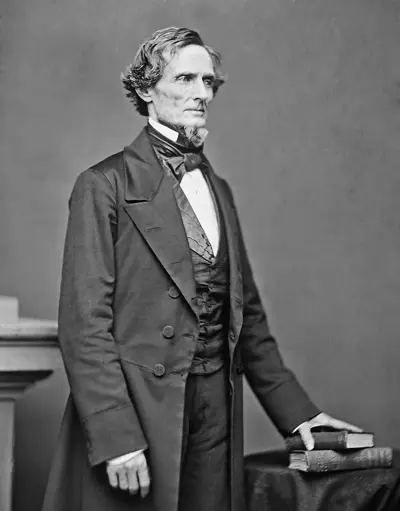
Jefferson Finis Davis was an American politician who served as the president of the Confederate States from 1861 to 1865. As a member of the Democratic Party, he represented Mississippi in the United States Senate and the House of Representatives before the American Civil War. He previously served as the United States Secretary of War from 1853 to 1857 under President Franklin Pierce.
