W. E. B. Du Bois Quotes
In the Constitution of the United States, Negroes are referred to as fellows although the word 'slave' is carefully avoided before the thirteenth amendment.
Du Bois, W. E. B. Black Reconstruction in America, 1860-1880. Harcourt, Brace and Company, 1935.


Lincoln had promised amnesty to Southerners who would pledge loyalty to the Union. What many feared was that this would include slave owners re-enslaving their former "property," or that the government would allow them to do so in order to stop the rebellion.


Blacks were fighting and dying in WWII. They were equal when they were under fire, but otherwise not. The war was against fascist protagonists whose creed was inequality while the allies were upholding freedom and equality. But making that aspiration a reality was difficult.

When the first Southern States seceded, each appointed a whose job it was to persuade the other Southern States to also secede. In this case Hale was marketing secession to Kentucky which with Maryland were the only two Southern States to reject what they regarded as treason and rebellion. The importance of the quotation however is in his argument which was all based on enmity to racial equality and abolition. Later Southern apologists would argue that the Civil War was fought, not about slavery and racism butt about different philosophies of government. See {623715} .
Professor Egerton documents how successful Reconstruction was in radically changing the positions of Blacks in the South. He points out that it was so effective that a hate-filled, racist group of Southern White terrorists, with murder, arson, torture and intimidation took over many of the governments of the South while President Andrew Johnson, who although he believed in the Union, was himself an inveterate racist and opponent of emancipation, would not use the force of the Federal Government to bring the terrorists to justice. (The KKK leaders were known in every state and county). They successfully overthrew Reconstruction and set the process back by 100 years.


This Civil War recruiting poster was described by the Free Library of Philadelphia as “Civil War recruitment print targeting African Americans by evoking the freedoms granted by the Emancipation Proclamation. Depicts a montage of symbolic scenes centered around an African American Union soldier triumphantly holding up a sword and an American flag with the banner "Freedom to the Slave." He stands near broken shackles upon a tri-color flag adorned with a coiled snake. The flag is tugged upon by one of three joyous slaves freed by an African American soldier. Other scenes depict an African American man reading a newspaper on a rocking chair near a plow and child, African American children entering a "Public School" near a church, and a regiment of "U.S. Colored Troops" marching across a battlefield strewn with dead bodies.”

What makes this quotation so historically interesting is that the abiding by the Supreme Court’s decisions on constitutionality was even an issue. It was because of the terrible Dred Scott decision which required Northern States to return fugitive slaves to their owners despite the constitutions of those states which stated that all men were free. A substantial part of the Democratic Party was the “solid South” and the return of fugitive slaves was one of the major issues of the 1860 Presidential Election. Ironically, the Southern States were arguing AGAINST states’ rights when the Northern States’ laws and Constitutions made fugitive slaves free the minute they set foot in the state.


While this assessment was true up until the 1980s. By the 21st century there were almost no serious historians who thought that the motivation of the Confederate States for the Civil War was anything but slavery and the economic impact that abolition might bring. However, one of your advantages having this collection of historical quotations is that you can see for yourself why the Southern states say they were seceding. This following are four of the official secession resolution documents. Read these and you will see that all the claims that there were other major reasons for secession are just attempts to make the Confederacy a little less brutal and greedy. See {621371}, {619793}, {621372}, {621375}


Jamaica, then part of the British Empire which had outlawed slavery, was quite racially integrated with negroes and mulattos in civil positions such as magistrate. When the ship landed, the slave, John Anderson, was kept locked below deck since if he ran off and reached shore, the Jamaican authorities would have declared him a free man. The presence of the captive negro slave leaked out and a group of Jamaicans boarded the ship uninvited and forcibly removed Anderson, He was taken before a Jamaican magistrate who declared him a free person. The ship’s captain demanded that the authorities return the American private property which had been stolen from an American ship by a “mob”. Harrison, the US Counsel complained to the Jamaican Governor of the “Insult” to the American Flag that had taken place and demanded redress. In both efforts, the original decision of the magistrate was supported and Anderson was a free man. Harrison, an ardent Southerner from Virginia was apoplectic and asked the State Department to make this case a major issue in relations with London. His description of the public opinion then in Jamaica was classic. His racial bias was even supplemented by a virulent anti-Semitism because not only had Jewish Jamaican merchants supported abolition of slavery but some had intermarried with Negroes who had converted to Judaism.

Marx followed the American Civil War very closely. The freeing of the slaves caused an immediate social, moral and economic revolution, the results of which we live with today.
Some whites opposed Slavery and new slave states, not becasue of any sympathy with Negroes or concern for the immorality of slavery, but becasue slavery made it difficult for the working white man to thrive.
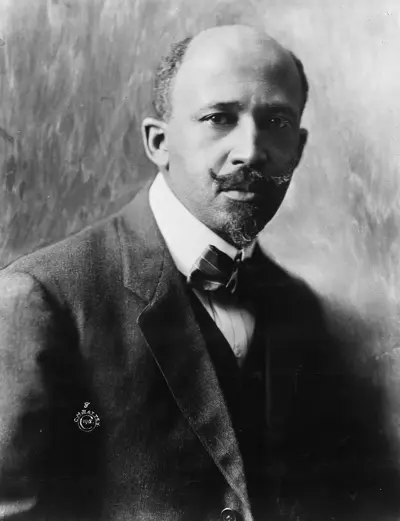
William Edward Burghardt Du Bois was an American sociologist, socialist, historian, and Pan-Africanist civil rights activist. Born in Great Barrington, Massachusetts, Du Bois grew up in a relatively tolerant and integrated community. After completing graduate work at the Friedrich Wilhelm University (in Berlin, Germany) and Harvard University, where he was the first African American to earn a doctorate, he became a professor of history, sociology, and economics at Atlanta University. Du Bois was one of the founders of the National Association for the Advancement of Colored People (NAACP) in 1909.
