Karl Marx Quotes
When Lincoln issued the Emancipation Proclamation, he turned the Civil War into a revolution.
Marx followed the American Civil War very closely. The freeing of the slaves caused an immediate social, moral and economic revolution, the results of which we live with today.
Karl Marx, 1818-1883, German Economist & Socialist, Quoted by Tony Kushner, C-SPAN, Book TV, February 15, 2013
Sourced by: Eigen's Political and Historical Quotations


This Civil War recruiting poster was described by the Free Library of Philadelphia as “Civil War recruitment print targeting African Americans by evoking the freedoms granted by the Emancipation Proclamation. Depicts a montage of symbolic scenes centered around an African American Union soldier triumphantly holding up a sword and an American flag with the banner "Freedom to the Slave." He stands near broken shackles upon a tri-color flag adorned with a coiled snake. The flag is tugged upon by one of three joyous slaves freed by an African American soldier. Other scenes depict an African American man reading a newspaper on a rocking chair near a plow and child, African American children entering a "Public School" near a church, and a regiment of "U.S. Colored Troops" marching across a battlefield strewn with dead bodies.”


While Lincoln was morally opposed to slavery, at the time the Civil War was not going well for the Union. The Emancipation Proclamation caused the South great distress in terms of practicality and their morale. The slaves if they escaped could come to a Union State and would be forever free. The South would lose labor that they could ill afford to lose as well as they were forced to devote more white manpower to keeping the slaves in bondage. While most people think the Proclamation freed all the slaves, it did not; it only freed slaves in the rebellious Southern states. Border states such as Maryland, not in rebellion, could keep their slaves legally and did until they were freed later.


After the Presidential years of James Buchanan who protected the South from slavery reform and abolition as the North was gaining political power and the abolitionists were having a greater and greater effect on public opinion in the North. While Southerners did not believe Lincoln would emancipate the slaves, they realized that the majority of the growing nation was opposed to slavery, and more and more Northern states were passimg laws making any slave who sets foot in the State a free person. Slaves coud not only have more reason to run away, but slave owners would not be able to get their “property” back. Lincoln would not help the South as Buchanan did, and the Southerners realized that over time, slavery would no longer be feasible or profitable. Cobb, very experienced at Washington politics, realized the changes that would come and thought that they would be “certain and speedy.” The irony was that if the South had not seceded and simply dragged its feet legislatively, it would have taken two or three decades for slavery to end. However, by seceding and initially fighting so hard and well while poor Union generals were in command, Lincoln was forced to try more drastic measures and issued the Emancipation Proclamation after only a few years. The Civil War and seccession was not only a tactical and strategic error for the South, but rapidly brought about just what the Southerners were fighting to prevent.


The writer was a free Black minister in Maryland. Maryland was a slave state, and the whites were very anti-Lincoln. The free Blacks were under constant scrutiny as there were rumors that the election of Lincoln would be the instigation of a free Black and slave revolt.


Lincoln had promised amnesty to Southerners who would pledge loyalty to the Union. What many feared was that this would include slave owners re-enslaving their former "property," or that the government would allow them to do so in order to stop the rebellion.


Much of the South was so insular that people knew nothing about the notion of abolition and just assumed that no one would ever consider freeing the slaves. Many never knew that it was the South that first fired on the Union troops and flag. If the North won the war, the assumption was that Northerners would then own the plantations and the valuable slaves. In reality, while all slaves were emancipated in the South, very few plantations and farms were confiscated from their Southern owners by Northerners despite the fact that there was political pressure in the North to confiscate the land of all rebels who had committed treason and use the value to repay the Union bonds and care for the wounded Union veterans and the widows of dead Union Soldiers. Eggleston was an accomplished writer who had served in the Confederate army of the Civil War. 20 year after the war he wrote a series of articles for the prestigious Northern Atlantic Monthly trying to convey the war from the Southerner’s point of view.

More new technology was deployed in the Civil War than any other war in history and Moltke did not realize that the classic European military tactics were obsoleted. However, neither did most of the Southern Generals and many of the Union Generals. Lincoln, Grant and Sherman were the ones who developed strategies and tactics to function in the new world of warfare.
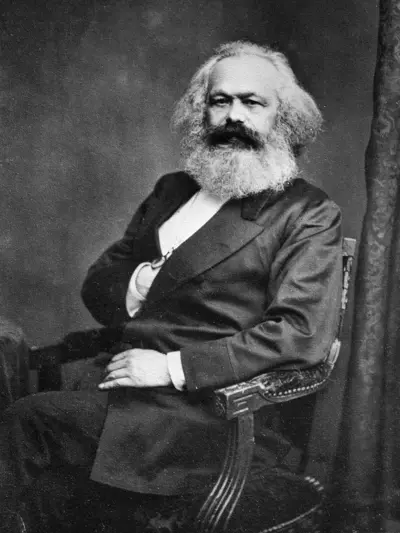
Karl Heinrich Marx was a German philosopher, economist, historian, sociologist, political theorist, journalist and socialist revolutionary. Born in Trier, Germany, Marx studied law and philosophy at university. He married Jenny von Westphalen in 1843. Due to his political publications, Marx became stateless and lived in exile with his wife and children in London for decades, where he continued to develop his thought in collaboration with German thinker Friedrich Engels and publish his writings, researching in the reading room of the British Museum. His best-known titles are the 1848 pamphlet The Communist Manifesto and the three-volume Das Kapital (1867–1883). Marx's political and philosophical thought had enormous influence on subsequent intellectual, economic and political history. His name has been used as an adjective, a noun, and a school of social theory.
