Abram D. Smith Quotes
They---the northern states---will never consent, that a slave-owner, his agent, or an officer of the United States, armed with process to arrest a fugitive from service, is clothed with entire immunity from state authority; to commit whatever crime or outrage against the laws of the state; that their own high prerogative writ of habeas corpus shall be annulled, their authority defied, their officers resisted, the process of their own courts contemned, their territory invaded by federal force, the houses of their citizens searched, the sanctuary or their homes invaded, their streets and public places made the scenes of tumultuous and armed violence, and state sovereignty succumb--paralyzed and aghast--before the process of an officer unknown to the constitution and irresponsible to its sanctions. At least, such shall not become the degradation of Wisconsin, without meeting as stern remonstrance and resistance as I may be able to interpose, so long as her people impose upon me the duty of guarding their rights and liberties, and maintaining the dignity and sovereignty of their state.
The Federal Fugitive Slave Act required all in free states to assist owners of escaped slaves to return them to their owners. In 1854 a Missouri slave owner tracked his escaped slave to Wisconsin and the Federal officials incarcerated the slave pending his return. A Wisconsin mob broke the slave out of jail and helped him escape to Canada. Sherman M. Booth, Publisher & Editor of the Wisconsin Free Soil Democrat was convicted under the Fugitive Slave Act for aiding the escape. Smith’s opinion overturned the Fugitive Slave Act on the grounds that it had usurped state’s rights. The Supreme Court overturned Smith’s ruling, but Booth was pardoned. See {587927} & {587928}.
Abram D. Smith, 1811-1865, Wisconsin Supreme Court Justice, Ruling that the Federal Fugitive Slave Act was void in Wisconsin, 1854
Sourced by: Eigen's Political and Historical Quotations

The Federal Fugitive Slave Act required all in free states to assist owners of escaped slaves to return them to their owners. In 1854 a Missouri slave owner tracked his escaped slave to Wisconsin and the Federal officials incarcerated the slave pending his return. A Wisconsin mob broke the slave out of jail and helped him escape to Canada. Sherman M. Booth, Publisher & Editor of the Wisconsin Free Soil Democrat was convicted under the Fugitive Slave Act for aiding the escape. Smith’s opinion overturned the Fugitive Slave Act on the grounds that it had usurped state’s rights. The Supreme Court overturned Smith’s ruling, but Booth was pardoned. See {587926} & {587928}. The more “dread calamity” was civil war which of course came a few years later.

Federal authorities had jailed Glover pending his return to his Missouri owner. A local Wisconsin judge issued an order for Glover’s release on the grounds that slavery was illegal in Wisconsin and he was entitled to freedom. The Federal authorities refused to release the escapee. The Wisconsin mob then stormed the jail and broke Glover out. Glover was helped to get to Canada and final freedom by the people of Wisconsin, but Booth was prosecuted and convicted under the Fugitive Slave Act. He was later pardoned. See {587921}.


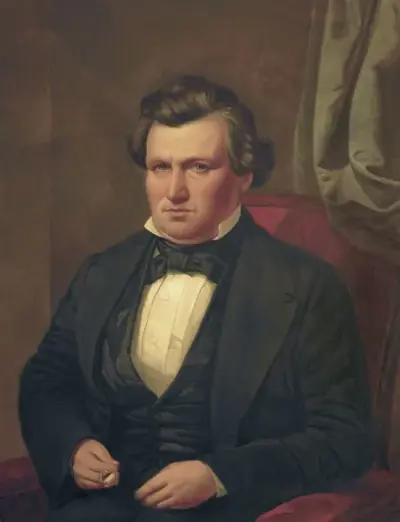
Abram Daniel Smith, often abbreviated A. D. Smith, was an American lawyer, politician, and pioneer. As a leader of the Hunters' Lodges, he was elected President of the Republic of Canada in the midst of the Canadian Rebellions of 1837–1838. Later, he became a prominent lawyer in the Wisconsin Territory, and was one of the first justices of the Wisconsin Supreme Court, where he authored a major opinion against the Fugitive Slave Act of 1850.
