Jacob M. Howard Quotes
The Dred Scott decision was a partisan political decision, the purpose of which was to establish ... for all time to come the legality, the rightfulness and even the piety of slavery ... The comment made upon that great wrongful judicial decision is to be seen in the dreadful war through which we have just passed
Jacob Merritt Howard, 1805-1871, U.S. Senator (Michigan), Quoted in Raoul Berger, Government by Judiciary: The Transformation of the Fourteenth Amendment, [See {75276}.]
Sourced by: Eigen's Political and Historical Quotations

This was a terrible Supreme Court decision which placed slave owning whites against whites who opposed slavery in conflict over runaway slaves and free blacks throughout the country. It held that Blacks—even free Blacks had no Constitutional rights and was one of the major causes of the Civil War. See {623426}.

Phelps was a Copperhead Democrat who was a virulent racist, an enemy of Lincoln and supported McClellan against Lincoln in 1864. His extreme disrespect for the President and his racism was not appreciated in Vermont, and Phelps not only failed to help McClellan but destroyed his own credibility in his home state of Vermont. Phelps had been practicing law in New York City where there was a large Copperhead, racist and anti-Lincoln part of the population there.

What makes this quotation so historically interesting is that the abiding by the Supreme Court’s decisions on constitutionality was even an issue. It was because of the terrible Dred Scott decision which required Northern States to return fugitive slaves to their owners despite the constitutions of those states which stated that all men were free. A substantial part of the Democratic Party was the “solid South” and the return of fugitive slaves was one of the major issues of the 1860 Presidential Election. Ironically, the Southern States were arguing AGAINST states’ rights when the Northern States’ laws and Constitutions made fugitive slaves free the minute they set foot in the state.
As just one example of Southern States' reasons, see {583044}. Many of the Northern States had passed laws declaring everyone in the state was free and making it illegal to return or assist in the returning of escaped slaves. The Southerners got the Federal Fugitive Slave Act passed which required all Americans to assist in recapturing escaped slaves. It was the Northern States who claimed states' rights were being trampled. The South was vehemently opposed to States' Rights when it came to allowing individual states to decide who was free and who was not. The Southerners had only one fundamental reason for secession—the maintenance of the Negro slavery system on which much of their economy depended as did their sociology, culture, and way of life.


Fremont and some of the Radical Republicans wanted Lincoln immediately to declare the slaves of the rebelling states free. As a major general in charge of an area, he wrote a military order emancipating all the slaves in his jurisdiction. President Lincoln countermanded the order as soon as he found out. He wanted Fremont to only free the slaves whose owners were actively working against the union. Lincoln needed to hold the border states like Maryland in the Union and was working on a plan whereby slave owners who were loyal to the Union would be economically compensated when their slaves were freed. If loyal slaveholders in Fremont’s area would lose their slaves with no compensation, Lincoln feared that the otherwise loyal border states would be driven to the confederacy thus shifting the balance of power. Lincoln had his own plan for emancipation and would not allow Fremont to alter that. As a result of this speech, the Radical Republicans nominated Fremont to run against Lincoln. For a few weeks he looked like he would run, but then he and Lincoln made a deal. Lincoln fired Montgomery Blair, Fremont’s arch enemy, from the cabinet, and Fremont withdrew from the election.


Contrast this view with that of Union General Ulysses S. Grant.

Newsletter of the United Sons of Confederate Veterans

The general issued a military order emancipating slaves in Florida, Georgia and South Carolina. President Abraham Lincoln rescinded the order feeling it was too premature and it would cause the slave states that stayed in the Union--Delaware, Maryland, and Kentucky--to go over to the Confederates.

Lincoln had promised amnesty to Southerners who would pledge loyalty to the Union. What many feared was that this would include slave owners re-enslaving their former "property," or that the government would allow them to do so in order to stop the rebellion.


Incredibly enough, after the Civil War and emancipation, most Virginia leaders opposed any form of rights for Blacks with one of the major reasons being that they were ignorant and uneducated. It was actually a crime to teach even a free Black to read.
Many free Negroes of the day did not have the paperwork, education, , sophistication, or access to attorneys that could prove that they were free. Scheming Southerner slave owners would go north find poor ignorant free blacks and swear that they ran away from their plantation. If the victim could not prove the contrary, he was enslaved, transported South and usually sold.
This letter was signed by a local white Priest and two other leading planters. This quotation gives us a marvelous feeling for what occurred when parts of the South was occupied by the Union Army shortly after the Emancipation Proclamation was issued. Minor and his fellows just did not “get it.” The concept of freedom of the slaves was intellectually so foreign to them, that they wanted the Union Army to “compel” the freed slaves to work. They were horrified that slaves went wherever they wanted, and they were most outraged when former slaves who had enlisted in the Army, would “visit” their old plantation setting such a terrible example. The letter gives us a perspective on how difficult it was to change the mental set of Southern Whites and why Reconstruction was so difficult. The year of the letter is somewhat uncertain as the original letter appears to be dated 1862 but the writing is not clear and that date does not comport with the history of the era and we believe 1863 was the correct year. The photograph is of the first official colored troops mustered into the Union Army. They were called the Louisiana Native Guards and contained the ex slaves who went over to the Union side just before the time this slave owner complained. These ex slaves, in uniform, and with arms would sometimes visit the plantations where they and been enslaved, thrilling the remaining slaves and infuriating owners like Minor.

The Confederacy was looking to develop sympathy for the their cause, even within the Catholic Church which many Southern Protestants were very prejudiced against. Davis, himself, however, had attended Catholic schools as a youth and almost converted to Catholicism. Reading this letter today we are fascinated by the fact that Davis could ensure the Pope that “everyone” in the Confederacy could enjoy “temorial” rights and also the “free exercise of his religion.” Blacks, a very large proportion of the Southern population, could of course enjoy neither. Davis did not even cover himself by saying :every citizen”. He said “everyone” an absurdity even then, but Jefferson, an otherwise intelligent man, was so prejudiced that he did not consciously realize that he was lying to the Pope whom he respected greatly.


This quotation is significant. Ibn Khalodun was one of the great intellectual Arab scholars, yet he looked upon Blacks as subhuman and fit for slavery. While Islam preaches the equality of all people, the Arabs had and many still have a raciest view of Blacks. The Arabs were the leaders among the slave traders and many an American Captain of a slave trader bought his slaves from Arab slave traders. Saudi Arabia was the last nation to outlaw legal slavery (1963) and it is still illegally practiced in Saudi Arabia and other Arab states of the Middle East. The attitude can be seen in much of the Arab Middle East even today. For examples, the Muslim Arabs in Northern Sudan refer to the Black non-Islamic Southerners using a derogatory term that means slave.

This is an important quotation because it shows that slavery was the principle reason that the South succeeded and began their rebellion. In the early 20th century, there was a movement to make the Confederacy and the rebellion more noble by promoting the idea that the Civil War was fought by the South for more lofty reasons such as States Rights, Original Construction, different economic philosophies and the like. This was a more noble cause then the right to deny other human beings their rights, to own other human beings who they could beat, torture, sexually use and even murder them was a pretty selfish and demeaning reason to have started a rebellion that would then cost more Americans their lives than any other American conflict. The succession documents and others of the Southern States and the Confederacy make it clear that slavery was THE issue and fleeting references to any of the others were only made to complain about the potential effect on abolition and the refusal of the abolitionist states to cease aiding and protecting fugitive slaves.
This is an important quotation because it shows that slavery was the principle reason that the South succeeded and began their rebellion. In the early 20th century, there was a movement to make the Confederacy and the Southern rebellion more noble by promoting the idea that the Civil War was fought by the South for more lofty reasons than greed and slavery such as States Rights, original construction, different economic philosophies and the like. This was a more noble cause then the right to deny other human beings their rights, to own other human beings who they could beat, torture, sexually use and even murder them was a pretty selfish and demeaning reason to have started a rebellion that would then cost more Americans their lives than any other American conflict. The succession documents and others of the Southern States and the Confederacy make it clear that slavery was THE issue and fleeting references to any of the others were only made to complain about the potential effect on abolition and the refusal of the abolitionist states to cease aiding and protecting fugitive slaves.
This is an important quotation because it shows that slavery was the principle reason that the South succeeded and began their rebellion. In the early 20th century, there was a movement to make the Confederacy and the rebellion more noble by promoting the idea that the Civil War was fought by the South for more lofty reasons such as States Rights, Original Construction, different economic philosophies and the like. This was a more noble cause then the right to deny other human beings their rights, to own other human beings who they could beat, torture, sexually use and even murder them was a pretty selfish and demeaning reason to have started a rebellion that would then cost more Americans their lives than any other American conflict. The succession documents and others of the Southern States and the Confederacy make it clear that slavery was THE issue and fleeting references to any of the others were only made to complain about the potential effect on abolition and the refusal of the abolitionist states to cease aiding and protecting fugitive slaves.
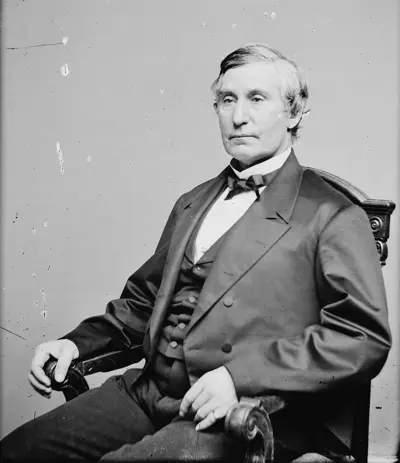
- Born: July 10, 1805
- Died: April 2, 1871
- Nationality: American
- Profession: Politician, Attorney
Jacob Merritt Howard was an American attorney and politician. He was most notable for his service as a U.S. Representative and U.S. Senator from the state of Michigan, and his political career spanned the American Civil War.
