Jefferson Davis Quotes
Major General David Hunter is a felon to be executed if captured.
This is a very important quotation historically. There are a few historians and many politicians who claim that the rebellion of the South in the Civil War was motivated by a number of principles having little or nothing to do with slavery, while most historians have found that slavery was the only major issue. This quote further supports that view. This is the only Union General Officer would be executed if captured by the South. What crimes did he perform to warrant such exceptional treatment? He issued an order Emancipating the Slaves of the Southern Department of which he was the Commanding General. See {619331} . Lincoln quickly countermanded the order, but the act of freeing slaves was to the Southern government so heinous that it deserved the death penalty.
Jefferson Davis, 1808-1889, U. S. Congressman & U. S. Senator (Democrat, MS), U. S. Secretary of War, President, Confederate States of America, Order issued regarding Union Major General David Hunter
Sourced by: Eigen's Political and Historical Quotations

More than a decade before the Civil War there were many proposals and plans for ending slavery in America without war. Many of these debates took place amongst major religious institutions. John Price Durbin, an eminent Methodist clergyman and former president of Dickinson College proposed one. His plan called for compensation to slaveholders and the relocation of the freed slaves to Africa—a form of ethnic cleansing. Brown disagreed with forced colonization to Africa. Instead, he suggested California as a voluntary option. Brown’s idea received about 9 months of serious consideration, but in January of 1848, gold was discovered in California and the Gold Rush was on. Black colonization of California was off the table.

General David Hunter had unilaterally freed all the slaves in the Southern Department. See {619331}. Lincoln rescinded Hunter’s proclamation instantly. Lincoln would issue the first Emancipation Proclamation 4 months later, but did not want each Army Department setting its own policy on such a touchy and serious subject. Also, Lincoln did not want to offend the two slave states that had remained loyal to the Union, Kentucky and Maryland. Some Lincoln critics claim that there was little or no moral motivation for Lincoln, and he was pressured into the Emancipation Proclamation. See {619335} for the Confederate Government reaction to Hunter’s Emancipation.

When the Confederate Government realized that the Union was planning to arm escaped slaves and induct them into the Union Army, they quickly passed a law that declared any escaped slave who joined the Union Army or wore its uniform was guilty of Treason and would be executed. Most Union Generals one way or another got word to the Confederate Officers that they had better treat all Negro Union Soldiers as prisoners of war. Even President Lincoln warned the South. Butler, however, had a large number of Negro troops in his area and had heard threats of some of the Southerners to execute Black prisoners of war. He had a way of making things very clear, and he was able to prevent murder of any of his Negro troops despite the Treason law.


He was explaining his repudiation of General John Fremont’s military proclamation in Missouri confiscating rebel property and emancipating their slaves. See {633732} .
While most modern armies treat officers and enlisted men who desert equally or even favor the officers, the Visigoths made desertion by an officer the severest of crimes. A centurion was the officer in charge of 100 men. There were 10 decurians (leaders of 10) under him, They were the modern equivalent of the Sergeants—non-commissioned officers. Their penalty for desertion was only the paying of a heavy fine. It was the officers who had to set the example. This set of laws is the most formalized and sophisticated compendium of laws of the so-called “barbaric peoples” of Europe. The compilation was in many ways a documentation of the traditional laws of the Visigoths that had evolved over hundreds of years.

This poster's distribution before the JFK murder, has fed numerous conspiracy theories that right wing extremists were behind the assassination.


He was being cheered by a large crowd.

This was one of the several early unofficial Emancipations that was issued in the Civil War.

Much of the South was so insular that people knew nothing about the notion of abolition and just assumed that no one would ever consider freeing the slaves. Many never knew that it was the South that first fired on the Union troops and flag. If the North won the war, the assumption was that Northerners would then own the plantations and the valuable slaves. In reality, while all slaves were emancipated in the South, very few plantations and farms were confiscated from their Southern owners by Northerners despite the fact that there was political pressure in the North to confiscate the land of all rebels who had committed treason and use the value to repay the Union bonds and care for the wounded Union veterans and the widows of dead Union Soldiers. Eggleston was an accomplished writer who had served in the Confederate army of the Civil War. 20 year after the war he wrote a series of articles for the prestigious Northern Atlantic Monthly trying to convey the war from the Southerner’s point of view.

He stated that he had a vision and made these two prophesies that indeed came true. The first was the South Carolina secession starting the Civil War. The second, when the North used former slaves as soldiers who fought their old masters.

Some Southerners, in order to obtain support in England for the Confederate cause claimed in their propaganda that slavery was not the issue but their issue with the Union was just one of local and regional autonomy. The British and most Europeans at that time were strongly against slavery so this “spin” might have gotten some support. Stowe and others put the lie to this, and the Confederacy never did get any significant material support from any country in Europe. The secession resolutions of the Southern States all state that Slavery was the cause (and often the ONLY cause stated) of secession. Also Southern General Mosby, called the spin for what it was. See {584991}.
Some Lincoln critics point to this quotation to illustrate their belief that Lincoln’s emancipation of slaves was not based on deeply held personal moral convictions but was the result of pragmatic political forces pure and simple. Others believe that this statement to Greeley represented a political tactic to hold Maryland and Kentucky—then slave states—in the Union, but that Lincoln was waiting for the right time to adopt a policy of making emancipation paramount.

He may well have been right if the South had capitulated. But that is exactly what happened when they did not and were beaten. So the worst that the South could have ended up with by not following Vance’s view would be what they ended up without the many deaths and wounded and the massive destruction of property that took place in the latter part of the war.


This Civil War recruiting poster was described by the Free Library of Philadelphia as “Civil War recruitment print targeting African Americans by evoking the freedoms granted by the Emancipation Proclamation. Depicts a montage of symbolic scenes centered around an African American Union soldier triumphantly holding up a sword and an American flag with the banner "Freedom to the Slave." He stands near broken shackles upon a tri-color flag adorned with a coiled snake. The flag is tugged upon by one of three joyous slaves freed by an African American soldier. Other scenes depict an African American man reading a newspaper on a rocking chair near a plow and child, African American children entering a "Public School" near a church, and a regiment of "U.S. Colored Troops" marching across a battlefield strewn with dead bodies.”

President Lincoln and Several of the Commanding Union Generals had declared that black slaves were free during the midst of the Civil War under the legal theory that if the slaves were property of the rebels, then they cold be seized as “contraband” and removed from the control of those who had committed treason. The question was, what would happen to those now free Negroes after the war? Many Negro leaders were anxious that if there were surrender, then the status quo ante might prevail and the Negroes—many have who had fought for the Union might be returned to slavery. This speech by the Secretary of State alarmed them further. This is why the Emancipation Proclamation was so important and even that might have been overturned by a subsequent President. This is why Lincoln, the white radical Republicans and the Black leadership placed so much emphasis on passing the 13th Amendment.
After the Civil War and Reconstruction, the American nation was still bitterly divided intelelctually, socially, emotionally and poliotically. In an effort to bring more unity to America, most of the power stucture and the influentials of the nation began to avoid those issues that would divide North and South and try and promote a narrative that both sides might be able to live with. And this is what Zeitz describes in this quotation. America went through a period of Revisionist History that even in the 21st century was held by many people. It wasn't until the middle of the 20th century that the real history and narrative of the Civil War and Reconstrution emerged from the few academics who had all along criticized the fabricated narritive that did unify the country at the cost of historical accuracy and truth. Many scholars point out that the price that America paid for this unity was the Jim Crow era and a century of legalized racism. Much of the nation was built on the labor of Negro slaves and the victims of the slavery era, also bore the brunt of American unity and reconcilliation.


The cause of the Civil War was slavery. When the Souh fired on the nation’s army and governmental personal, the secession became treason. So Slavery was the cause of the treason. Douglass argued that if we eliminate slavery, we eliminate the cause of the Treason.
This letter was signed by a local white Priest and two other leading planters. This quotation gives us a marvelous feeling for what occurred when parts of the South was occupied by the Union Army shortly after the Emancipation Proclamation was issued. Minor and his fellows just did not “get it.” The concept of freedom of the slaves was intellectually so foreign to them, that they wanted the Union Army to “compel” the freed slaves to work. They were horrified that slaves went wherever they wanted, and they were most outraged when former slaves who had enlisted in the Army, would “visit” their old plantation setting such a terrible example. The letter gives us a perspective on how difficult it was to change the mental set of Southern Whites and why Reconstruction was so difficult. The year of the letter is somewhat uncertain as the original letter appears to be dated 1862 but the writing is not clear and that date does not comport with the history of the era and we believe 1863 was the correct year. The photograph is of the first official colored troops mustered into the Union Army. They were called the Louisiana Native Guards and contained the ex slaves who went over to the Union side just before the time this slave owner complained. These ex slaves, in uniform, and with arms would sometimes visit the plantations where they and been enslaved, thrilling the remaining slaves and infuriating owners like Minor.
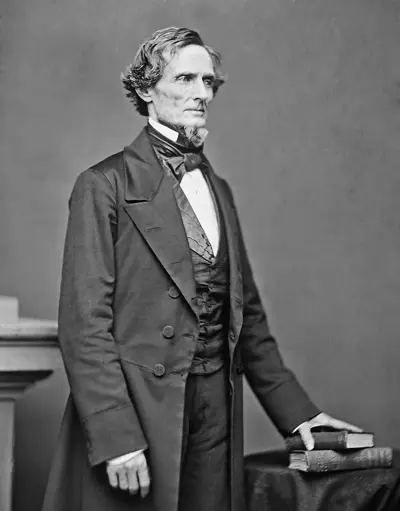
- Born: June 3, 1808
- Died: December 6, 1889
- Nationality: American
- Profession: Leader
Jefferson Finis Davis was an American politician who served as the president of the Confederate States from 1861 to 1865. As a member of the Democratic Party, he represented Mississippi in the United States Senate and the House of Representatives before the American Civil War. He previously served as the United States Secretary of War from 1853 to 1857 under President Franklin Pierce.
