John Quincy Adams Quotes
I had a visit from Mr. James Buchanan, Secretary of State. He told me that he had formerly visited my father at Quincy [MA], and said that in speaking to him of some of the Tories during our Revolutionary War, he said they were men of great respectability, fine talents, and excellent private character, but that they were all deplorably loyal—an epithet which Mr. Buchanan said had greatly diverted him.
John Adams, 2nd President of the U.S.
John Quincy Adams, 1767-1848, 6th President of the United States (Independent, MA), Diary, December 25, 1845
Sourced by: Eigen's Political and Historical Quotations


Lee although born in England was one of the most ardent of the patriots fighiting the British. This oath was even considered extreme at the time. He was considered a super hawk by Washington and others. He became the Senior Major General and if anything had happened to Washington he would have command. He was an extremist who thought himself far more militarily qualified than Washington. See {59589} and {55885} for two of his slights against Washington.

The French Revolution was out of control and terribly bloody. Most Americans and even English who supported the principles and reasons for the French revolution ceased their support because of the Reign of Terror. Jefferson, however, saw a link between France and American democracy and was reluctant to end support.


Americans were by no means united in wanting to take up arms against Britain. Relatively few of the loyalist quotations have come down to us, but here is one. It also illustrates why some Americans wanted complete independence: So that they could escape their debts to English merchants. Most however had more noble and unselfish motives. As a matter of fact, the American Revolution is unusual in the sense that there were so many men of substance who sacrificed much of their material wealth for the American ideal. There were also the rogues and opportunists as Galloway describes.
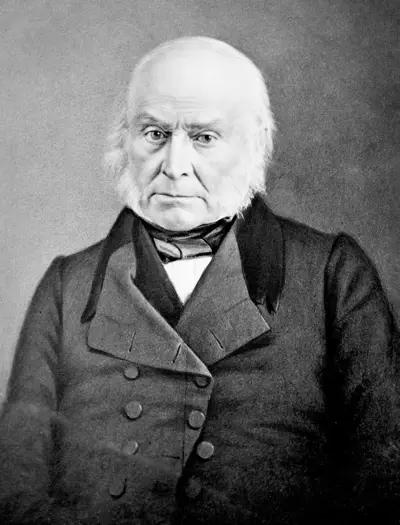
John Quincy Adams was an American statesman, diplomat, lawyer, and diarist who served as the sixth president of the United States, from 1825 to 1829. He previously served as the eighth United States Secretary of State from 1817 to 1825. During his long diplomatic and political career, Adams also served as an ambassador, and as a member of the United States Senate and House of Representatives representing Massachusetts. He was the eldest son of John Adams, who served as the second U.S. president from 1797 to 1801, and First Lady Abigail Adams. Initially a Federalist like his father, he won election to the presidency as a member of the Democratic-Republican Party, and in the mid-1830s became affiliated with the Whig Party.
