William Apess Quotes
As the immortal Washington lives endeared and engraven on the hearts of every white in America, never to be forgotten in time -- even such is the immortal Philip honored, as held in memory by the degraded but yet graceful descendants who appreciate his character.
King Philip was the great Indian leader of the time.
William Apess, 1798–1839, Native American (Pequot) Writer, Eulogy on King Philip
Sourced by: Eigen's Political and Historical Quotations

This quotation about George Washington is one of the best complements ever paid to any political leader.


In the attack on Fort Wagner, the color bearer was killed as was the Commanding Officer, Colonel Shaw. Carney raised the flag and led the men up the sand wall into the Confederate midst. They were vastly outnumbered and then retreated. Carney was the first Black to win the Medal of Honor.


This line was used in the WPA Federal Theater Project. The play was closed down, because the State Department was distressed that the Federal Theater quoting heads of State might be insulting to the world leaders. Mussolini was another character in the play and he was depicted as the boorish thug that he turned out to be. It was that which offended the government officials who closed the show before it could open. FDR used a similar line 6 years later. See {32529} . Dolores Ibarruri in the Spanish Civil War is quoted with a similar phrase at about the same time. See {604321}


Thomson had thousands of pages of notes, minutes and other documents as a result of his role as Secretary of the Continental Congress. There was much in the documents to embarrass many of the patriots who after the Revolution were the “great men of the nation.” Although he was expected to write a history, he translated the Bible and studied bee keeping instead and reputations of some of the Founding Fathers were not tarnished.


Smyth was one of the leading historians in England in the first half of the 19th century. His title was Professor of Modern History at Cambridge University. One of his areas was the American Revolutionary War where he was very critical of the English policies and implementation of the war which he thought was needlessly provoked by the Parliamentary majority at the time. He was a great admirer of George Washington and considered him one of the great men of all time.’


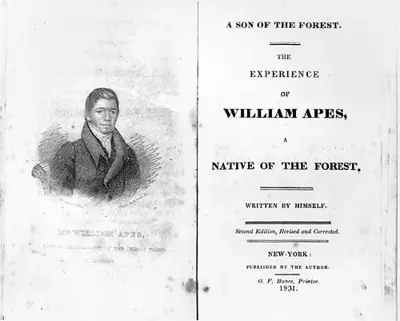
William Apess (1798–1839, Pequot) (also known as William Apes before 1837), was an ordained Methodist minister, writer, and activist of mixed-race descent, who was a political and religious leader in Massachusetts. After becoming ordained as a Methodist minister in 1829, he published his autobiography the same year. It is among the first autobiographies by a Native American writer. Apess was part Pequot by descent, especially through his mother's family, and identified with their culture.
