Milton Friedman Quotes
The worst mistake Ronald Reagan ever made was to accept George W. Bush as his running mate.
Milton Friedman, 1912-2006, 1912-2006, Nobel Laureate in Economics, Quoted on PBS The Charlie Rose Show, December 26, 2005
Sourced by: Eigen's Political and Historical Quotations


While this probably was a slip of the tongue, President Bush and governor Perry both had civil right and individual had rights as a lower priority than a individual responsibility, strong growth economy or the military. There were many who really believed that the two men really thought excessive personal reedom a problem that people and the government must be protected from, like freedom for a woman to choose an abortion. For Perry in particular many thought that if this was a slip of the tounge, it was likely a Freudian slip as it what he really wants.


While Bannon was more critical of anyone who disagreed wiuth him than most, it was unusual for a conservative to use such harsh tems about a conservative presidential administration.

Owens had just retired after 24 years in Congress. When Reagan began his campaign the majority of the racists of the South were furious that their party, the Democrats, had passed the Civil Rights Act of 1964 ending legal segregation and racism of the South. Reagan implemented a “Southern Strategy” by using code words that endorsed Southern racism and this swung the formerly Democratic “Solid” South to the Republican side changing the balance of power for years. Although Reagan was not himself racist and was a very popular President there were many who never forgot his pandering to the racists to get elected to begin with.

In the razor thin 2000 Presidential election the Republican controlled Florida legislator called a special session to name their own electors to go to the electoral college. The Governor, Jeb Bush, was the brother of the Republican candidate.


Bush, himself a born-again Christian, made religion in general and fundamentalist Christian values in particular, a major driver of policy making in his administration, subjugating science, medicine, research and social policy to the prevailing views of the evangelical and other fundamentalist Christians. He also claimed that God spoke though him as President. See {589627}.


See {618460} for the kinds of statements that stimulated this type of political attack.


The Republican candidates were campaigning for the Primary election in Illinois. Lincoln was the first and the greatest of the Republican Presidents and a great liberal. The Republicans used to be the more liberal of the two American major parties and even referred to themselves as “radicals.” However the political parties flip flopped over time and in the 2012 primary campaign the Republican candidates were outdoing each other to show who was the most conservative and could trash liberals the most. Pointing out this contradiction between the politics of the first and most popular Republican President and the then current crop of contenders was a little embarrassing to some Republicans and a powerful anti-current Republican message to independents and Democrats.

Prior to this question, Thomas had not been called on at a White House press conference for 3 years. After it, she was again avoided.

Bush adopted a foreign policy of unilateralism which was offensive to and resented by most of the foreign countries with whom we had good relations. Many people thought it would take years to repair the damage, but President Obama and Secretary of State Hillary Clinton were able to turn the situation around in a few years. The George W. Bush administration, in contrast to his father’s administration, was considered an aberration in American foreign policy by most countries.

Carter, who had his own share of blunders, may well have been right about this. History will have to judge.

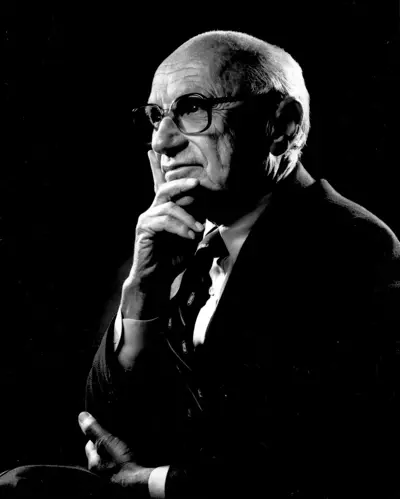
Milton Friedman was an American economist and statistician who received the 1976 Nobel Memorial Prize in Economic Sciences for his research on consumption analysis, monetary history and theory and the complexity of stabilization policy. With George Stigler and others, Friedman was among the intellectual leaders of the Chicago school of economics, a neoclassical school of economic thought associated with the work of the faculty at the University of Chicago that rejected Keynesianism in favor of monetarism until the mid-1970s, when it turned to new classical macroeconomics heavily based on the concept of rational expectations. Several students and young professors who were recruited or mentored by Friedman at Chicago went on to become leading economists, including Gary Becker, Robert Fogel, Thomas Sowell and Robert Lucas Jr.
