Jimmy Carter Quotes
It’s going to prove to be one of the greatest blunders any American President has ever made.
Carter, who had his own share of blunders, may well have been right about this. History will have to judge.
Jimmy Carter, 39th President of the United States (Democrat, GA), Description of the decision of George W. Bush to invade Iraq, 2006
Sourced by: Eigen's Political and Historical Quotations


This quotation is a good example of how tolerant some nations can be in terms of maintaining diplomatic relations and trade relations with other countries. The American and English governments chose to simply protest and condemn the slanderous statement but decided that the Prime Minister was pandering to his political local Islamic base, so took no further action and kept open diplomatic relations. Mahathir had a history of being very accusatory of the West with respect to anything that affected the Arab Muslims. The number of Muslims killed by the Americans and British in the Iraq War was very small compared to the huge number of Muslims killed by other Muslims in their Sunni Shiite civil war. While Bush and Blair both generated support for the Iraq invasion by making claims of WMD development in Iraq that were false, it is not clear whether or not they knew their statements were false, should have known that they were false, created an atmosphere against Iraq that was likely to produce false accusations, or were simple misled by poor intelligence. Mahathir, of course, chose to assume the worst case, and claim it was true, which is what many people think Bush and Blair did in analyzing the intelligence on Iraq.

Ford gave the confidential interview under the condition that it would not be made public until after he passed away. It was published by the Washington Post on December 26, 2006 just after Ford died. Ex-President’s are very reluctant to criticize a current President---especially on a foreign policy issue.


In 2002, President George W. Bush, determined to invade Iraq and bring democracy to the Muslim Middle East, reported that Iraq had stockpiles of weapons of mass destruction and were very close to a nuclear bomb. They had even used biological weapons against Iran and the Kurdish minority in Iraq. The president claimed that the evidence was incontrovertible and removed those generals who questioned the wisdom of an Iraq invasion and besmirched the character and patriotism of those civilian officials and figures who questioned the evidence or its sources. After the invasion, it turned out that there were not only no stockpiles of WMD but there was no capability to manufacture WMD as had existed before the Gulf War. Bush claimed he was misled by the CIA and other intelligence operatives. It turned out that the Vice President and other administration officials only examined the intelligence which supported their justification for war.


Llewellyn H. Rockwell, Jr. The title was a take-off on the film, The Madness of King George, that described a demented king of England.

Abu Ghraib was the major prison in Iraq during the Iraq War. American military committed many crimes on prisoners ranging from murder to sexual humiliation. The actual perpetrators claimed that the higher ranks of officers knew what was ongoing and provided the policies, rules and culture of the prison. The president and the Vice President many thought were the officers responsible and violated the Uniform Code of Military Justice. Their administration had issued a legal memorandum that for the first time in American history would allow some kinds of torture of prisoners in the War on Terror. A few enlisted personnel were punished and a general was transferred but no senior military or civilian personnel were held responsible or punished.


She was lampooning George W. Bush who had made some recent gaffs.

Bush had stated when he was running for President that he was opposed to placing America’s nuclear waste in the Nevada mountain which was very unpopular with Nevada voters, but once in the Presidency he changed his position. The reason might have been that there was no backup plan to Yucca Mountain that Bush could select. It was wither Nevada or back to the drawing board with radioactive waste piling up each day.

Bush adopted a foreign policy of unilateralism which was offensive to and resented by most of the foreign countries with whom we had good relations. Many people thought it would take years to repair the damage, but President Obama and Secretary of State Hillary Clinton were able to turn the situation around in a few years. The George W. Bush administration, in contrast to his father’s administration, was considered an aberration in American foreign policy by most countries.
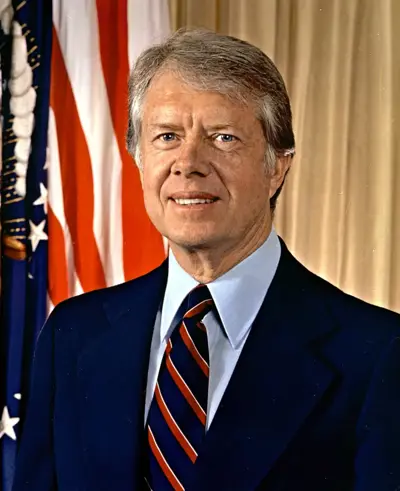
James Earl Carter Jr. is an American politician, businessman, and philanthropist who served as the 39th president of the United States from 1977 to 1981. A member of the Democratic Party, he previously served as a Georgia State Senator from 1963 to 1967 and as the 76th governor of Georgia from 1971 to 1975. Since leaving the presidency, Carter has remained engaged in political and social projects as a private citizen. In 2002, he was awarded the Nobel Peace Prize for his work in co-founding the Carter Center.
