Ron Paul Quotes
Though many will criticize the president for mis-steps in Iraq and at home, it is with the complicity of Congress that we have become a nation of pre-emptive war, secret military tribunals, torture, rejection of habeas corpus, warrantless searches, undue government secrecy, extraordinary renditions, and uncontrolled spying on the American people. Fighting over there has nothing to do with preserving freedoms here at home. More likely the opposite is true.
Ronald E. Paul, U.S. Congressman (Republican, TX), Libertarian Nominee for President, Getting Iraq War Funding Wrong Again, April 30, 2007
Sourced by: Eigen's Political and Historical Quotations


President George W. Bush, to justify the invasion of Iraq had told the public that the Iraqi regime was developing nuclear weapons and other weapons of mass destruction, and had participated in the September 11 attack on the United States by assisting Al Qaeda. It turned out that these statements were false. The administration claimed that their error was well intentioned and the result of faulty intelligence. Opponents claimed that the administration officials knew that they were exaggerating and had pressured the intelligence agencies to create intelligence conclusions that supported their story.


In addition to creating many protests from the public, the Bush administration was reprimanded by the Supreme Court which stated that the detention of an American Citizen as an enemy combatant. The administration must charge and try such an American for treason, assault, conspiracy or whatever crimes the facts substantiate. The administration could not just hold a citizen without due judicial processes. They certainly could not detain a citizen and then secretly or openly execute him/her without a trial, conviction, and sentence with all appeals exhausted.


This quotation is a good example of how tolerant some nations can be in terms of maintaining diplomatic relations and trade relations with other countries. The American and English governments chose to simply protest and condemn the slanderous statement but decided that the Prime Minister was pandering to his political local Islamic base, so took no further action and kept open diplomatic relations. Mahathir had a history of being very accusatory of the West with respect to anything that affected the Arab Muslims. The number of Muslims killed by the Americans and British in the Iraq War was very small compared to the huge number of Muslims killed by other Muslims in their Sunni Shiite civil war. While Bush and Blair both generated support for the Iraq invasion by making claims of WMD development in Iraq that were false, it is not clear whether or not they knew their statements were false, should have known that they were false, created an atmosphere against Iraq that was likely to produce false accusations, or were simple misled by poor intelligence. Mahathir, of course, chose to assume the worst case, and claim it was true, which is what many people think Bush and Blair did in analyzing the intelligence on Iraq.
Llewellyn H. Rockwell, Jr.


There are many who do not agree with Hayden’s thesis that there was a national consensus about the degree of compromise with Constitutional rights. It is the case that the 3 Presidents maintained a continuity, but there was no great outcry of public opinion for roundups and arrests of Muslims after 9-11. The government never at the time revealed the data on what they were doing. When that became public, it was clear that there was no consensus as was the case with torture. The military authorities who interned American Citizens of Japanese Origin argued that there was little public opposition but many citizens did not even know it was happening, and the ones who did, for the most part, thought that it was only the suspected saboteurs and spies who were interned, not American citizens who were suspected of nothing; not little children; not 90 year old men and women. When the facts were known Americans did form a national consensus—that it was one of the worst practices in which the United States ever engaged.

President George W. Bush, to justify the invasion of Iraq had told the public that the Iraqi regime was developing nuclear weapons and other weapons of mass destruction, and had participated in the September 11 attack on the United States by assisting Al Qaeda. It turned out that these statements were false. The administration claimed that their error was well intentioned and the result of faulty intelligence. Opponents claimed that the administration officials knew that they were exaggerating and had pressured the intelligence agencies to create intelligence conclusions that supported their story.

While this probably was a slip of the tongue, President Bush and governor Perry both had civil right and individual had rights as a lower priority than a individual responsibility, strong growth economy or the military. There were many who really believed that the two men really thought excessive personal reedom a problem that people and the government must be protected from, like freedom for a woman to choose an abortion. For Perry in particular many thought that if this was a slip of the tounge, it was likely a Freudian slip as it what he really wants.


This is a great example of Presidential stonewalling of Congress. The legislative branch is often exercising its oversight role and demanding executive department documents which for various reasons the President does not want the Congress to see. In this case, almost all attorneys would have said that the Congress was entitled to see the documents. This set a precedent of de facto Executive Privilege for war time. However, Congress very often has used their power of demanding documents for political and ideological reasons and not for the better functioning of the government. In the Eisenhower administration the concept of Executive Privilege was formalized to protect President Eisenhower and officials in the Executive Branch from the abuses and excesses of Joseph P. McCarthy who was a fanatic, ideologue and an alcoholic at the same time. See {595900}.

Abu Ghraib was the major prison in Iraq during the Iraq War. American military committed many crimes on prisoners ranging from murder to sexual humiliation. The actual perpetrators claimed that the higher ranks of officers knew what was ongoing and provided the policies, rules and culture of the prison. The president and the Vice President many thought were the officers responsible and violated the Uniform Code of Military Justice. Their administration had issued a legal memorandum that for the first time in American history would allow some kinds of torture of prisoners in the War on Terror. A few enlisted personnel were punished and a general was transferred but no senior military or civilian personnel were held responsible or punished.

Agree resigned from the CIA in protest to its political position.


Alberto Gonzalez, White House Counsel and later Attorney General who was forced to resign and David S. Addington, Counsel to the Vice President, had come up with a novel view of the powers of the presidency. They argued that since the President is the Commander in Chief, in a war situation or intelligence gathering thereto, has the Constitutional responsibility for that function, he need not obey any laws of Congress as in the conduct of the war Congress would be impinging on the Constitutional separation of powers which itself was prohibited by the Constitution. The argument did not find any significant legal support but for a while the George W. Bush White House behaved as if this were the law, despite the fact that even in the American Revolution and the War of 1812 Congress passed laws regulating the conduct of the armed forces as is provided for in other parts of the Constitution. Yet even Goldsmith would allow the President some powers that many think are unconstitutional and/or belong to Congress. See {32436}.


Abu Ghraib was the prison in Iraq where prisoners were brutalized and treated illegally and immorally. Seymour Hirsh was the Pulitzer Prize-winning investigative journalist who broke the story. Levy contrasted that where the Algerian War was full of such atrocities but French intellectuals and press would not publicize it. It didn’t stop for the whole war.


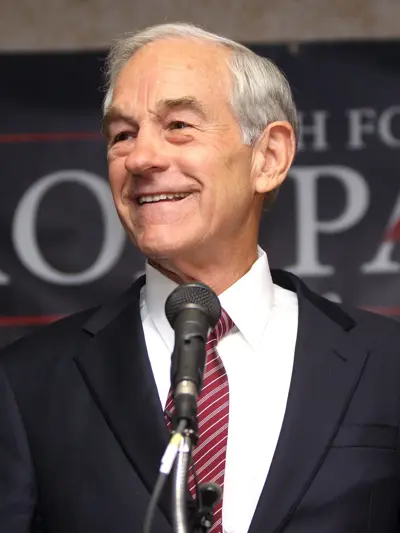
Ronald Ernest Paul is an American author, physician, and retired politician who served as the U.S. Representative for Texas's 22nd congressional district from 1976 to 1977 and again from 1979 to 1985, and for Texas's 14th congressional district from 1997 to 2013. On three occasions, he sought the presidency of the United States: as the Libertarian Party nominee in 1988 and as a candidate for the Republican Party in 2008 and 2012. A self-described constitutionalist, Paul is a critic of the federal government's fiscal policies, especially the existence of the Federal Reserve and the tax policy, as well as the military–industrial complex, the war on drugs, and the war on terror. He has also been a vocal critic of mass surveillance policies such as the USA PATRIOT Act and the NSA surveillance programs. He was the first chairman of the conservative PAC Citizens for a Sound Economy, a free-market group focused on limited government, and has been characterized as the "intellectual godfather" of the Tea Party movement, a fiscally conservative political movement that is largely against most matters of interventionism.
