Chuck Hagel Quotes
I certainly believe that we got into the Iraq War on an edifice of distortions.
In 2002, President George W. Bush, determined to invade Iraq and bring democracy to the Muslim Middle East, reported that Iraq had stockpiles of weapons of mass destruction and were very close to a nuclear bomb. They had even used biological weapons against Iran and the Kurdish minority in Iraq. The president claimed that the evidence was incontrovertible and removed those generals who questioned the wisdom of an Iraq invasion and besmirched the character and patriotism of those civilian officials and figures who questioned the evidence or its sources. After the invasion, it turned out that there were not only no stockpiles of WMD but there was no capability to manufacture WMD as had existed before the Gulf War. Bush claimed he was misled by the CIA and other intelligence operatives. It turned out that the Vice President and other administration officials only examined the intelligence which supported their justification for war.
Chuck Hagel, U. S. Senator (Republican, NB), Interview, NBC Meet the Press, July 8, 2007
Sourced by: Eigen's Political and Historical Quotations

President George W. Bush, to justify the invasion of Iraq had told the public that the Iraqi regime was developing nuclear weapons and other weapons of mass destruction, and had participated in the September 11 attack on the United States by assisting Al Qaeda. It turned out that these statements were false. The administration claimed that their error was well intentioned and the result of faulty intelligence. Opponents claimed that the administration officials knew that they were exaggerating and had pressured the intelligence agencies to create intelligence conclusions that supported their story.

Prior to this question, Thomas had not been called on at a White House press conference for 3 years. After it, she was again avoided.


The facts given by the administration to justify the preemptive invasion of Iraq turned out to be wrong. Moore who is usually not very circumspect in his accusations delicately used the term “misled” as the major debate became one or whether 1) the wrong intelligence was given to the President and his administration and they unknowingly used and reported the false information to the public. 2) the uncertainty of the intelligence accuracy and the contrary evidence was given to the administration which had a predisposition to believe one scenario and the deluded themselves and our allies and the public. 3) The decision to invade Iraq was made with full knowledge that the intelligence was wrong in some areas and weak in others and some administration members pressured the intelligence agencies to make the kind of assessment they administration wanted. “Misled” covers all 3 possibilities.

One of the major reasons that President George W. Bush had given for invading Iraq was that Iraq had weapons of mass destruction. None were found.

This quotation is a good example of how tolerant some nations can be in terms of maintaining diplomatic relations and trade relations with other countries. The American and English governments chose to simply protest and condemn the slanderous statement but decided that the Prime Minister was pandering to his political local Islamic base, so took no further action and kept open diplomatic relations. Mahathir had a history of being very accusatory of the West with respect to anything that affected the Arab Muslims. The number of Muslims killed by the Americans and British in the Iraq War was very small compared to the huge number of Muslims killed by other Muslims in their Sunni Shiite civil war. While Bush and Blair both generated support for the Iraq invasion by making claims of WMD development in Iraq that were false, it is not clear whether or not they knew their statements were false, should have known that they were false, created an atmosphere against Iraq that was likely to produce false accusations, or were simple misled by poor intelligence. Mahathir, of course, chose to assume the worst case, and claim it was true, which is what many people think Bush and Blair did in analyzing the intelligence on Iraq.

President George W. Bush, to justify the invasion of Iraq had told the public that the Iraqi regime was developing nuclear weapons and other weapons of mass destruction, and had participated in the September 11 attack on the United States by assisting Al Qaeda. It turned out that these statements were false. The administration claimed that their error was well intentioned and the result of faulty intelligence. Opponents claimed that the administration officials knew that they were exaggerating and had pressured the intelligence agencies to create intelligence conclusions that supported their story.

President George W. Bush, to justify the invasion of Iraq had told the public that the Iraqi regime was developing nuclear weapons and other weapons of mass destruction, and had participated in the September 11 attack on the United States by assisting Al Qaeda. It turned out that these statements were false. The administration claimed that their error was well intentioned and the result of faulty intelligence. Opponents claimed that the administration officials knew that they were exaggerating and had pressured the intelligence agencies to create intelligence conclusions that supported their story.

George W. Bush had told the country that the reason for the Iraq War was that Iraq had developed weapons of mass destruction. After the invasion it was determined that there were no such weapons that had justified the war. Debate since has concentrated in whether the Bush administration had pressured the intelligence experts to provide the information they wanted to justify the war or whether the administration was misled by their intelligence agencies.

See {618460} for the kinds of statements that stimulated this type of political attack.


She was attacking George W. Bush who had started the Iraq War on the pretext that Iraq had weapons of mass destruction, while Clinton lied over sex and although it violated the law by lying under oath, there were no injuries or deaths, while hundreds of thousands died as a result of the Iraq war. Bush claimed that he did not intentionally lie, but was mislead by poor intelligence estimates. See {583802} for another view opposing the impeachment which ended when Clinton was Easily acquitted.

Franks as the Commander of U. S. forces in the Iraq War always appeared to be in command of the forces and the facts and made an excellent impression and had a strong public image. But he was poor on the accuracy of his details and his optimism of the way the Iraq War and occupation were going were woefully misleading.

He was referring to the George W. Bush and his behavior on the Iraq War.


President Bush claimed that he authorized the invasion because Iraq had developed and were about to deploy weapons of mass destruction. After the invasion, there were no such weapons ever found. Some believe Bush had acted on bad intelligence; others argued that Bush and the neocoms had wanted to invade Iraq for other reasons, and used the bad intelligence knowingly and actually suppressed intelligence that contradicted the hypotheis of weapons readiness.
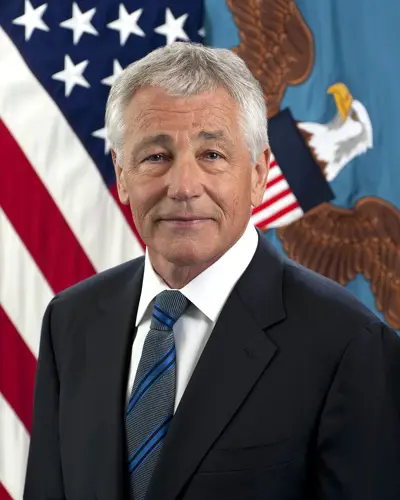
Charles Timothy Hagel is an American military veteran and former politician who served as a United States Senator from Nebraska from 1997 to 2009 and as the 24th United States secretary of defense from 2013 to 2015 in the Obama administration.
