Newt Gingrich Quotes
This is the most dangerous summit for the West since Neville Chamberlain met with Adolf Hitler in 1938
In this case, the Speaker of the House attacked the President of his own party for being willing to conduct disarmament discussions with the Russians. He implied that the outcome could be the appeasement of the Russians just as British Prime Minister Neville Chamberlain appeased Hitler in 1938 in Munich, giving the German Fuhrer the “green light” to take over Europe. The Conservative Caucus went even further and explicitly called it “appeasement”. Reagan however always talked about military strength and power, and provided plenty of money for the military and weapons a few of which were boondoggles but he was a very cautious American president in authorizing military force. And he not only was willing to discuss arms control and reductions and enter into treaties for disarmament, much to the distress of the hawks of his own party. Few American Presidents have so well balanced the use of diplomacy with the threat of military force as well as Reagan.
Newt Gingrich, U.S. Congressman (Republican, GA), Speaker of the House, Attack on President Ronald Reagan’s upcoming summit with Russian Premier Gorbachev meeting on arms reduction Speech, House of Representatives, 1983 (5)
Sourced by: Eigen's Political and Historical Quotations


The reference to Munich was to the famous appeasement of Adolf Hitler and the Nazis by British Prime Minister Neville Chamberlain. See {585941}.

The “fool” was Neville Chamberlain, 1869-1940, the British Prime Minister who refused to stand up to Hitler and instead negotiated a peace pact, returned home declaring that he had preserved peace. (See {585941}.) Then Hitler invaded more of Europe and WWII was begun. Ford was a Hitler admirer and pro-German (Hitler supported him for the American Presidency--{586988}—and awarded him a medal) but he thought that England had bungled the negotiations by sending someone who was very weak. In this sense his views were the same as most who were anti-Hitler.

After a reception given by Lady Astor, Channon wrote in his diary that the “Cliveden Set” {598323} would be criticized because it was in favor of the policy of appeasement. The name came from the seat of Lord and Lady Astor, who were both supporters of the policy. To some the policy was seen as pro-Hitler, but Channon saw it as reasonable and in concert with Neville Chamberlain’s views. Even so, Chamberlain’s policy of appeasement was very controversial. This very policy prevented early Allied involvement in World War II and therefore gave Hitler time to buildup the German military while invading much of Eastern Europe.


Neville Chamberlain is viewed in Britain as one of the worst appeasers of all time. He refused to fulfill the obligations of Great Britain when Hitler invaded parts of Europe. He appeased Hitler because he wanted to avoid war and is a historical icon of a person who would do anything to avoid war.


In addition to the men who feared communism so much that they ignored the then greater menace of Fascism, there was also a small but influential pro Fascist influence in England which included the King who was forced to abdicate as The Duke of Windsor.


This was the 14th part of the Japanese reply to a previously made American peace proposal. The Japanese policy was to unite all of Asia into a co-prosperity sphere controlled by Japan where Japan would militarily conquer those Asian countries which did not “voluntarily” want to join. The Japanese were in the process of conquering China and the United States and Britain had embargoed oil and other material to Japan trying to pressure them to withdraw their troops from China and cease Japanese conquest by force. Japan believed that it was their right to conquer and control Asia and it was beneficial to the region, and that the U. S. and Britain had no right to curtail the expansion that Japan required to assure raw materials and other necessities. At the very time that these negotiations were on going, the Japanese fleet was sailing for the sneak attack on Pearl Harbor. The attack took place the very day this part of the Japanese reply was received.

Both Hitler and Stalin were gross egomaniacs who each thought that they had gotten the better of things. The result was that 22 million Russians were killed and the industrial base if Russia Was destroyed. On the German side, the German military was virtually destroyed, many civilians were killed, the nation reduced to rubble and starvation, German leaders were killed, jailed or committed suicide including Hitler, and the country was occupied for years. Neither leader appeared very smart if one judges by the results.


Theodore Roosevelt was the Presidential nominee. Johnson was a leader of some members of Congress some of whom were extreme isolationists and some of whom were Nazi sympathizers and Hitler admirers. When the Japanese attacked Pearl Harbor later that year, Germany, fulfilling its treaty with Japan, declared war on America, Johnson’s group no longer mattered. Before WWII most Republicans were opposed to Defense Spending and accused the Democrats of being war hawks. After WWII, they flip flopped and became more hawkish than the Democrats who they accused of being soft on defense for years thereafter. See {631380} for President Roosevelt’s different view.

At first glance, the reader might think that this quotation in a leading university newspaper was from the Vietnam War era. However, it was argument against U. S. involvement in World War II. There was a very negative reaction to Wilson’s visions and claims for the First World War which never did come to pass that stuck with many.

The Scientific Project that developed the Atomic Bomb. He was a strong advocate for disarmament and that was being debated at the United Nations. He was critical of Bernard Baruch’s tactics but it soon was clear to almost all that the Russians were not interested in a serious UN supervised disarmament. Oppenheimer was profoundly disappointed when it was clear that disarmament was being blocked by the Russians and their veto. After that he didn’t trust the Russians, and concentrated on trying have US policies that would not goad the Russians into an arms race. This quotation is particularly important because in an effort to discredit his views on nuclear policy some politicians accused him of being a security risk with the innuendo that he was a communist and even a Russian agent.

He was discussing the conflict in the Ukraine between keeping their historical economic relationships with Russia and being more involved with Europe and the West. He observed that the Ukraine has been for centuries not only and integral part of Russia but played a huge role in the Russian Revolution of 1917. Kissinger urged Ukraine independence and relations with both Russia and Europe and not making the Russians feel that they have little or no influence over what was not very long ago a critical part of their country.

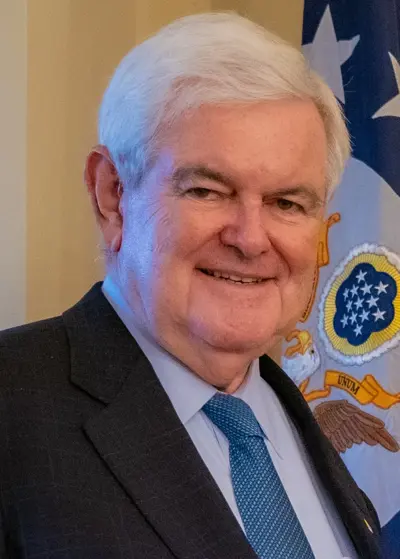
Newton Leroy Gingrich is an American politician and author who served as the 50th Speaker of the United States House of Representatives from 1995 to 1999. A member of the Republican Party, he was the U.S. Representative for Georgia's 6th congressional district serving north Atlanta and nearby areas from 1979 until his resignation in 1999. In 2012, Gingrich unsuccessfully ran for the Republican nomination for President of the United States.
