DONALD RUMSFELD
(Donald Henry Rumsfeld)

There was a major policy split between Secretary of State Colin Powell and the Vice President / Secretary of Defense. The latter, together with a number of neoconservatives, had been advocating invasion of Iraq and aggressive use of the military. Virtually all of these advocates had never served in the military and had no experience with war. Secretary Powell, in contrast, fought in Vietnam, was a General in the Gulf War, and served as Chairman of the Joint Chiefs of Staff. Wilkerson, his Chief of Staff at the State Department was also a senior military officer who had seen war and sent men into battle. They were much more reluctant to use military power unless the nation's vital interest demanded it. Hence, the quotation.


The three leading “hawks” of the administration and the architects of the Iraq War. However, not only had none of them ever been in combat, but none had ever served on active duty in the military. None of the three had been drafted or enlisted during the Vietnam war except for Bush who was accepted into the Texas Air National Guard; parts of his service record has been last, but he never was outside the United States. Murtha, John Kerry, John McCain and many of the administration's critics were all decorated war heroes who had been wounded in action.


They referred to the George W. Bush Administration. The Powell Doctrine, created by then Secretary of State when he was Chairman of the Joint Chief’s of Staff stated that if American Troops were ever to be used in combat, they should be deployed in massive overwhelming force and have a clear exit strategy. Powell lost the internal argument and was marginalized, but he turned out to be absolutely right.

It was almost unheard of for generals and retired generals to criticize the administration publicly, but the George W. Bush Administration polarized not only the country as a whole but the military as well.

The general’s view was that if the Secretary found something unacceptable in one of his direct subordinates, then there was something unacceptable about him as he supervised the man and approved of his work. Rumsfeld backed down.


Ford gave the confidential interview under the condition that it would not be made public until after he passed away. It was published by the Washington Post on December 26, 2006 just after Ford died. Ex-President’s are very reluctant to criticize a current President---especially on a foreign policy issue.

Although most listeners had to spend some time parsing this famous quote, it actually was not a new notion. See Copernicus in linked quotes.
The Israeli experience with the Muslims of Palestine, the U. S. in Afghanistan and Iraq showed that many Muslim terrorists not only take shelter from mosques but use them as weapons storage and shooting platforms. The Mullahs are either too weak to discourage the practice or support the terrorism.
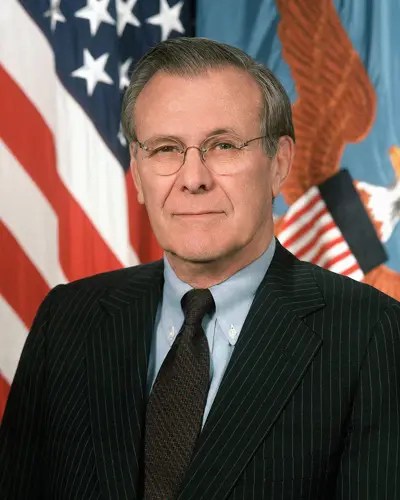
- Born: July 9, 1932
- Nationality: American
- Profession: Politician
Donald Henry Rumsfeld is a retired American politician. Rumsfeld served as Secretary of Defense from 1975 to 1977 under Gerald Ford, and again from January 2001 to December 2006 under George W. Bush. He is both the youngest and the second-oldest person to have served as Secretary of Defense. Additionally, Rumsfeld was a three-term U.S. Congressman from Illinois (1963–69), director of the Office of Economic Opportunity (1969–70), counsellor to the president (1969–73), the United States Permanent Representative to NATO (1973–74), and White House Chief of Staff (1974–75). Between his terms as Secretary of Defense, he served as the CEO and chairman of several companies.
