JOSEPH STALIN
(Joseph Vissarionovich Stalin)

The organization thought that Franklin D. Roosevelt was surrounded by and influenced by communists, and was destroying America for capitalism, when in reality it was Roosevelt who saved capitalism in America by leading the country out of the Great Depression without any revolution or insurgency and maintaining the basic structure of capitalism. They were so fearful of communism that most Americans thought paranoid and unrealistic. When Roosevelt trounced Alf Landon in the 1936 Presidential election, the Liberty League collapsed.

Mandelstam was later sent to a Soviet gulag for writing a poem denouncing Stalin. He died there.
Mandelstam was later sent to a Soviet gulag for writing a poem denouncing Stalin. He died there.

Truman had been briefed on the number of Japanese who committed suicide rather than surrender—including civilians—in Saipan, Okinawa, Iwo Jima, and other locations where United States troops had invaded. He and his experts agreed that the Japanese would not surrender unless there was a new dramatic factor that was outside the usual thinking—the atomic bomb. He was proved right about the warning. Not only did the Japanese ignore it, but they did not even surrender after the nuclear devastation at Hiroshima. It took a second bomb dropped on Nagasaki to motivate the surrender. So even a demonstration with all those Japanese casualties did not cause the surrender until it was repeated.


Djilas, who had fought against the Nazis and had witnessed the cruelty of both Hitler and Mussolini, nonetheless thought Stalin should deserved the title as the most infamous criminal in history.
Ironically Mandelstam was later sent to a Soviet gulag for writing a poem denouncing Stalin. He died there.
In the midst of World War II, FDR asked Wendell Wilkie, his former Presidential opponent, to make a fact finding, good-will tour to The Middle East and the Soviet Union. One plane stop on the tour was in Mongolia where the local communist leader had been instructed by Stalin to care for Willkie’s safety. The quotation is very important becasue it illustrated Stalin's method of control and administration: Liquidate (murder) those whose attitude or performance was not to his satisfaction. Unfortunately, even though Willkie wrote of this incident, no one in America--especially not the Media--picked up on this. This was about 20 years before the world learned of Stalin's "liquidations". In the inerim many idealists in America and the rest of the world, became or flirted with Communists as they knew the good and the worst of the bad had not been public knowledge.

Vladimir Lenin. Although Lenin’s letter was given to the Central Committee by his wife, it was not read or debated at the Congress and Stalin was elected.

Accusing her of being a fellow traveler with Communist sympathies, Nixon called her "the Pink Lady" and said she was "pink right down to her underwear." See {627826} and {619498}. Douglas and her campaign thought the accusations were so absurd that at first they did not even bother to respond. Nixon repeated the them and stayed “on message” and by the time that Douglas, who had opposed communism all her life, was believed to be one or at least a “fellow traveler” by most Californians—and finally she responded with statements like this, but it was way too late to turn public perception around. She awarded Nixon the derogatory nickname “Tricky Dick” which the majority of the public used for him throughout his career--{600036}.

Vladimir Lenin. Ironically it was Lenin who was among the first Russian leaders to recognize Stalin’s shortcomings. However, it turned out to be too late. He had enough strength and power in Russia to withstand attempts to depose him.

Wallace had been a supporter of Russia throughout WWII and thought that on balance the Russian Revolution was a constructive historical event. He was very naive naïve the excess of Stalin and thought that the reports of his atrocities and excesses were propaganda. However, when he found out the truth about Stalinist Russia, he became an anti-Communist, and wrote this book. He also supported Dwight D. Eisenhower for President which added to some of the radical right wing distrust of Eisenhower.

Lev Davidovich Bronstein

During the Cold War, Yugoslavia was a part of the Eastern Communist Bloc, but was very independent. They had a very experienced military and were the one country of the Eastern Bloc who the Russians could not easily militarily dominate. Tito was a great and feared military leader having killed More Germans per soldier with his army than any of the Allies in WWII. He was also very independent of Moscow and would not follow Russia directives. The Russians decided on assassinating Tito but the attempts failed.


Churchill put great store in personal interaction in diplomacy.

Even leading Soviet officials were critical of the Stalin era and Stalin’s brutal, dictatorial methods.


He served as a liaison with the Russian military officers after WWII. As a result he developed friendships with some who told him much about Stalin.

Seeger had joined the Young Communist League as a young boy, and was a supporter of Joseph Stalin until all the information about Stalin was made public by Russian Premier Nikita Khrushchev. Seeger, along with other Stalin apologists throughout the world realized that the criticisms of Russian Communism under Stalin were not just right wing propaganda.
Seeger’s admission was typical of tens of thousands of Americans who had become disillusioned with the fairness, equity, and effectiveness of capitalism during the depression. They were easy prey for Communist propaganda which pointed out all the problems in American society from legal racial discrimination to lack of a social safety net while at the same time lying about the Russian achievements and hiding the horrible abuses of human rights—especially the political murders of millions of people. Then the truth about Russia emerged, Seeger and so many others abandoned the Communist Party as at the same time America was improving its society and beginning to try and deal with the great problem that had plagued America from its inception—racism and slavery.

So many Afghans thought very differently and resisted Amin’s Government and the Russians, that the Russians pulled out of Afghanistan.

The Russian troops, killed more Germans and liberated more territory than the rest of the Allies together. They also suffered many more casualties than the rest of the Allies.

Communists had different reactions to the atrocities committed by Stalin. Many, like Buck condemned it and remained committed to Communism. Others, were so outraged that the left the party and had no more to do with Communism. Others were in denial and did not believe it. Still others acknowledge the crimes but consider Stalin, on balance a positive force. A few concluded that what Stalin did was necessary for Communism and the Soviet Union to develop.

Even when Russia was coming to grips with Stalin’s crimes against humanity, Hoxna was still an apologist for the Soviet Dictator, whose “mistakes” cost millions of lives.

Harriman at that time was the United States Ambassador to Russia and one of President Roosevelt’s closest advisers. There were those who claimed that the Roosevelt administration was very naïve about the potential danger of Stalin. This statement as well as others like it, show that the administration was not so naïve and ignorant.


There's no proof that Stalin ever said this, but if he did, he would likely have been quoting a 1932 essay on French humor by the German journalist, satirist, and pacifist Kurt Tucholsky who wrote in a fiction story: "The war? I cannot find it to be so bad! The death of one man: this is a catastrophe. Hundreds of thousands of deaths: that is a statistic!".
Although this is generally attributed to Stalin, there is no writing of his that has the quotation. So some believe that this quotation is apocryphal.
{627488} is an earlier quotation by a French Diplomat of very similar sentiment, but it is not known if Stalin had ever seen it. Also See Beilby Porteus {627489} for an 18th century variation. This is a puzzling phenomenon. In the United States if there is a plane crash and a hundred people are killed, it is page one and television lead news. But between 40,000 and 50,000 Americans die each year, one or two at a time in auto crashes, and it does not seem to be news. More American college students commit suicide (about 1200 a year) then are killed in mining or other industrial accidents, but the former we rarely hear about.
Some analysts believe that this may have been literally true, given his brutal record thereafter.
There's no proof that Stalin ever said this, but if he did, he would likely have been quoting a 1932 essay on French humor by the German journalist, satirist, and pacifist Kurt Tucholsky who wrote in a fiction story: "The war? I cannot find it to be so bad! The death of one man: this is a catastrophe. Hundreds of thousands of deaths: that is a statistic!".
Although this is generally attributed to Stalin, there is no writing of his that has the quotation. So some believe that this quotation is apocryphal.
Russia suffered enormous casualties in WWII where over 20 million Russians were killed. None the less, at the end of the war Europe was devastated with no viable economy. The fascist states and the democracies were all devastated. But Russia was still functioning. Instead of crediting the enormous Russian land mass, the success of the Russian Army, and the enormous amount of aid that the U. S. had provided, Stalin concluded that the reason was the Soviet Communist System.
Stalin was an avid reader.
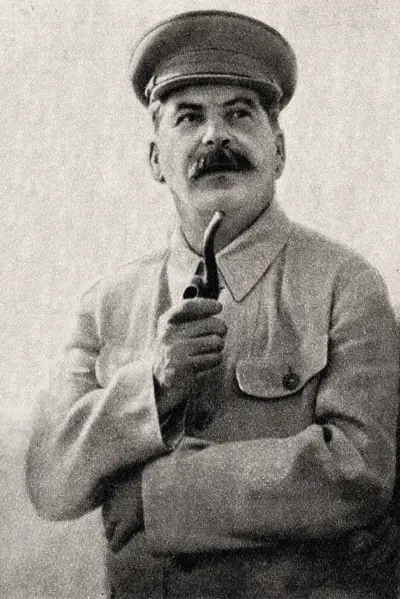
- Born: December 18, 1878
- Died: March 5, 1953
- Nationality: Russian, Georgian
- Profession: Leader
Joseph Vissarionovich Stalin was a Georgian revolutionary and the ruler of the Soviet Union from 1927 until 1953. He served as both General Secretary of the Communist Party of the Soviet Union (1922–1952) and Chairman of the Council of Ministers of the Soviet Union (1941–1953). Despite initially governing the country as part of a collective leadership, he ultimately consolidated power to become the Soviet Union's de facto dictator by the 1930s. A communist ideologically committed to the Leninist interpretation of Marxism, Stalin formalized these ideas as Marxism–Leninism while his own policies are known as Stalinism.
