Joseph Stalin Quotes
World War II proved our Soviet system to be a better form of organization of society than any non-Soviet social system.
Russia suffered enormous casualties in WWII where over 20 million Russians were killed. None the less, at the end of the war Europe was devastated with no viable economy. The fascist states and the democracies were all devastated. But Russia was still functioning. Instead of crediting the enormous Russian land mass, the success of the Russian Army, and the enormous amount of aid that the U. S. had provided, Stalin concluded that the reason was the Soviet Communist System.
Joseph Stalin, 1879-1953, Russian Premier, Speech, Moscow, February 8, 1946
Sourced by: Eigen's Political and Historical Quotations

Harriman at that time was the United States Ambassador to Russia and one of President Roosevelt’s closest advisers. There were those who claimed that the Roosevelt administration was very naïve about the potential danger of Stalin. This statement as well as others like it, show that the administration was not so naïve and ignorant.


Russian Tanks moved into Prague and returned “order” ending the reform. Dubcheck was arrested and flown to the Soviet Union.

This was the origin of the ultra right wing British Fascistic.

Browder, had been prohibited by Court Order from touring the country during the 1940 Presidential Campaign. He personally blamed FDR although the Communist vote was so small that no matter where and how Browder campaigned it would not have made any difference. However, the court order gave Browder the opening leading some to believe that the communist following was larger than it was—why else would the establishment want to keep the campaign limited?


FDR was right about Russia being a major factor in stopping Hitler, but partially wrong about the danger of Russia. The Soviets never did dominate Europe although the tried, but they did dominate Eastern Europe.


Seeger had joined the Young Communist League as a young boy, and was a supporter of Joseph Stalin until all the information about Stalin was made public by Russian Premier Nikita Khrushchev. Seeger, along with other Stalin apologists throughout the world realized that the criticisms of Russian Communism under Stalin were not just right wing propaganda.

This was a very important quotation in that Sartre was a very influential liberal philosopher and when he condemned Russian communism, many other liberals opposed communism, and those who had already felt vindicated in their decision.

In 1918 the Treaty of Versailles—peace treaty ending WWI—was signed. Many Germans felt that their defeat in WWI forced them to sign the treaty which weakened Germany and assured that they would be a 2nd rate power thereafter. After that Germans blamed every negative aspect of their government, economy and society on the treaty that was “forced” on them. Nazism was a consequence of these feelings, and the Nazis adopted policies and practices to get around their anti-military obligations and have a strong government so that the allies could not enforce the treaty obligations on Germany.


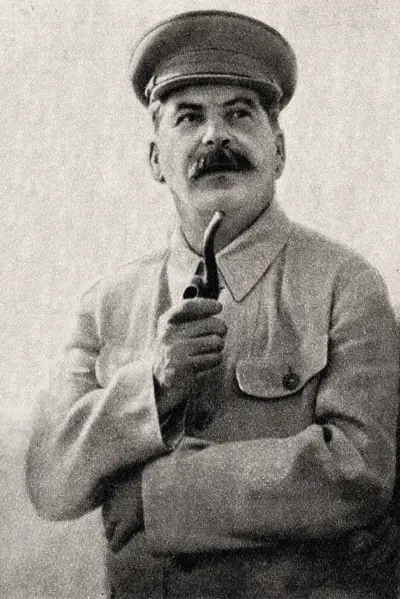
Joseph Vissarionovich Stalin was a Georgian revolutionary and the ruler of the Soviet Union from 1927 until 1953. He served as both General Secretary of the Communist Party of the Soviet Union (1922–1952) and Chairman of the Council of Ministers of the Soviet Union (1941–1953). Despite initially governing the country as part of a collective leadership, he ultimately consolidated power to become the Soviet Union's de facto dictator by the 1930s. A communist ideologically committed to the Leninist interpretation of Marxism, Stalin formalized these ideas as Marxism–Leninism while his own policies are known as Stalinism.
