Vladimir Lenin Quotes
Our involvement in this war is treason to the interests of international socialism.
Vladimir Lenin
Nikolai Lenin, 1870-1924, Russian Communist Premier, Debate with Alexander Karensky, Pan-Russian Congress of All Councils of Workmen’s and Soldiers, June 16, 1917
Sourced by: Eigen's Political and Historical Quotations


See the American ambassador’s assessment after the war began {41089}


The Dixie Chicks were a female country singing group that originated in Dallas, Texas. The right wing supporters of President Bush were incensed, and the conservative Talk Show hosts pilloried Maines and the singing group in general. Ironically many of the same conservative pundits who so castigated the Dixie Chicks for their anti-war and anti-president rhetoric several years later were themselves attacking Bush and his Iraq War with far greater intensity and reach than the one small singing group–The Dixie Chicks. This quotation also gives us insight into the Tea Party and ultra Conservatives who were vehement and totally committed to attacking their enemies but who, in a short period of time, could totally flip flop as to who their enemies were. They were quick to jump onto bandwagons, loud and vigorous while they were on, but also quick to jump off.

Russia suffered enormous casualties in WWII where over 20 million Russians were killed. None the less, at the end of the war Europe was devastated with no viable economy. The fascist states and the democracies were all devastated. But Russia was still functioning. Instead of crediting the enormous Russian land mass, the success of the Russian Army, and the enormous amount of aid that the U. S. had provided, Stalin concluded that the reason was the Soviet Communist System.


Vladimir Lenin


He was thrown out of the Labour Party for his pro Cold War and Soviet statements.
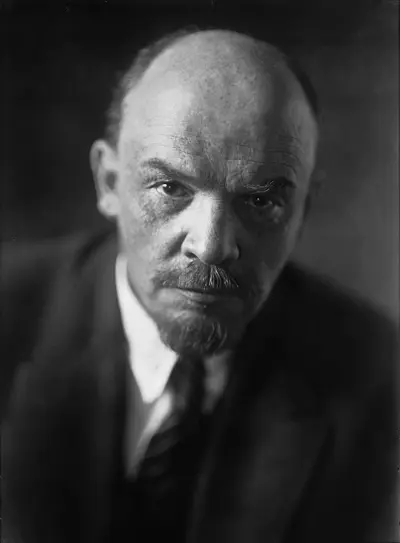
Vladimir Ilyich Ulyanov, better known by his alias Lenin, was a Russian revolutionary, politician, and political theorist. He served as the first and founding head of government of Soviet Russia from 1917 to 1924 and of the Soviet Union from 1922 to 1924. Under his administration, Russia, and later the Soviet Union, became a one-party socialist state governed by the Soviet Communist Party. A Marxist, he developed a variant of this communist ideology known as Leninism.
