JOSIP BROZ TITO
(Josip Broz)

During the Cold War, Yugoslavia was a part of the Eastern Communist Bloc, but was very independent. They had a very experienced military and were the one country of the Eastern Bloc who the Russians could not easily militarily dominate. Tito was a great and feared military leader having killed More Germans per soldier with his army than any of the Allies in WWII. He was also very independent of Moscow and would not follow Russia directives. The Russians decided on assassinating Tito but the attempts failed.
Tito did a marvelous job of keeping the lid on the ethnic hatred that was always present. Where he failed however was that as soon as Tito died, the ethnic groups were literally at each others’ throats.
While he disagreed with Russian policies in any cases, he kept his criticism private but strove to maintain Yugoslavia as a Socialist state and part of the Soviet lock but independent. As his policies more and more deviated from Russian policies, Stalin tried to have Tito assassinated as Tito had his own independent policies on relations with the West.
The Nazis occupied the cities, but the partisans survived in the mountains. The resistance was ferocious and very effective. From a German Soldier’s point of view, the Yugoslav front was the most dangerous assignment where his odds of being killed was even greater than the Russian front.
Tito often did not support Soviet policies, but in the case of the Hungarian Revolution he did. He saw Hungary was split into pro and anti Communist factions in the midst of the Cold war. He and the Russians feared that if the Hungarians were allowed to settle their own dispute, there would be a protracted civil war with neither side strong enough to win rapidly. If this happened, the Russians were treaty bound to provide arms and other assistance to the Communist Hungarian government. And if they did so, it was very likely that NATO and the United States would supply similar assistance to the Hungarian Revolutionaries. The result would surely involve enormous loss of Hungarian lives on both sides, and the clear risk of an East West clash that would lead to a World War that might be nuclear. Russian troops and tanks rolled into Hungary and the conflict was over in a few days with very little loss of life. Therefore, even though Hungary lost its independence and freedoms, it was a necessary evil in Tito’s view.
Although the Yugoslav casualties were horrific, they inflicted great casualties on the Germans who lost more men fighting the Yugoslavs than they lost to any other of the allies except the Russians.
After WWII the United States provided food aid to much of Western Europe and offered it to some of the Eastern European Russian dominated countries as well. Russia would not allow them to accept American aid, but Tito of Yugoslavia was very independent and although his nation was socialist, he exported manufactured goods to the West and was happy to accept American aid. During the Cold War, Yugoslavia was doing business with America and other Western nations. A large proportion of all the school desks in America were manufactured in Yugoslavia much the distress of the Russians.
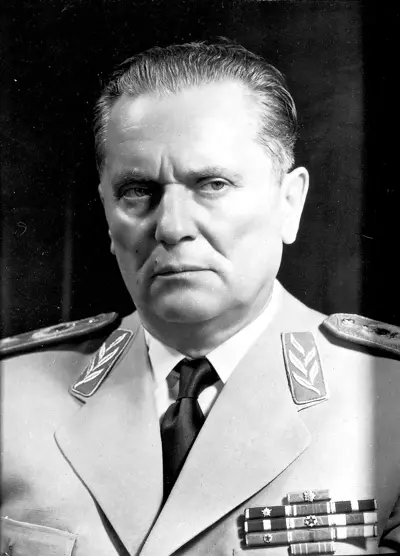
Josip Broz, commonly known as Tito (/ˈtiːtoʊ/; Serbo-Croatian Cyrillic: Тито, pronounced [tîto]), was a Yugoslav communist revolutionary and statesman, serving in various roles from 1943 until his death in 1980. During World War II, he was the leader of the Partisans, often regarded as the most effective resistance movement in occupied Europe. He also served as the president of the Socialist Federal Republic of Yugoslavia from 14 January 1953 until his death on 4 May 1980.
