Josip Broz Tito Quotes
In the new, socialist Yugoslavia the existing equality of rights for all nationalities has made it impossible for one national group to impose economic exploitation upon another. That is because hegemony of one national group over another no longer exists in this country. Any such hegemony must inevitably bring with it, to some degree or other, in one form or another, economic exploitation; and that would be contrary to the principles upon which socialism rests. Only economic, political, cultural, and universal equality of rights can make it possible for us to grow in strength in these tremendous endeavours of our community.
Tito did a remarkable job of suppressing the historical ethnic and religious strife among the nationalities and religious groups of Yugoslavia. Hatred and the thirst for “justice”, nationalism, and vengeance went back 1000 years in the Balkans. However, when Tito died, Yugoslavia collapsed in a resumption of the traditional inter-ethnic hatred and violence.
Josip Broz Tito, 1892-1980, President of Yugoslavia, Speech held at the Slovene Academy of Arts and Sciences, Ljubljana, November 26, 1948
Sourced by: Eigen's Political and Historical Quotations

See {626594} for Polk’s negative view of delegation of any authority or responsibility.

Tito did a marvelous job of keeping the lid on the ethnic hatred that was always present. Where he failed however was that as soon as Tito died, the ethnic groups were literally at each others’ throats.
Tito did not realize how right he was. The class issues were relatively easy to resolve into a unified nation, but the ethnic, national, and religious difference and historical hatreds and conflicts were held together during Tito’s lifetime, as he was a very strong leader committed to multiculturalism and imposed it on all of Yugoslavia. However, when he did in 1980, Yugoslavia rapidly flew apart into ethnocentric independent cultures which then went to war with each other.


After Independence, the original credo of the Indonesian hero and leader was slowly ignored. The Muslim majority established Islam as the dominant religion and began to create laws that discriminated against Christians, Hindus, Buddhists, and Jews. The ethnic Chinese had been very successful in business and commerce and soon they were discriminated against and even physically attacked in Pogroms.

Whenever different ethnicities perceive that they are in a “zero sum game” situation where one group cannot benefit without detriment to others, the situation is always unstable and usually explodes as when Yugoslavia broke apart at the end of the 20th century after being held together by a strong leader, Tito. Note that there was a different spelling of Yugoslavia in the 1920s. The pronunciation was the same.
He was a brutal, sadistic war criminal who was assassinated by one of his many enemies in 2000 before he could be brought to trial.


He was one of those arguing for tha nation to award every American 15 pounds upon reaxhing the age of 18, This would allow the young man (it is not clear that this applied to females as well) to buy a basic start in life. A houirse, a gun, and the ability to buy a small plot of land. The proposal got lost in the events of the Revolution. The ancient middle age Jews had a custom whereby when a young man reached the age of 13, and could demonstrate that he was literate, and familiar with the Torah (1st 5 Books of the Old Testament which was for them the "law", he would be given gifts by his relatives and often the comminithy or congregation as a whole, so taht he had the wherewithall to start an adult life. Many of the founding fathers were very familiar with the Ancient Jewish Republic and some adopted a version of this.]


This is one of the most idealistic and hopeful statements ever constructed by man. It was ironic that UNESCO which began with so much principle and hope became corrupt and even moved into the political arena taking positions on international disputes which was at odds with the Security Council.

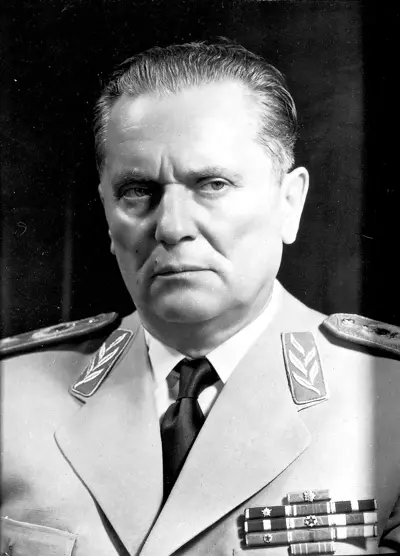
- Born: May 7, 1892
- Died: May 4, 1980
- Nationality:
- Profession: Machinist, Revolutionary, Resistance Commander, Statesman
Josip Broz, commonly known as Tito (/ˈtiːtoʊ/; Serbo-Croatian Cyrillic: Тито, pronounced [tîto]), was a Yugoslav communist revolutionary and statesman, serving in various roles from 1943 until his death in 1980. During World War II, he was the leader of the Partisans, often regarded as the most effective resistance movement in occupied Europe. He also served as the president of the Socialist Federal Republic of Yugoslavia from 14 January 1953 until his death on 4 May 1980.
