Josip Broz Tito Quotes
Comrade Khrushchev often repeats that Socialism cannot be built with American wheat. I think it can be done by anyone who knows how to do it, while a person who doesn't know how to do it cannot build Socialism even with his own wheat. Khrushchev says we live on charity received from the imperialist countries ... What moral right have those who attack us to rebuke us about American aid or credits when Khrushchev himself has just tried to conclude an economic agreement with America?
After WWII the United States provided food aid to much of Western Europe and offered it to some of the Eastern European Russian dominated countries as well. Russia would not allow them to accept American aid, but Tito of Yugoslavia was very independent and although his nation was socialist, he exported manufactured goods to the West and was happy to accept American aid. During the Cold War, Yugoslavia was doing business with America and other Western nations. A large proportion of all the school desks in America were manufactured in Yugoslavia much the distress of the Russians.
Josip Broz Tito, 1892-1980, President of Yugoslavia, Quoted in Jasper Ridley, Tito: A Biography
Sourced by: Eigen's Political and Historical Quotations

The British suspected that the Turks of Anatolia were complicit with Bolshevism

This is an example of what made the Cold War so difficult. The Italian Communists had great misgivings about the Russian version of Communism that tended to abuse human rights and try and control other countries. However, when the Russian Communists were under world attacks by the West, as with their incursion into Hungary, he urged that all the Communists stick together and defend the Russians even for policies that they thought wrong. On the West side, the same thing occurred. The United States tolerated and supported a number of terribly oppressive dictatorships that were virulently anti-Communist. Polarization was the international norm.

The issue of unilateral or multilateral foreign policy efforts faced America after WWII.


In 1980 Russian troops moved into Afghanistan, and President Jimmy Carter imposed an American grain export embargo against Russia:


This was an incredible prediction with no other world leader thinking it possible for decades until that is exactly what happened.

This statement became known as "The Truman Doctrine." Truman asked for $400 million to help Greece and Turkey fight stave off armed Communist minorities destabilizing their governments.

This became known as the Brezhnev Doctrine.
Truman had to deal with Stalin for many years and over time he became more and more soured on the Russians. See {626411} for his view 22 years later,

Tito often did not support Soviet policies, but in the case of the Hungarian Revolution he did. He saw Hungary was split into pro and anti Communist factions in the midst of the Cold war. He and the Russians feared that if the Hungarians were allowed to settle their own dispute, there would be a protracted civil war with neither side strong enough to win rapidly. If this happened, the Russians were treaty bound to provide arms and other assistance to the Communist Hungarian government. And if they did so, it was very likely that NATO and the United States would supply similar assistance to the Hungarian Revolutionaries. The result would surely involve enormous loss of Hungarian lives on both sides, and the clear risk of an East West clash that would lead to a World War that might be nuclear. Russian troops and tanks rolled into Hungary and the conflict was over in a few days with very little loss of life. Therefore, even though Hungary lost its independence and freedoms, it was a necessary evil in Tito’s view.
While he disagreed with Russian policies in any cases, he kept his criticism private but strove to maintain Yugoslavia as a Socialist state and part of the Soviet lock but independent. As his policies more and more deviated from Russian policies, Stalin tried to have Tito assassinated as Tito had his own independent policies on relations with the West.

This quotation illustrates White’s extreme naivety about Stalinist Russia. At the time the Soviet Union had been backing communist insurgencies blatantly in China, Greece, and Korea for example. Most historians agree that White passed classified information to the Russians. He was accused of being a Communist, but there was never any evidence of that. Some people believe that he was a spy for the Russians and committed espionage, but others disagree observing that White was very much his own man and felt that much information that was classified never should have been. White substituted his own judgment, it is believed, about what could be given to the Russians. He was an admirer of what Russian socialism had accomplished economically, educationally and medically since the 1917 revolution deposing the Czar. Russia had been a valuable military ally, which had taken the brunt of both military and civilian casualties in WWII. White’s economics were certainly not Marxist but very much Keynesian. He was subpoenaed by the House Un-American Activities Committee where he was accused of being a Communist which he denied (see {634907}). He died of a heart attack 3 days later.


Vladimir Lenin. While Lenin was of this view, Stalin and other hard liners disagreed. They not only imposed their brand of communism on their own people via force with terrible consequences for any dissidents, but the Soviet Army imposed Communism on most of the states of Eastern Europe, and those states in turn used their Armies and secret police to impose it on their own citizens.

After the 1917 Russian Revolution many of the Western Countries sent troops to Russia where they aided the Whites against the Reds. When the Red Bolsheviks prevailed, there were many attempts to diplomatically and economically undermine the Communist government. This caused a unity among different Russian factions. Sforza urged leaving them alone and letting the Bolsheviks fail by their own ideology. Most Western nations and the United States did not agree with him.

This was much less a treaty of how the two nations would interact with each other, than a joint statement to the world of opposition to any nation interfering with the internal affairs of another country.

Cuba was not Communist under Castro in the Russian style of Communism. However, Castro operated Cuba with many of the key Marxist & Leninist Communist Principles {636672} (some of which the Russians were hypocritical about). Cuba was very much a Marxist, Socialistic State with few of the democratic reforms that characterized European Socialism. Until the collapse of the Soviet Union, Russian Communist aid propped up the Cuban economy, and that was another motivation for Castro not to criticize Russian Communism so he often appeared to be in agreement with Russian Communism even when he wasn't.

Some on the extreme left of the Labor Party at the time were extolling Soviet Russia while denigrating the United States. Crossman, an avid socialist thought that was absurd and said so at every opportunity. The pro Soviet wing of the Labour party got smaller and smaller. He and many others thought that Russian Communism was a very poor implementation of socialist ideas.

Ironically, at the time she wrote this column, Mrs. Roosevelt was being accused of being a communist by some Southerners who associated her strong views against racism and segregation. Some in the North thought she was a communist because of her active role in the New Deal, Yet here she was, willing to use military force to prevent Soviet expansion.

This was a big factor that made the Red Scare so damaging.

Many Americans were paranoid about Democratic Socialism being a stalking horse or front organization for Communists. Similarly, many Socialists were paranoid that the American and European (and other) capitalists were out to destroy them in their conflation of socialism and communism.

All of Europe and the US and the other industrial democracies wanted South Africa to end apartheid and allow majority rule. Many had imposed strong economic sanctions upon the Apartheid nation. Botha, and most of the other Afrikaners, believed that Nelson Mandala and the Blacks were all communists or under the control of the communists, and that ending apartheid would turn South Africa into a Communist Country. Of course that was a paranoid fantasy as all movements for racial or ethnic equality are accused of being communists just as in the American South. When majority rule finally came to South Africa, it showed just how wrong the Afrikaners were as there has been a small communist movement in South Africa which has like the Italian communists functioned but had very little power or influence.

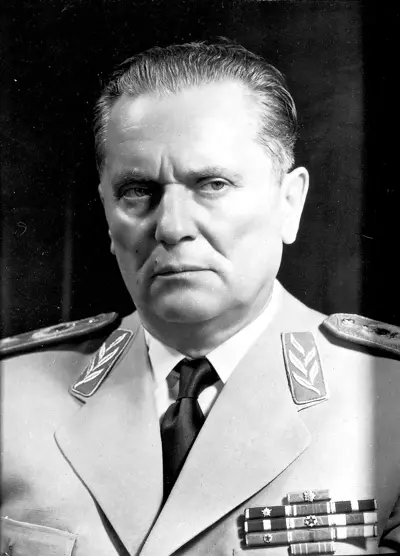
Josip Broz, commonly known as Tito (/ˈtiːtoʊ/; Serbo-Croatian Cyrillic: Тито, pronounced [tîto]), was a Yugoslav communist revolutionary and statesman, serving in various roles from 1943 until his death in 1980. During World War II, he was the leader of the Partisans, often regarded as the most effective resistance movement in occupied Europe. He also served as the president of the Socialist Federal Republic of Yugoslavia from 14 January 1953 until his death on 4 May 1980.
