Harry S. Truman Quotes
The Russians are like us, they look and act like us. They are fine people. They got along with our soldiers in Berlin very well. As far as I am concerned, they can have whatever they want just so they don't try to impose their system on others..
Truman had to deal with Stalin for many years and over time he became more and more soured on the Russians. See {626411} for his view 22 years later,
Harry S Truman, 1884-1972, 33rd President of the United States (Democrat, MO), Statement to a group of Congressional freshmen, July 2, 1947
Sourced by: Eigen's Political and Historical Quotations

Truman had to deal with Stalin for many years. In earlier days he had a much more favorable view of the Russians. See {626410} for his view 22 years earlier.


During the Cold War and afterwards many Americans attributed the problems we were having with the Soviet Union emenated from the fact that they were Communists, and our focus was anti-communism. Kennen, however argued that it was not Communism that was the cause of the Aggression of the Soviet Union. It was an extension of the Russian Culture. After the Soviet Union collapsed, and Communism was rejected by the Russians, we still had a great deal of Russian aggression and Foreign Policy problems with Russia. Kennan was right. It was the Russian culture, history, values and traditions that were the primary cause of most of the problems with Russia.


The British suspected that the Turks of Anatolia were complicit with Bolshevism


The then Attorney General had established a back channel to the Russian agent. There was genuine fear by the Russians and some in America that there were still many Nazis and German nationalists who would try and influence, if not take over, German politics to produce another aggressive German fascist state. The Russians had lost 22 million citizens to the Germans in the war and had faced a defeated Germany where virtually every German over the age of 30 had been cheering for and supporting Hitler a decade ago. Neither the Russians nor we and the other allies had not yet seen the remarkable turn-around that the German nation would make and the intense anti-fascist, non-military ethos that would be brought by the younger German generations. The direction of Germany was then very unpredictable.

At the end of WWII there was much tension between Russia and the Anglo-American alliance. This plan was developed but never implemented. See {613195} for Prime Minister Winston Churchill’s description of the invasion idea.


at the end of World War I 1st Earl Lloyd-George of Dwyfor

After the 1917 Russian Revolution many of the Western Countries sent troops to Russia where they aided the Whites against the Reds. When the Red Bolsheviks prevailed, there were many attempts to diplomatically and economically undermine the Communist government. This caused a unity among different Russian factions. Sforza urged leaving them alone and letting the Bolsheviks fail by their own ideology. Most Western nations and the United States did not agree with him.

Many Americans were paranoid about Democratic Socialism being a stalking horse or front organization for Communists. Similarly, many Socialists were paranoid that the American and European (and other) capitalists were out to destroy them in their conflation of socialism and communism.


This quotation illustrates White’s extreme naivety about Stalinist Russia. At the time the Soviet Union had been backing communist insurgencies blatantly in China, Greece, and Korea for example. Most historians agree that White passed classified information to the Russians. He was accused of being a Communist, but there was never any evidence of that. Some people believe that he was a spy for the Russians and committed espionage, but others disagree observing that White was very much his own man and felt that much information that was classified never should have been. White substituted his own judgment, it is believed, about what could be given to the Russians. He was an admirer of what Russian socialism had accomplished economically, educationally and medically since the 1917 revolution deposing the Czar. Russia had been a valuable military ally, which had taken the brunt of both military and civilian casualties in WWII. White’s economics were certainly not Marxist but very much Keynesian. He was subpoenaed by the House Un-American Activities Committee where he was accused of being a Communist which he denied (see {634907}). He died of a heart attack 3 days later.


Like many in the 1920s, Dewar saw the Communist Soviet Union as the biggest potential risk to peace. However, although the Russian leaders constantly castigated the West, they did not have a large military, and were for the most part highly anti-war as they saw war as the product of Capitalistic competition and the tool of the aristocracy. They had little military equipment and almost no training or officer corps with which to build any Army. Germany in contrast had the skill, experience, officers, a history of aggression, and huge resentment over what they considered their humiliating WWI defeat and peace terms. They would start WWII, not Russia.


This was only 6 years after the Russian Revolution. Communist Russia had extended its influence to much of the world without firing a shot. To many, communism looked like the future. The Russian inability to make communism work economically in the next 70 years destroyed most of its influence.
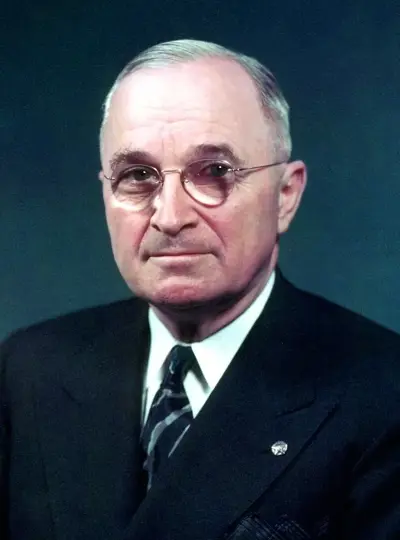
- Born: May 8, 1884
- Died: December 26, 1972
- Nationality: American
- Profession: President
Harry S. Truman was an American politician who served as the 33rd President of the United States (1945–53). He served as a United States Senator from Missouri (1935–45) and briefly as Vice President (1945) before he succeeded to the presidency on April 12, 1945 upon the death of Franklin D. Roosevelt. He was president during the final months of World War II, and approved the plan to drop atomic bombs on Hiroshima and Nagasaki. Truman was elected in his own right in 1948. He presided over an uncertain domestic scene as America sought its path after the war and tensions with the Soviet Union increased, marking the start of the Cold War.
