NEVILLE CHAMBERLAIN
(Arthur Neville Chamberlain)

In addition to the men who feared communism so much that they ignored the then greater menace of Fascism, there was also a small but influential pro Fascist influence in England which included the King who was forced to abdicate as The Duke of Windsor.

This was very much a minority opinion at the time, and has much historical significance as he was the father of the British Prime Minister, Neville Chamberlain, 1869-1940, whose appeasement of Germany led to Word War II. . See {585941}.


The “fool” was Neville Chamberlain, 1869-1940, the British Prime Minister who refused to stand up to Hitler and instead negotiated a peace pact, returned home declaring that he had preserved peace. (See {585941}.) Then Hitler invaded more of Europe and WWII was begun. Ford was a Hitler admirer and pro-German (Hitler supported him for the American Presidency--{586988}—and awarded him a medal) but he thought that England had bungled the negotiations by sending someone who was very weak. In this sense his views were the same as most who were anti-Hitler.

Many in the House were calling on England to fulfill its treaty obligations and stop Hitler and the Germans from overrunning Europe. Prime Minister Chamberlain, kept trying to appease Hitler by giving in to some of his demands. The more he gave in, the greater the demands became. Maxton was one of the few members of Parliament who wanted to give the Prime Minister more time to avoid war. Chamberlain’s efforts failed miserably and Hitler already had a huge advantage.


After a reception given by Lady Astor, Channon wrote in his diary that the “Cliveden Set” {598323} would be criticized because it was in favor of the policy of appeasement. The name came from the seat of Lord and Lady Astor, who were both supporters of the policy. To some the policy was seen as pro-Hitler, but Channon saw it as reasonable and in concert with Neville Chamberlain’s views. Even so, Chamberlain’s policy of appeasement was very controversial. This very policy prevented early Allied involvement in World War II and therefore gave Hitler time to buildup the German military while invading much of Eastern Europe.

Prime Minister Neville Chamberlain, 1869-1940, had:

Chamberlain did indeed resign. Churchill replaced him as Britain’s wartime Prime Minister.
Prime Minister Neville Chamberlain, 1869-1940

The set was in favor of the policy of appeasement. The name came from the seat of Lord and Lady Astor, who were both supporters of the policy. To some the policy was seen as pro-Hitler, but in reality they were supporting the position of the Prime Minister, Neville Chamberlain. For more on this topic see {597331} and {597329}

In 1938 beginning his policy of appeasement of the axis powers, Prime Minister Neville Chamberlain, 1869-1940, agreed to negotiate with Benito Mussolini, 1883-1945. Four days before this letter, Cranborne, along with his Foreign Secretary, Anthony Eden, 1897-1977, resigned in protest.


English Prime Minister Neville Chamberlain

President Kennedy's father, Joseph P. Kennedy, was U. S. Ambassador to Great Britain when Neville Chamberlain appeased Hitler, leading to World War II. The elder Kennedy opposed war with Germany. During the 1960 Democratic convention Johnson and JFK were rivals for the nomination:

After the signing of the Munich Pact:


The meeting between Neville Chamberlain and Adolf Hitler in September 1938 marked a marked a change in diplomacy. For one, most diplomacy in the past had been conducted through diplomats and secondly the ability to meet quickly was enhanced through advances in communication and transportation technology.

Attlee was not the first person who observed this phenomenon about peace and war politics but his articulation of it is classic.
The Parliament was paralyzed by the issue of wartime leadership when PM Neville Chamberlain failed so miserably in standing up to the Germans at Munich. The speech urging the termination of the Prime Minister’s government reminded all of the famous speech whereby Lord Protector Oliver Cromwell dismissed Parliament in 1655 (see related quote). In this case Amery had no power, but much influence as the Government fell a few days later and Winston Churchill assumed British leadership.

In this case, the Speaker of the House attacked the President of his own party for being willing to conduct disarmament discussions with the Russians. He implied that the outcome could be the appeasement of the Russians just as British Prime Minister Neville Chamberlain appeased Hitler in 1938 in Munich, giving the German Fuhrer the “green light” to take over Europe. The Conservative Caucus went even further and explicitly called it “appeasement”. Reagan however always talked about military strength and power, and provided plenty of money for the military and weapons a few of which were boondoggles but he was a very cautious American president in authorizing military force. And he not only was willing to discuss arms control and reductions and enter into treaties for disarmament, much to the distress of the hawks of his own party. Few American Presidents have so well balanced the use of diplomacy with the threat of military force as well as Reagan.


Neville Chamberlain is viewed in Britain as one of the worst appeasers of all time. He refused to fulfill the obligations of Great Britain when Hitler invaded parts of Europe. He appeased Hitler because he wanted to avoid war and is a historical icon of a person who would do anything to avoid war.

Cromwell to the Rump Parliament: These same words were used by Tory insurgent Leopold Amery in 1940 calling for the resignation of British Prime Minister Neville Chamberlain.

See {634908} for an interaction between the two men that shaped FDR’s opinion. Roosevelt, when President very much sided with Winston Churchill in disapproval of Chamberlain’s appeasement of Hitler at Munich at the beginning of WWII. Morganthau became FDR’s choice for Treasury Secretary when he became President.
This is the quotation that came to define Chamberlain’s naivety for history and the icon of failed diplomacy. However to see the beginning of the sequence of events that would lead up to this statement, see {585940} when Chamberlain suggested the infamous meeting in Munich. There had been an interesting history to Chamberlain’s appeasement of Germany. 39 years earlier, Chamberlain’s father, then Britain’s Colonial Secretary, and advocated a natural alliance with Germany. See Joseph Chamberlain, 1836-1914: {585939}.
War between England and Germany had just commenced. The last sentence refers to the fact that Hitler had recently signed a peace pact with Stalin to everyone’s surprise as Hitler told the German people over and over that Russia was Germany’s biggest enemy. The pact was only a ruse on Hitler’s part to delay Russia’s entry into the war. Hitler broke the treaty and invaded Russia a little later.
Chamberlain was the British Prime Minister (before Churchill) who so disgracefully appeased Hitler leading to WWII. It is not known if Chamberlain’s anti-Semitic attitude had anything to do with this perceptions and actions regarding Hitler and Germany.
War between England and Germany had just commenced.
Chamberlain’s military assessment of Russia’s military ability was yet another example of his faulty judgment. He was not alone however in that many British military experts and American as well, thought that Stalin and Russia could not hold out against Hitler and any military aid given to Russia would just fall into German hands. It was FDR assistant Harry Hopkins who went to Russia, toured the front, met with Stalin and other Russian leaders and observed the Russian people and then recommended to FDR that we send arms to Russia. It was a critical judgment. In the end, the Germans suffered more casualties on their Russian front than any other part of the war and it was the Russians who took Berlin though they suffered large casualties themselves.
This was the week after he returned from his meeting with Hitler in Munich where he appeased the German Dictator. See {585941} for his famous naive statement.
That day, Hitler had made a very aggressive speech with ominous war threats. The Prime Minister sent this cable initiating a meeting in Munich which would do no good but would culminate with his famous naïve quotation that would define him for history. See {585941}.
This is the quotation that came to define Chamberlain’s naivety for history and the icon of failed diplomacy. However to see the beginning of the sequence of events that would lead up to this statement, see {585940} when Chamberlain suggested the infamous meeting in Munich. There had been an interesting history to Chamberlain’s appeasement of Germany. 39 years earlier, Chamberlain’s father, then Britain’s Colonial Secretary, and advocated a natural alliance with Germany. See Joseph Chamberlain, 1836-1914: {585939}.
Chamberlain’s policy was to appease Hitler and Germany to avoid war. Although he did not see Czechoslavkia as a critical British national interest and claimed he had secured peace {585941} , the reality was that he gave Germany room to start its aggression which would engulf all of Europe and much of the world. The British became the only bulwark against Hitler until the Russians stopped the Germans and America entered the war.
Chamberlain was the British Prime Minister (before Churchill) who so disgracefully appeased Hitler leading to WWII. It is not known if Chamberlain’s anti-Semitic attitude had anything to do with this perceptions and actions regarding Hitler and Germany.
Chamberlain’s military assessment of Russia’s military ability was yet another example of his faulty judgment. He was not alone however in that many British military experts and American as well, thought that Stalin and Russia could not hold out against Hitler and any military aid given to Russia would just fall into German hands. It was FDR assistant Harry Hopkins who went to Russia, toured the front, met with Stalin and other Russian leaders and observed the Russian people and then recommended to FDR that we send arms to Russia. It was a critical judgment. In the end, the Germans suffered more casualties on their Russian front than any other part of the war and it was the Russians who took Berlin though they suffered large casualties themselves.
His judgment was as flawed here as with his belief that he had agreed to a peace with Hitler. He completely misjudged and underestimated the Nazi dictator.
War between England and Germany had just commenced.
War between England and Germany had just commenced. The last sentence refers to the fact that Hitler had recently signed a peace pact with Stalin to everyone’s surprise as Hitler told the German people over and over that Russia was Germany’s biggest enemy. The pact was only a ruse on Hitler’s part to delay Russia’s entry into the war. Hitler broke the treaty and invaded Russia a little later.
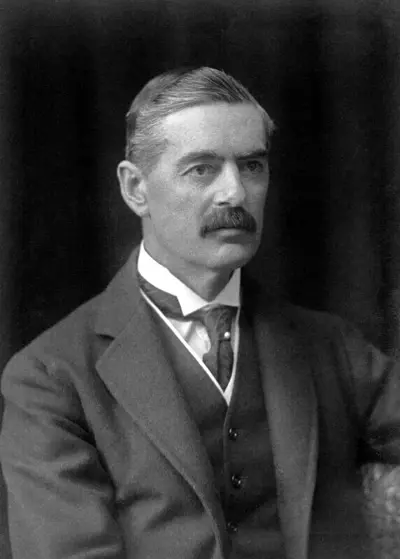
- Born: March 18, 1869
- Died: November 9, 1940
- Nationality: British
- Profession: Politician
Arthur Neville Chamberlain FRS was Prime Minister of the United Kingdom and Leader of the Conservative Party from 1937 to 1940. He is best known for his foreign policy of appeasement, and in particular for his signing of the Munich Agreement on 30 September 1938, conceding the German-speaking Sudetenland region of Czechoslovakia to Germany. Following the German invasion of Poland on 1 September 1939, which marked the beginning of World War II, Chamberlain announced the declaration of war on Germany two days later and led the United Kingdom through the first eight months of the war until his resignation as prime minister on 10 May 1940.
