Winston Churchill Quotes
That old town clerk looking at foreign affairs through the wrong end of a municipal drainpipe.
Prime Minister Neville Chamberlain, 1869-1940
Winston Churchill, 1874-1965, British Prime Minister (Conservative), After Munich, 1938
Sourced by: Eigen's Political and Historical Quotations


In 1938 beginning his policy of appeasement of the axis powers, Prime Minister Neville Chamberlain, 1869-1940, agreed to negotiate with Benito Mussolini, 1883-1945. Four days before this letter, Cranborne, along with his Foreign Secretary, Anthony Eden, 1897-1977, resigned in protest.


This quotation illustrates White’s extreme naivety about Stalinist Russia. At the time the Soviet Union had been backing communist insurgencies blatantly in China, Greece, and Korea for example. Most historians agree that White passed classified information to the Russians. He was accused of being a Communist, but there was never any evidence of that. Some people believe that he was a spy for the Russians and committed espionage, but others disagree observing that White was very much his own man and felt that much information that was classified never should have been. White substituted his own judgment, it is believed, about what could be given to the Russians. He was an admirer of what Russian socialism had accomplished economically, educationally and medically since the 1917 revolution deposing the Czar. Russia had been a valuable military ally, which had taken the brunt of both military and civilian casualties in WWII. White’s economics were certainly not Marxist but very much Keynesian. He was subpoenaed by the House Un-American Activities Committee where he was accused of being a Communist which he denied (see {634907}). He died of a heart attack 3 days later.


The “bozos” beat him and won the Presidency. And then conducted a very successful foreign policy for 8 years.


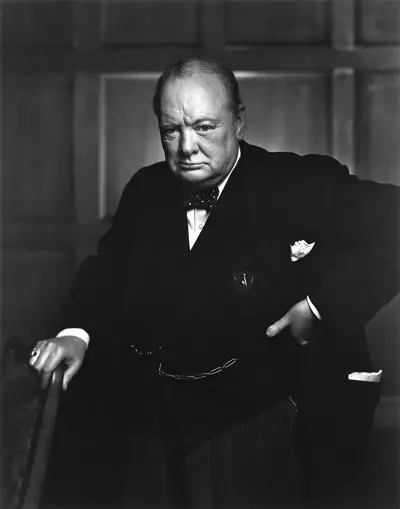
Sir Winston Leonard Spencer Churchill, KG, OM, CH, TD, DL, FRS, RA was the Prime Minister of the United Kingdom from 1940 to 1945, during the Second World War, and again from 1951 to 1955. Apart from two years between 1922 and 1924, Churchill was a Member of Parliament (MP) from 1900 to 1964 and represented a total of five constituencies. Ideologically an economic liberal and imperialist, he was for most of his career a member of the Conservative Party, as leader from 1940 to 1955. He was a member of the Liberal Party from 1904 to 1924. Churchill was also well known for his military career and as a historian, painter and writer, and among his many awards was the Nobel Prize in Literature.
