LYNDON B. JOHNSON
(Lyndon Baines Johnson)

He was driving through Tennessee and some white demonstrators were carrying racist signs insulting to Blacks. A companion asked what was the cause of Southern white racism.
When he assumed the presidency, Lyndon Johnson considered not renewing the appointment of FBI Chief J. Edgar Hoover, but finally decided to keep him: The quotation has its origin in a joke of the British Arabists about having a camel inside or outside of the tent. A similar phrase was used earlier by Winston Churchill to King George VI when the King asked him to form a government but advised him not to include Lord Beaverbrook.
The press secretary found the President very morose the day after his great triumph of passing the Civil Rights Bill of 1964. Moyers asked why he looked so sad.
The President had told the library director that during his administrations he had received some very mean letters and perhaps one of two of them should be exhibited in the Presidential Library. The library staff looked through the letters and came up with one which Middleton then showed to LBJ.
President Johnson said this after a meeting with governors from the South and border states, who had criticized his policies on civil rights as well as his vocal support of expanded rights for blacks
In the wake of the Tonkin Gulf incident, the United States bombed and destroyed North Vietnam naval installations:
Prior to Johnson’s civil rights efforts, the South virtually always voted for Democrats in all elections. The only political competition was for the Democratic Party Primaries. The term “Solid South” meant that it was solid for the Democratic Party. But after the Civil Rights Act was passed in 1964, the racist whites who used to be Democrats switched and joined the genuine traditional conservative and created a Republican Southern majority that was as solid for the GOP as the Democrats had ever enjoyed.
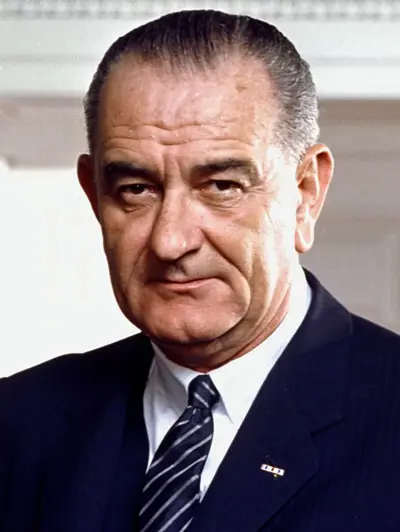
Lyndon Baines Johnson, often referred to by his initials LBJ, was the 36th president of the United States, in office from 1963 to 1969. He served as the 37th vice president from 1961 to 1963 and assumed the presidency following the assassination of President John F. Kennedy. A Democrat from Texas, Johnson was also a United States representative and later majority leader in the United States Senate. Johnson is one of only four people to have served, at various times, in all four federal elected positions.
