Lyndon B. Johnson Quotes
Niggah! Niggah! Niggah! That’s all they said to me all day. Hell, there’s one thing they’d better know. If I don’t achieve anything else while I’m President, I intend to make it impossible for people to come here and shout “Niggah! Niggah! Niggah! to me and the American people.
President Johnson said this after a meeting with governors from the South and border states, who had criticized his policies on civil rights as well as his vocal support of expanded rights for blacks
Lyndon Baines Johnson, 1908-1973, 36th President of the United States (Democrat, TX), Statement to Joe Califano, December 21, 1966
Sourced by: Eigen's Political and Historical Quotations


The law enforcement officers were the ones who broke the law when they beat and brutalized the peaceful civil rights marchers. The “white niggers” refer to the white marchers including clergy.

Forrest went on to be the first National Leader of the Terrorist Organzation.

Billy Sunday was the most famous preacher of the day. Unlike the vast majority of white preachers, he not only preached to black audiences but exuded an atmosphere of friendliness and comfort around Blacks that amazed most. Most Black leaders thought Sunday was very good for race relations, but there were some clergy like Grimke who criticized him. Sunday was castigated by many racist whites for preaching to Blacks, but he did not go as far as to condemn or preach against racism and the discrimination of the day and he would not preach to an integrated audience. Grimke, in contrast, preached to an integrated congregation and was one of the few white clergy who did in the South. (Washington DC was then a southern, segregated city.) See {585415} for another critique of Sunday.


She was one of the first prominent white southerners to denounce racial segregation.

For years through the Jim Crow years, Whites murdered many Blacks with impunity if they were perceived to be uppity or to try and obtain their Constitutionally Protected rights. Most took place in the South. The Negroes were typically tortured, mutilated, burned and hung from trees where they would be left for days as the major purpose was to strike terror in the Southern Black population. The Southern State and local governments never opposed the policy via oratory, legislation of law enforcement. The Federal Government did not interfere either. And much of the FBI under J. Edgar Hoover actually enabled the White Citizen’s Councils and the Klu Klux Klan. The NAACP began an anti-lynching campaign and Ms. Holiday was a one-woman public exposure campaign centered around this song. The anthem itself was written by a New York City schoolteacher named Abel Meeropol, using the pen name, Lewis Allan. It reached millions of Americans and Holiday fans the world over. To view some of the historical scenes described in the song, see http://withoutsanctuary.org/main.html
Louis Farrakhan was an anti-Semitic and Black Racist.


President Ford forced him to resign. He had been a holdover from the Nixon Administration. Ford did not chooses him. Nixon appointed him on the advice of the ultra conservatives in the party who liked the fact that he wanted to dismantle many of the FDR New Deal policies. However, he came from Indiana which was the lost racist of all the Northern States. In the 1920s Indiana had the largest membership in the KKK of any state in the Union, and Butz came from this line of racists. He also was convicted for Federal Tax Evasion.
[This was the first Abolition appeal written by a Black Man. It was published in Boston and despite the fact that it was very critical of whites, was very popular going through two more printings within the next two years.]


He was not only an atheist himself, but he was a major opponent of organized religion which he regarded as one or the major initiators and drivers of slavery, segregation and discrimination. For this reason he was critical of Martin Luther King—{583307}. His irreligiosity had always prevented his gaining much support from his fellow African Americans even though a great writer like H. L. Menken considered Schuyler, "the best writer in America".


This quotation was used by the Lyndon B. Johnson 1964 Campaign as: “We represent the majority of the people in Alabama who hate niggerism, Catholicism, Judaism, and all the isms of the whole world.” So said Robert Creel of the Alabama Ku Klux Klan. He also said, “I like Barry Goldwater. He needs our help.” The second statement was made at a different time.
The Black campaign staffer was asked if he was anti-Semitic.


Describing the National Association for the Advancement of Colored People in speeches in the 1960's:

Johnson was then Vice President.
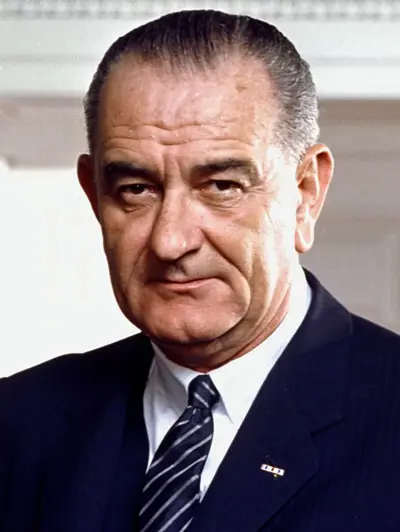
Lyndon Baines Johnson, often referred to by his initials LBJ, was the 36th president of the United States, in office from 1963 to 1969. He served as the 37th vice president from 1961 to 1963 and assumed the presidency following the assassination of President John F. Kennedy. A Democrat from Texas, Johnson was also a United States representative and later majority leader in the United States Senate. Johnson is one of only four people to have served, at various times, in all four federal elected positions.
