Richard B. Russell Jr. Quotes
We could beat back Kennedy on Civil Rights, but Lyndon [Johnson] knows how to beat us.
He was right. Even the vaunted Southern Filibuster was broken by the strategy and tactics Johnson and Senator Humbert Humphry, the Floor Leader for the 1964 Civil Rights Bill.
Richard B. Russell Jr., 1897-1971, U. S. Senator (Democrat, GA), Talking to some of his fellow Southern Senators About Civil Rights Legislation, 1964, Quoted by Joseph Califano, PBS, JFY & LBJ, August 4, 2015
Sourced by: Eigen's Political and Historical Quotations


It was used as a whipping boy and led to a re-alignment of Southern politicians to the Republican party.

The statement was made even more dramatic as the outgoing Governor, Lester Mattox, standing behind Carter at the ceremony, was an arch segregationist.

at the Department of Justice He was commenting on the fact that when he was an official of the Civil Rights Division of the U. S. Justice Department, the Southern members of Congress would not allow any appropriated money to be spend for Civil Rights reform activities. So they would do the Civil Rights work and call it something else so the Southerners who dominated the key Congressional Committees just never knew what was happening in the Department. Ideally, government officials would not try and deceive members of Congress, but the racism of a minority of Congress had been corrupting American life and law since the Constitution was originally ratified. Somoral corruption just brought on another type of moral corruption.


Southerners and some others wanted to discriminate and fought civil rights legislation. The excuse they gave for opposition was that the Federal Government was usurping the power of the states to determine what civil rights people of the state would have. Shellabarger made it clear that the civil rights bill would not require ANY rights to be given. It just required that if the states granted rights, they could not discriminate by race as to those rights. But the states were free to decide which rights all citizens of the state would have. See {623473} .

The large majority of the American people opposed legal segregation and for years, the segregationist, racist, Southern white minority were able to prevent any Civil Rights legislation by using the filibuster until President Lyndon Johnson, formerly a Southern Senator who understood the legislative process better than any other American president used his great skill to pass Civil Rights legislation instead of opposing it which he had done for years as a Texas Senator and the Majority Leader of the Senate.


At the time, the Southern segregationists were all Democrats and they blocked any Democratic attempt to pass any Civil Rights legislation. When he could not get a Civil Rights commitment from his own party, Powell turned to the Republicans and the President wrote this letter. In return, in November, Powell endorsed and supported Eisenhower instead of Stevenson, his own party’s nominee. Eisenhower could not get any legislation on Civil Rights as the Southern Democrats would always block it. When President Lyndon Johnson finally forced the 1963 Civil Rights Act through the Congress, the racist Southern Democrats cut a deal with Goldwater and the conservative Republicans, and switched parties. Since then the Civil Rights stance of the two parties reversed. The Democrats were thereafter pro Civil Rights and the Republicans, the party of Lincoln and Reconstruction, thereafter reversed their Civil Rights position and opposed progress in this area.

This painting depicted a young black girl walking to school surrounded by 4 U. S. Marshalls protecting her from the crowd of white racists trying to prevent her from attending an elementary school under court order. The vicious race hatred that school integration revealed was the national problem that was then surfacing. The graphic is the illustration that appeared in Look with that name.


The following year most of the Southern Democrats joined the Republican Party in Protest over the Civil Rights Act. Reagan began to have national political ambitions and therefore flip flopped and stated that he would never have voted for the Civil Rights Act. This made him acceptable later as a conservative.


This widely publicized statement by Mr. Ethridge was made when he was a member of the President's Committee on Fair Employment Practices during the hearings of this Committee at Birmingham, Alabama.


There are few people today who could believe that a United States senator would castigate the head of a Federal Agency for spreading “racial equality propaganda.” But at the time—1943—the actions of Education Commissioner John W. Studebaker and his Assistant took remarkable courage.
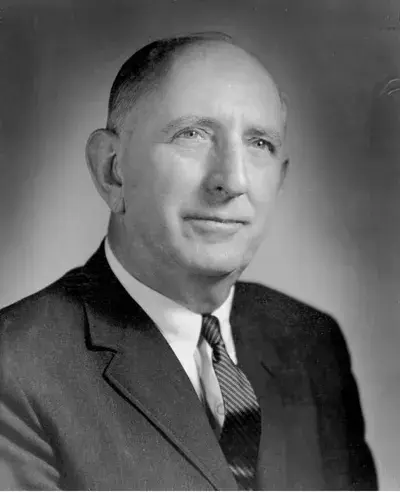
Richard Brevard Russell Jr. was an American politician. A member of the Democratic Party, he served as the 66th Governor of Georgia from 1931 to 1933 before serving in the United States Senate for almost 40 years, from 1933 to 1971. Russell was a founder and leader of the conservative coalition that dominated Congress from 1937 to 1963, and at his death was the most senior member of the Senate. He was for decades a leader of Southern opposition to the civil rights movement.
