Lyndon B. Johnson Quotes
We just delivered the South to the Republican Party for a long time to come.
Lyndon Baines Johnson, 1908-1973, 36th President of the United States (Democrat, TX), Remark to a Assistant Bill Moyers, just after signing the 1964 Civil Rights Act
Sourced by: Eigen's Political and Historical Quotations

Prior to Johnson’s civil rights efforts, the South virtually always voted for Democrats in all elections. The only political competition was for the Democratic Party Primaries. The term “Solid South” meant that it was solid for the Democratic Party. But after the Civil Rights Act was passed in 1964, the racist whites who used to be Democrats switched and joined the genuine traditional conservative and created a Republican Southern majority that was as solid for the GOP as the Democrats had ever enjoyed.
The press secretary found the President very morose the day after his great triumph of passing the Civil Rights Bill of 1964. Moyers asked why he looked so sad.

This was art of the Nixon "Southern Strategy" to alienate the white supremacists and racists from the Democratic Party with Civil Rights legislation and rhetoric, and get most of them to become Republicans. But as Phillips observed, when Negroes began voting in significant numbers in the South the party switching really accelerated.


He was right. Even the vaunted Southern Filibuster was broken by the strategy and tactics Johnson and Senator Humbert Humphry, the Floor Leader for the 1964 Civil Rights Bill.

This phrase was also to be used over 100 years later by Malcolm X. See {624101} and {38291}.


In the South racism was so extensive that Blacks were not allowed to even vote. Brooke had moved from the South to Massachusetts and there as in the North, Midwest and West, African Americans could vote. So the first time Brooke ever voted he was a candidate.

The stranglehold that the Southern Democrats had held on civil rights legislation had been broken in 1968 by Lyndon Johnson and the other Democrats with key support from some liberal Republicans like Lindsay. However, the South felt politically betrayed. The Republican leadership, in what was one of the most brilliant political strategies in American history, played to the disaffected racist Southerners and welcomed into their party. Within the next 30 years virtually the entire South had gone Republican, and the Republican captured both houses of Congress and the Presidency with the South solidly Republican. At the time, Lindsay and some Republican leaders criticized bitterly about the party pandering to the worst racist elements of the nation. The “Party of Lincoln” had become the party of the segregationists, the racists, the hate groups of the country.

The 1963 Civil Rights Bill passage infuriated the Southern Racists, and the Republicans invited them to switch parties in revenge and by 1990 the shift was almost total.


Nixon, in his second attempt to win the Presidency was told by a small group of Southern Republican politicians that his support was wavering in the South. They had already left the Democratic Party in reaction to the Passage of the 1964 Civil Rights Act. They were concerned because in order to try and capture some of the more liberal anti-war Democrats, Nixon had been making speeches advocating the vigerous enforcement of of civil rights and improving the lot of the Negro. But Nixon could not afford to lose his political base inb the south. Hence the promise which did not keep very long after he was elected President. Nixon was not a strong civil rights President, but he was totally without principles and had no political idiology he would sacrifice any of his political capital for. So once he was elected, he didn't want to offend the centerists whose support he needed for his legislatrive program so he did pay lip service to the prinicples of equality when he himself was anti-Black, andti-Semitic and prejudiced in many areas including against intelelctuals.


The Nixon "Southern Strategy" was that if the Republican Party made extensive efforts to appeal to minorities, given the previous decades of support of white supremacy, they would only be successful with a few, whereas if the Party went in the other direction and supported the Whites fighting against the Democratic initiated, racist hated, Civil Rights Act, they would get almost all the racist Southern Democrats, which were most white males and many white females. This racist policy enabled the Republicans to gain control of the Federal Government more often than not whereas before, it was very unusual.

The large majority of the American people opposed legal segregation and for years, the segregationist, racist, Southern white minority were able to prevent any Civil Rights legislation by using the filibuster until President Lyndon Johnson, formerly a Southern Senator who understood the legislative process better than any other American president used his great skill to pass Civil Rights legislation instead of opposing it which he had done for years as a Texas Senator and the Majority Leader of the Senate.


Owens had just retired after 24 years in Congress. When Reagan began his campaign the majority of the racists of the South were furious that their party, the Democrats, had passed the Civil Rights Act of 1964 ending legal segregation and racism of the South. Reagan implemented a “Southern Strategy” by using code words that endorsed Southern racism and this swung the formerly Democratic “Solid” South to the Republican side changing the balance of power for years. Although Reagan was not himself racist and was a very popular President there were many who never forgot his pandering to the racists to get elected to begin with.
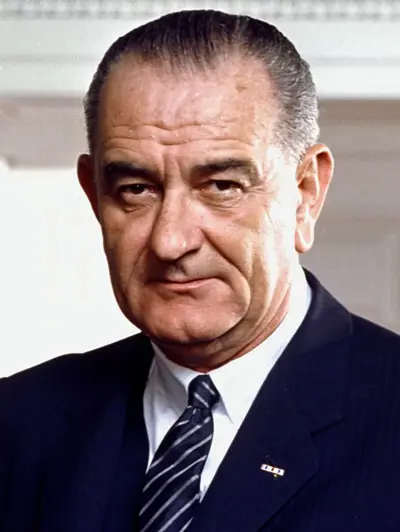
Lyndon Baines Johnson, often referred to by his initials LBJ, was the 36th president of the United States, in office from 1963 to 1969. He served as the 37th vice president from 1961 to 1963 and assumed the presidency following the assassination of President John F. Kennedy. A Democrat from Texas, Johnson was also a United States representative and later majority leader in the United States Senate. Johnson is one of only four people to have served, at various times, in all four federal elected positions.
