Lyndon B. Johnson Quotes
No memorial oration or eulogy could more eloquently honor President Kennedy’s memory than the earliest possible passage of the civil rights bill for which he fought so long.
Lyndon Baines Johnson, 1908-1973, 36th President of the United States (Democrat, TX), Address to Congress, November 27, 1963
Sourced by: Eigen's Political and Historical Quotations

They were discussing the Civil Right Bill of 1964 which they all wanted to pass. See {605438} . However, they faced a filibuster from the Southern Senators who had always before used this tactic and blocked Civil Rights legislation. However, the President here committed himself to the one way to take most of the power out of the filibuster. Accept a shutdown of the Senate, give up the rest of the President’s legislative program but the filibuster blocks all legislation that the Southerners wanted like cotton and tobacco subsidies.
The Civil Rights Bill of 1964

He was right. Even the vaunted Southern Filibuster was broken by the strategy and tactics Johnson and Senator Humbert Humphry, the Floor Leader for the 1964 Civil Rights Bill.

Johnson had proposed an extremely strong civil rights bill. Most Washington insiders assumed that he would gain favor amongst fair minded whites and Blacks for making the attempt, but then he would compromise with the Southerners, and water down the bill to something that had little or no teeth. His staff were trying to learn from Johnson, which aspects of the bill he was willing to compromise on assuming that the President could never get Congress to pass the bill in its original form. They were really surprised at the President’s answer and assumed that he could not do it. They were more surprised when he did drive the bill through Congress without any substantive compromises. It was the most powerful and effective Civil Rights legislation passed since Reconstruction a century earlier.

He was responding to Mississippi Congressman William Colmer-- {637395}. Southern racists frequently accused other members of Congress of being intimidated by civil rights leaders rather than voting for civil rights legislation out of conviction. Many of them, like Colmer, were so insular that revanchist that they did not realize that other whites could really believe that segregation was not a necessary and good thing.


After Adams’ term as President, he was elected to the House of Representatives where he served for the rest of his career. He was constantly calling for the emancipation of slaves (see {77463}) in the House debates. The Southern Congressmen were so offended by this that they got the majority of the House to pass a rule that made using the word “slavery” out of order. It was called the “Gag Rule”. Adams, one of the best legislators and lawyers of his day, then started reading in the House debates petitions of his constituents calling for an end to slavery. The Southerners called for the Speaker to declare him out of order for violating the gag rule. But Adams pointed out that the Constitution gave citizens the right to petition Congress with no controls on the petitions. Therefore the reading of the petitions was Constitutionally mandated and trumped the Rules of the House. He then arranged to have many petitions submitted which he dutifully read on the House floor to the extreme anger of the Southerners.

Miller was the Chairman of the House Committee that wrote the bill. The Act allowed women and other workers who were the victims of wage discrimination to sue the discriminating employers even after the statute of limitations and run out provided that they victim had no knowledge of the discrimination. Lilly Ledbetter was a Goodyear Supervisor who was for years paid far less than the male supervisors doing the same work. But the company kept it secret and Ms. Ledbetter didn’t find out until the statute of limitations had said she could no longer sue. The Lilly Ledbetter Act corrected that injustice. President Obama observed that discrimination in pay affects not only the woman or other worker, but also the entire family which might therefor not be able to obtain health care, education or care for elderly parents. At the time that this quotation was made, white women in America who were working full time were earning only 77 percent of what men earned. For minority women, the proportion is even less. As bad as that was, it was an improvement over the situation when the equal pay act was passed 50 years before. Then women earned only 53 percent of what a man did.

Goldwater was not a racist personally, however he opposed the Civil Rights Bill of 1964 against the leadership and majority of the Republican Party, and he initiated a “Southern Strategy” whereby he invited the racists of the South who were furious that Democrat Lyndon Johnson had abandoned them and ended legal segregation forever, to leave the Democratic Party. They did, and while they and the hard core of ultraconservative Goldwater republicans were not enough to overcome the public disapproval of the callous strategy and Goldwater’s nuclear positions. However, the coalition that Goldwater had assembled formed the base of a new Republican Party which gave Ronald Reagan strong majorities, and in the early 21st century the Goldwater coalition of Southerners, Goldwater conservatives gained control of the Republican Party and purged most of the moderates and polarized American politics ending even the traditional bipartisanship in Foreign Affairs.


The Civil Rights Act of 1964 This is a classic example of a twisted logic what was used for many years in the 20th century Red Scare in America. The International Communist Party was critical of the United States legal racial segregation as it was one of the great weaknesses of U. S. Capitalism for most people in the world. The American Communist party also echoed the party line. Almost all socialist organizations supported the Civil Rights Bill as well. Therefore argued Russell and most Southerners, it should be opposed as a Communist effort to weaken America. What they did not mention was that the majority of Democrats and Republicans supported the bill. That the vast majority of all the American churches and other religious organizations supported the bill, that Business groups all across the country wanted legal segregation ended. The only reason there was a long debate is that the Southerners used the filibuster where a small minority could block Senate legislation. But the American majority was so great for civil rights that the filibuster was defeated and the law passed which changed America forever.

Rustin urged them to accept a compromise what would give them the majority of everything that they were demanding but not all. See {637623} for Moses’ counter-argument.


The President wanted Anderson to relay his message to other Republicans which he did. At that time the Southern racists were almost all members of the Southern bloc of the Democratic Party. Most Republicans were then advocates of non discrimination. By 2010 virtually all the racists, nativists, neo Nazis, anti Catholics, and anti Semites had gravitated to the Republican party if they were still active in politics. Reasonable Republicans were embarrassed as reasonable Democrats had been before the shift which resulted from passing the Civil Rights Act of 1964.

Hollings who was one of the senior experienced senators was offended by the degree to which the George W. Bush Administration and the Republican leadership had turned to lobbyists to draft legislation and amendments to pending legislation. Lobbyists often have specialized information that members of Congress do not have, so there has been in modern times communications between lobbyists and members of Congress and their staffs. However, during the Bush Presidency the practice reached an extreme where lobbyists would even write the legislative language and give it to the members in whom they had invested by giving them large campaign contributions and many perks. K Street is the fanciest street in Washington DC with some of the most expensive office space. A substantial proportion of the lobbyists have K Street offices, hence the metaphor.
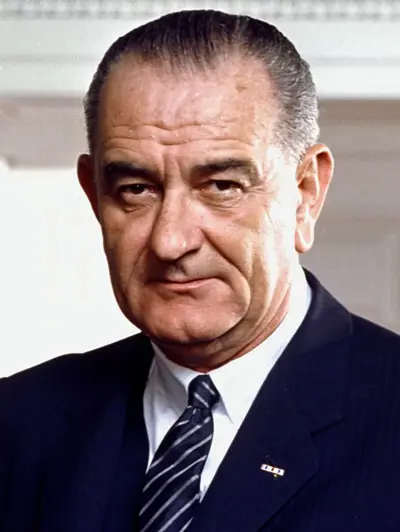
- Born: August 27, 1908
- Died: January 22, 1973
- Nationality: American
- Profession: President
Lyndon Baines Johnson, often referred to by his initials LBJ, was the 36th president of the United States, in office from 1963 to 1969. He served as the 37th vice president from 1961 to 1963 and assumed the presidency following the assassination of President John F. Kennedy. A Democrat from Texas, Johnson was also a United States representative and later majority leader in the United States Senate. Johnson is one of only four people to have served, at various times, in all four federal elected positions.
