Gerald R. Ford Quotes
The veto forces Congress to take another look at legislation that has been passed…
Gerald R. Ford, 1913–2006, 38th President of the United States (Republican, MI), Speaker of the House, Interview, The Readers Digest, October 1976
Sourced by: Eigen's Political and Historical Quotations


His main reason for believing this is that all appropriations bills must be initiated by the House of Representatives. Lobbyists therefore often give the House more attention than the Senate.

A veto power for the President would be absurd because

His admonition did little good. That Congress passed fewer bills than any other in history.


Miller was the Chairman of the House Committee that wrote the bill. The Act allowed women and other workers who were the victims of wage discrimination to sue the discriminating employers even after the statute of limitations and run out provided that they victim had no knowledge of the discrimination. Lilly Ledbetter was a Goodyear Supervisor who was for years paid far less than the male supervisors doing the same work. But the company kept it secret and Ms. Ledbetter didn’t find out until the statute of limitations had said she could no longer sue. The Lilly Ledbetter Act corrected that injustice. President Obama observed that discrimination in pay affects not only the woman or other worker, but also the entire family which might therefor not be able to obtain health care, education or care for elderly parents. At the time that this quotation was made, white women in America who were working full time were earning only 77 percent of what men earned. For minority women, the proportion is even less. As bad as that was, it was an improvement over the situation when the equal pay act was passed 50 years before. Then women earned only 53 percent of what a man did.

In 2012 the Republicans controlled the House but not the Senate or the White House. As the nation grows, the Congressionally voted budgets have implications and the budget ceiling has to be raised to balance the two. That had always been a bipartisan process over the life of the nation. However, the Republicans in the House decided that they would hold the debt ceiling legislation hostage to pressure the Senate and the White House to pass legislation that the majority of the Senate and the President thought was bad for the country. Krugman advised the President and the Senate to resist giving in to this blackmail even if the debt ceiling was hostage to their demands.
In general, there are so many versions of a bill as it goes through the Congressional process, that the members of Congress do not read each and every draft. Some do not read any of the drafts and leave it to the Committee; others trust their staffs or their party leadership. More often they trust the lobbyists who donate to their campaigns. Sometimes, the bills are so large—many thousands of pages that the members of Congress lose track of all the aspects of the proposed law and only read a few sections in which they may have participated in debate. Often, the only people who read the entire bill are the lobbyists and one or two of committee staff.

The Congress over the last century has ceded much of its Constitutional power to the President. Congress has much power to check the President, but just as Congress has not been very competent at legislating, oversight, and conducting hearings and investigations, it has not organized itself to use the powers it has very well.

When requested to have the assembly remove items in the proposed constitution at the last minute:


Alberto Gonzalez, White House Counsel and later Attorney General who was forced to resign and David S. Addington, Counsel to the Vice President, had come up with a novel view of the powers of the presidency. They argued that since the President is the Commander in Chief, in a war situation or intelligence gathering thereto, has the Constitutional responsibility for that function, he need not obey any laws of Congress as in the conduct of the war Congress would be impinging on the Constitutional separation of powers which itself was prohibited by the Constitution. The argument did not find any significant legal support but for a while the George W. Bush White House behaved as if this were the law, despite the fact that even in the American Revolution and the War of 1812 Congress passed laws regulating the conduct of the armed forces as is provided for in other parts of the Constitution. Yet even Goldsmith would allow the President some powers that many think are unconstitutional and/or belong to Congress. See {32436}.


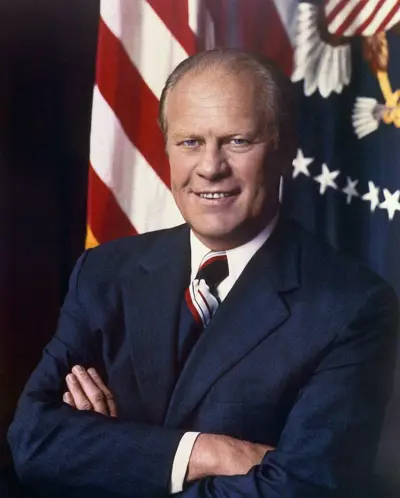
Gerald Rudolph Ford Jr. was an American politician and attorney who served as the 38th president of the United States from 1974 to 1977. A member of the Republican Party, Ford previously served as the 40th vice president of the United States from 1973 to 1974. To date, Ford is the only person to have served as both vice president and president without being elected to either office by the Electoral College.
