Paul Krugman Quotes
We have a constitution that says that the way you get things is by passing legislation, not by threatening to destroy the country unless you get your way.
In 2012 the Republicans controlled the House but not the Senate or the White House. As the nation grows, the Congressionally voted budgets have implications and the budget ceiling has to be raised to balance the two. That had always been a bipartisan process over the life of the nation. However, the Republicans in the House decided that they would hold the debt ceiling legislation hostage to pressure the Senate and the White House to pass legislation that the majority of the Senate and the President thought was bad for the country. Krugman advised the President and the Senate to resist giving in to this blackmail even if the debt ceiling was hostage to their demands.
Paul Krugman, Economist & Political Columnist, Nobel Laureate in Economics, Interview with Fareed Zakaria, CNN Global Public Square, May 20, 2012
Sourced by: Eigen's Political and Historical Quotations


See Henry Clay for an earlier expression of this point.

This is an interesting variation of the FDR quotation regarding the President and Congress.


This was an insult to the George W. Bush administration which had stretched the Constitution more so than any previous administration, had asserted Presidential powers that had never been asserted before and had had several of its more controversial policies and practices overturned by the Supreme Court.


Boehner’s Republicans controlled the House of Representatives. However the Democrats controlled the Senate and Obama, the president, was a Democrat. So while Boehner could block any legislation, he could not pass legislation that the Republicans wanted. So the speaker resorted to the tactic of holding for ransom import legislation unless the President and the Democrats would pass legislation that the majority of the public and the Democrats were against. In this case it was the debt ceiling limit. The United States spends money authorized by Congress and then has to pay the bills. When the country is growing, the government has to borrow money in order to meet its obligations and pay bills. Congress must authorize the increase in the debt limit. Boehner held the debt limit hostage until Obama would agree to spending cuts that were unpopular with the majority. A problem for the Republicans with this strategy however was that the government would not have enough money to pay the regular bills and the government would have to slow down. This was considered a most unpatriotic thing to do and one would put the United States full faith and credit at risk. Republicans justified it on the grounds that spending money as the government was doing was worse and therefore it requires extreme measures. This was not the only occasion where a political party put its ideology ahead of the welfare if the nation as a whole. But in those few past occasions the party doing this was not overt about it, and could never be accused of blackmailing. What made this quotation remarkable was that it was the first time that the politician was very explicit about the blackmail strategy. President Obama actually caved in a bit and compromised and reduced spending so the debt ceiling was raised. Earlier, President Clinton had the same tactic tried on him but he let the Government shut down, and after a few days, The political heat on the Republicans were so great that they had to raise the debt ceiling and reopen the government.


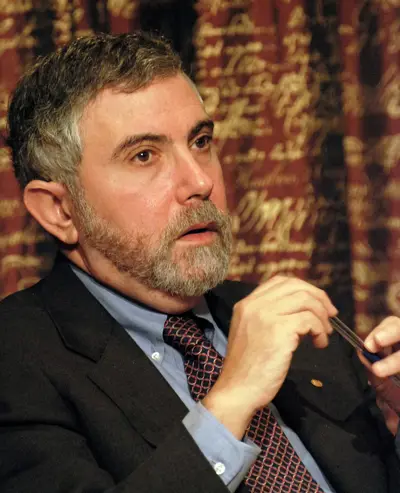
Paul Robin Krugman is an American economist who is the Distinguished Professor of Economics at the Graduate Center of the City University of New York, and a columnist for The New York Times. In 2008, Krugman was awarded the Nobel Memorial Prize in Economic Sciences for his contributions to New Trade Theory and New Economic Geography. The Prize Committee cited Krugman's work explaining the patterns of international trade and the geographic distribution of economic activity, by examining the effects of economies of scale and of consumer preferences for diverse goods and services.
