John Boehner Quotes
Everything comes at a price and I’m going to use the debt limit to extract things out of you that I would not otherwise get.
Boehner’s Republicans controlled the House of Representatives. However the Democrats controlled the Senate and Obama, the president, was a Democrat. So while Boehner could block any legislation, he could not pass legislation that the Republicans wanted. So the speaker resorted to the tactic of holding for ransom import legislation unless the President and the Democrats would pass legislation that the majority of the public and the Democrats were against. In this case it was the debt ceiling limit. The United States spends money authorized by Congress and then has to pay the bills. When the country is growing, the government has to borrow money in order to meet its obligations and pay bills. Congress must authorize the increase in the debt limit. Boehner held the debt limit hostage until Obama would agree to spending cuts that were unpopular with the majority. A problem for the Republicans with this strategy however was that the government would not have enough money to pay the regular bills and the government would have to slow down. This was considered a most unpatriotic thing to do and one would put the United States full faith and credit at risk. Republicans justified it on the grounds that spending money as the government was doing was worse and therefore it requires extreme measures. This was not the only occasion where a political party put its ideology ahead of the welfare if the nation as a whole. But in those few past occasions the party doing this was not overt about it, and could never be accused of blackmailing. What made this quotation remarkable was that it was the first time that the politician was very explicit about the blackmail strategy. President Obama actually caved in a bit and compromised and reduced spending so the debt ceiling was raised. Earlier, President Clinton had the same tactic tried on him but he let the Government shut down, and after a few days, The political heat on the Republicans were so great that they had to raise the debt ceiling and reopen the government.
John Boehner, U. S. Congressman (Republican, OH), Speaker of the House, Statement to President Barack Obama, 2012
Sourced by: Eigen's Political and Historical Quotations

The President had cut some programs that were Congressional favorites:

In 2012 the Republicans controlled the House but not the Senate or the White House. As the nation grows, the Congressionally voted budgets have implications and the budget ceiling has to be raised to balance the two. That had always been a bipartisan process over the life of the nation. However, the Republicans in the House decided that they would hold the debt ceiling legislation hostage to pressure the Senate and the White House to pass legislation that the majority of the Senate and the President thought was bad for the country. Krugman advised the President and the Senate to resist giving in to this blackmail even if the debt ceiling was hostage to their demands.

As the Majority Leader of the House, Eric Cantor had to resolve conflicts and for coalitions that will compromise to get anything done. However, the Tea Party movement didn’t want any compromises even if it meant shutting down the government and defaulting on the national debt. They ran against conservative Republicans in the Republican primary elections campaigning that the incumbent made and facilitated compromises with Democrats. In some districts like Eric Cantor’s there were enough primary voters who agreed. Terry was explaining the message that the other conservative politicians received.

The Republicans who had control of the House of Representatives were reaching the end of the fiscal year and had not yet passed a budget nor expanded the debt ceiling so the government would have to shut down in a few days and a little later America could not pay any of its bills. They had a very strong position if they willing to blackmail the Democratically controlled Senate and the Democratic President. But the last time the Republicans had ever tried this before was the Republican House when Gingrich was speaker and they shut down the government for almost 3 weeks. It cost the Republicans the next election’s majority in the House. President Obama decided that he would not set a precedent of negotiating with a house of Congress that was threatening to shut down the government or threatening not to pay the nation’s bills which Congress had already authorized the purchase of.

One of the most effective Senators, she became more and more frustrated as her party was dragged into obstructionism and hyperpartisanship by ultra conservative but inexperienced Tea Party Republicans who saw every compromise as treason to the party and a craven sell out of principle. They were not able to pass a single law however, and Snowe chose not to run despite an easy reelection and tried to reform the Congress from the outside.


This was one of the worst Congresses in American History and had the worst productivity record—passing very few bills, and none of any significance. The anti-government, Tea Party hyper-conservative Wing of the Republican Party intimidated the Speaker of the House and they were opposed to any compromise at all on anything.


The senator had broken with his own party on the issue of slavery in the territories.

Paxon himself was one of the ‘whips’ responsible for doing this for the Republicans when he was in the Congress.

Explaination of why he threatened to block Senate approval of an appointment he favored in order to achieve another political objective.

This is an important political quotation because it illustrates one of the major reasons that Congress was so gridlocked at the time and passed hardly any legislation at all. Farenthold was a relatively new Congressman supported by the Tea Party extreme conservatives. He had no Congressional legislative experience and viewed the House / Senate Conference Committee process more like a Middle East rug bazaar than a serious democratic process of constructive legislation. The position that he wants to take to the Conference Committee which is “livable” to him is not only unlivable to the majority of the Senate, but unlivable for a large part of his own House of Representatives, His position is so extreme that most Senators and many House members on the Conference Committee do not even bother to attempt to negotiate from there. Experienced Congressional legislators realize that negotiation can only take place between realistic options. Otherwise no legislation gets passed which was at that time, OK with most of the Tea Party supporters.

The War on Poverty Bill The bill passed on August 8, 1964 by 226-184 a wider margin that Johnson thought he could get. See {637611}.
Johnson thought that he was 5 votes short to pass the Economic Opportunity Act to launch his War on Poverty. This quotation shows the master of Presidential vote getting in action. Jones came from a very conservative and racist district in Florida. In addition to the general conservative concern about the bill. White Southern racists were still angry about the Civil Rights Act that had just passed and saw the anti-poverty programs as another opportunity for the Federal Government to have racially integrated employment and training programs in the South. If Jones voted for the anti-poverty bill, he might well be defeated in the 1966 election. The President promised to appoint him as a Federal Judge—a lifetime appointment—if he were defeated. A potential problem was that there would not likely be a vacant judgeship open in Alabama. Johnson promised that he would create another judgeship for Jones if necessary—a judgeship that was not really needed. Jones was reelected and President Johnson did not have to create a new judgeship.


The threat was delivered to Mark Sanford a conservative Congressman from Southg Carolina, Sanford had stated that he would vote against Trump's plan for a replacement to Obamacare. He paid no attention to the threat and the intent of intimidating other Republican members of the House of Representatives failed, There were so many Republican defectors who would not vote for the bill that House Speaker Ryan, withdrew the bill at the last minute has the majority Republicans had so many defectors that the Obama Care replacement coult not possibly pass. This was a great blow to Presieent Trump and not President in history had been thwarted so early in his administration on a major bill. Worse Trump's own party contolled the majority and the entire party had run their campaingns with the "promise" to repeal ObabaCare. However when they tried to do it, they cound it was not so easy and even most of the conservatives proferred ObamaCare to the propsed legislation that the Speaker or the House and the Presidenet were advocating.


Hollings who was one of the senior experienced senators was offended by the degree to which the George W. Bush Administration and the Republican leadership had turned to lobbyists to draft legislation and amendments to pending legislation. Lobbyists often have specialized information that members of Congress do not have, so there has been in modern times communications between lobbyists and members of Congress and their staffs. However, during the Bush Presidency the practice reached an extreme where lobbyists would even write the legislative language and give it to the members in whom they had invested by giving them large campaign contributions and many perks. K Street is the fanciest street in Washington DC with some of the most expensive office space. A substantial proportion of the lobbyists have K Street offices, hence the metaphor.
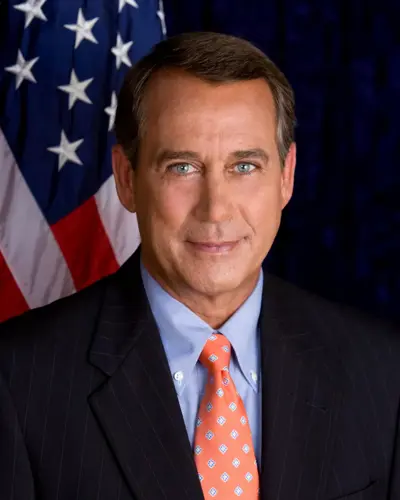
John Andrew Boehner is an American politician who served as the 53rd speaker of the United States House of Representatives from 2011 to 2015. A member of the Republican Party, he was the U.S. Representative for Ohio's 8th congressional district from 1991 to 2015. The district included several rural and suburban areas near Cincinnati and Dayton.
