Richard Nixon Quotes
Because of unsure and undecided leadership in the field of foreign policy, questions are being raised on all sides. The administration is plagued by a Hamlet-like psychosis which seems to paralyze it every time decisive action is required.
Zacharia read the quotation which the audience was sure was another of the many Republican attacks on Barack Obama’s foreign policy and his decision making. The Republicans came up with the same type rhetoric that they did in earlier years with Democratic Presidents starting with Harry Truman. There have always been some politicians and pundits who regard any President (or other leader) who takes time to gather facts, hear alternative views, consider and reflect upon them, and then reach a decision as week and indecisive—an intellectual. To them, a real man—a real leader—listens looks at an issue before him and shows decisiveness by not vacillating and making his decision relatively quickly. To them if it took that much time and thought to reach a decision the President is not confident that his is the right decision and that shows weakness. Of course, every senior leader knows that if the decision reaches him, there is no clear good solution. If there were, it would have been decided at a lower level. Ideologues however don’t like to acknowledge complexity.
Richard M. Nixon, 1913-1994, 37th President of the United States (Republican, CA), Attack on John F. Kennedy and his aministration, 1961, Quoted on CNN, Fareed Zacharia, Global Public Square, June 1, 2014
Sourced by: Eigen's Political and Historical Quotations


He was very critical of Arraham Lincoln even though he was a Republican. Many percieved that Lincoln's administration could not get anything done. Lincoln might have lost the 1864 campaign but for the great victory that General Sherman's troops had in taking Atlanta. This changed a lot of mionds about Lincoln's War strategy. Actually, in the first 2 years of the Civil War, Lincoln could not get his generals to fight his preferred kind of war until he appointed Grant who brought Sherman to high command.


McClellan liked to parade and drill his troops but not fight them. Lincoln wanted him to take the offensive but the general always found an excuse not to. Many historians believe that McClellan wanted the war to end, the South to rejoin the Union and be allowed to maintain slavery. Others feel that he was just a military man who maintained his popularity by minimizing casualties. Finally, Lincoln fired McLellan and the complexion of the war changed thereafter. McClellan ran against Lincoln for the Presidency in 1864. See {633923}

on the decision of whether to use military force against the Assad Syrian regime for their using chemical warfare against their own people


On military or foreign policy matters his view was that presidents ought not to rule anything in or out so that he/she can keep all the options open and not reduce future flexibility.


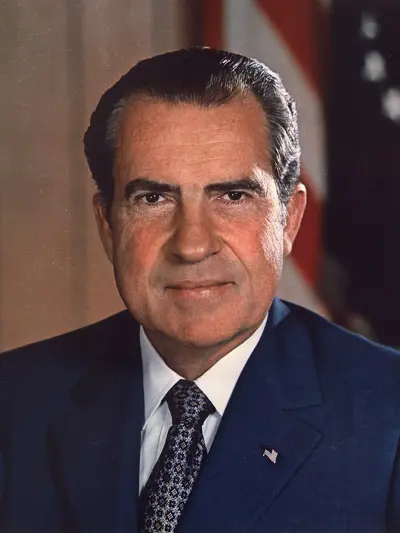
Richard Milhous Nixon was the 37th president of the United States, serving from 1969 to 1974. A member of the Republican Party, Nixon previously served as the 36th vice president from 1953 to 1961, having risen to national prominence as a representative and senator from California. After five years in the White House that saw the conclusion to the U.S. involvement in the Vietnam War, détente with the Soviet Union and China, and the establishment of the Environmental Protection Agency, he became the only president to resign from the office, following the Watergate scandal.
