Charles Sumner Quotes
The nation needs"a president with brains; one who can make a plan and carry it out.
He was very critical of Arraham Lincoln even though he was a Republican. Many percieved that Lincoln's administration could not get anything done. Lincoln might have lost the 1864 campaign but for the great victory that General Sherman's troops had in taking Atlanta. This changed a lot of mionds about Lincoln's War strategy. Actually, in the first 2 years of the Civil War, Lincoln could not get his generals to fight his preferred kind of war until he appointed Grant who brought Sherman to high command.
Charles Sumner, 1811-1874, U. S. Senator (Democrat, Free Soiler and Republican, MA) Speech, Critcism of Abraham Lincoln, 1864 Quoted in Josua Zeitz, Lincolns Boys: John Hay, John Nicolay, and the War for Lincoln's Image, Penguin Group, 2014
Sourced by: Eigen's Political and Historical Quotations

MacArthur was astounded that the country turned to Eisenhower rather than him. He actually did not think much of Eisenhower. Eisenhower, was very critical of MacArthur. See


Reagan, Ford, Bush, Clinton


even though in this case the objective The State Department, the Defense Department and most important President Kennedy had decided to get rid of Diem. Most of the Central Intelligence Agency thought that this was a very unwise policy, because Diem was a known risk, and the people who would replace him and their talents and policies were unknown. The negatives of Diem—the facts that he, a Christian, was persecuting the majority Buddhists, was totally corrupt, and not a very good leader was less distressful to the CIA than to the President and the other agencies as the intelligence agency frequently not only tolerated “offensive” allies, but actually employed them including war criminals. Another importance of this quotation is that it shows that it was by no means certain that the CIA would always follow the orders of the President and the government policy makers. Colby, who was not the agency director at that time but was the head of the South East Bureau, was one high level official who argued that the policies should always be followed even if they were unwise or foolish. Another importance of this quotation is that it illustrate a common error that administrations are frequently forced to make: making a policy decision to eliminate a problem while not having much of an idea of what the alternative or consequence would be when the policy is implemented. The Syrian Civil War in 2013 was a good example. The Government side appeared to have used Chemical Warfare on Civilians and public opinion demanded that we do something. However, having a no-fly zone or any of the alternatives to prevent (punish) the government for the Chemical Warfare would strengthen the rebel side which was made up of numerous factions—some of which were known Islamic fundamentalist terrorists and jihadists. If the balance of power were tipped toward the rebels, the consequence for the American national interests were unknown—just as the consequence of ousting Diem was unknown and turned out to also be bad and was probably worse.

This was an indirect criticism of Condoleezza Rice, the National Security Advisor to George W, Bush for not taking a role that Mazarr and many others believe she should have. On the other hand, President Bush selected her precisely because she shared his values and instincts. Perhaps, Bush should have selected and advisor who held a DIFFERENT view and perspective from himself. This quotation reveals the classic dilemma of political appointments of key advisors and cabinet members. Bush and Ronald Reagan tended to select advisors who agreed with them in philosophy and politics. FDR and Obama, followed the Lincoln tradition and appointed many advisors who were not intellectual clones of their own views and values.


The President told McNamara that if the administration does not send the troops the Generals want, they will be blamed for any military failures that occur. If they do send all the troops that the Joint Chiefs wanted, they would be going far beyond the limits that the Defense Secretary recommended and the President would have preferred. JBJ felt he really had no political choice. He authorized the wanted troops further escalating the war. See his special assistant’s question about that decision in {617151}.

Zacharia read the quotation which the audience was sure was another of the many Republican attacks on Barack Obama’s foreign policy and his decision making. The Republicans came up with the same type rhetoric that they did in earlier years with Democratic Presidents starting with Harry Truman. There have always been some politicians and pundits who regard any President (or other leader) who takes time to gather facts, hear alternative views, consider and reflect upon them, and then reach a decision as week and indecisive—an intellectual. To them, a real man—a real leader—listens looks at an issue before him and shows decisiveness by not vacillating and making his decision relatively quickly. To them if it took that much time and thought to reach a decision the President is not confident that his is the right decision and that shows weakness. Of course, every senior leader knows that if the decision reaches him, there is no clear good solution. If there were, it would have been decided at a lower level. Ideologues however don’t like to acknowledge complexity.

President Roosevelt was on an extended Western trip and had left Taft in charge of the Government as a type of “Acting President”—See {639910} and {640479}. However, many issues were arising including foreign policy problems that had to be handled. Taft was unsure of his authority, but Roosevelt in his own inimitable style assured him with this quotation. No other President since has delegated this much authority to anyone for the operation of the government. With modern communications, it is doubtful that any president will ever do so again.


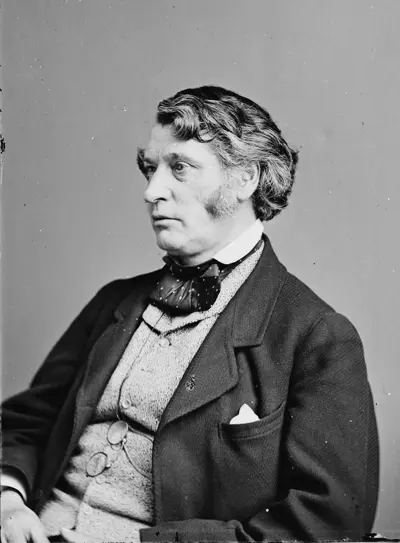
Charles Sumner was an American statesman and United States Senator from Massachusetts. As an academic lawyer and a powerful orator, Sumner was the leader of the anti-slavery forces in the state and a leader of the Radical Republicans in the U.S. Senate during the American Civil War. During Reconstruction, he fought to minimize the power of the ex-Confederates and guarantee equal rights to the freedmen. He fell into a dispute with President Ulysses Grant, a fellow Republican, over the control of Santo Domingo leading to the stripping of his power in the Senate and his subsequent effort to defeat Grant's re-election.
