George Washington Quotes
The time is near at hand which must determine whether Americans are to be free men or slaves.
Washington, George. "General Orders, 2 July 1776." The Writings of George Washington from the Original Manuscript Sources, 1745-1799, edited by John C. Fitzpatrick, vol. 5, U.S. Government Printing Office, 1932, p. 211.

The glorious spectacle of eighteen millions of people, struggling to burst their chains and be free.
The entire speech was translated into Spanish and read to great applause to Latin American revolutionary regiments.


Marion was the initiator of Guerilla Warfare and he and his men traveled lightly spending much time in the South Carolina swamps. They had few supplies and when chased by the British could not stop to hunt. The British called him the “Swamp Fox”. The American colonists at this point still thought of the British as “their countrymen.”

The Kandahar region of Afghanistan was occupied by the Persians under Gurgin Khan. The Persians at the time were Shiite Muslims while the Afghans were Sunnis. Gurgin Khan forced all the Sunnis to convert to become Shia under threat of death. Mirwais Hotak led a force of freedom fighters, and defeated the Persians, killing Gurgin Khan in the process. There were some Afghan people who by collaborating with the Persians had done very well for themselves. They were anxious about their liberator and some were thinking about sneaking away and joining up with the Persians. He then made this speech, remarkable for any time, and especially so at the early 18th century. Notice, that unlike most other peoples of the Middle East, the Afghan’s placed a high value on freedom, and were willing to fight for it. In that sense, Afghanistan was culturally and politically different from the rest of the Islamic world.


This quotation is historically important because Davis clearly states the reason for the rebellion of the South. The anti-slave states were growing at a greater rate than the slave states and despite the greater voting power that a southerner had (a result of the 3/5 count of slaves for census purposes, and the Senate), the handwriting was on the wall and the majority of the United States was against the vicious institution of slavery and would make it unprofitable, impossible and/or illegal in the coming years. Southern slavery advocates saw this as a “tyranny of the majority” and therefore took up arms. In the early 20th century, apologists for the Southern rebellion tried to promote the idea that there were reasons other than slavery, but this quotation and the resolutions of the states who withdrew from the Union make it clear that the right to maintain slavery was the only significant issue. In that sense it was a States’ Rights issue, but the South was opposed to States’ Rights when it came to States refusing to return fugitive slaves when Federal Law required such under the Dred Scott Supreme Court Decision.

Hopkins was complaining about the fact that England could tax the colonies and thereby take their property without their consent made the American colonists in the “miserable condition of slaves.” Essentially the fundamental complaint of the Americans was this and in a decade it would erupt as the American Revolution. At the same time, Hopkins was a slave owner and yet saw nothing wrong with that.
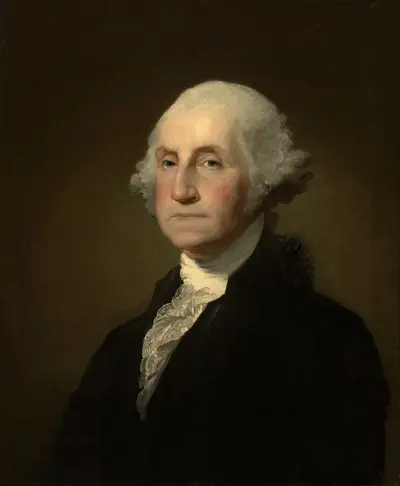
George Washington was the first President of the United States (1789-97), the Commander-in-Chief of the Continental Army during the American Revolutionary War, and one of the Founding Fathers of the United States. He presided over the convention that drafted the current United States Constitution and during his lifetime was called the "father of his country".
