Woodrow Wilson Quotes
Liberty has never come from the government. Liberty has always come from the subjects of it. The history of liberty is the history of resistance.
Woodrow Wilson, 1856-1924, 28th President of the United States (Democrat, NJ), Speech, New York City, September 9, 1912
Sourced by: Eigen's Political and Historical Quotations


The Kandahar region of Afghanistan was occupied by the Persians under Gurgin Khan. The Persians at the time were Shiite Muslims while the Afghans were Sunnis. Gurgin Khan forced all the Sunnis to convert to become Shia under threat of death. Mirwais Hotak led a force of freedom fighters, and defeated the Persians, killing Gurgin Khan in the process. There were some Afghan people who by collaborating with the Persians had done very well for themselves. They were anxious about their liberator and some were thinking about sneaking away and joining up with the Persians. He then made this speech, remarkable for any time, and especially so at the early 18th century. Notice, that unlike most other peoples of the Middle East, the Afghan’s placed a high value on freedom, and were willing to fight for it. In that sense, Afghanistan was culturally and politically different from the rest of the Islamic world.

The veiled threat of violence and disruption was a tactic that did not work.


Goldman and other American radicals who had been born in Russia were deported to America after the Palmer Raids. When she arrived, she was shocked that the Russian Revolution had betrayed all the principles of freedom that had been advocated by most of the communist leaders. She left Russia and for the rest of her life condemned the Russian Bolsheviks and the result of the Revolution. She was one of the first radicals who realized that Russia itself had betrayed the principles of the revolution.


Massachusetts rioters who had distressed Abigail Adams and others were pardoned for their crimes. Jefferson was responding to her concerns {592539} and providing her with the pardon news.
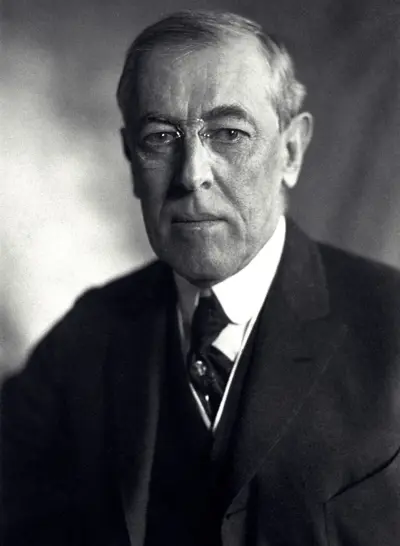
Thomas Woodrow Wilson was an American politician and academic who served as the 28th president of the United States from 1913 to 1921. A member of the Democratic Party, Wilson served as the president of Princeton University and as the 34th governor of New Jersey before winning the 1912 presidential election. As President, Wilson led the United States into World War I in 1917. He was the leading architect of the League of Nations, and his progressive stance on foreign policy came to be known as Wilsonianism. Scholars have generally ranked Wilson in the upper tier of U.S presidents, although he has been criticized for supporting racial segregation and white supremacy.
