Theodore Roosevelt Quotes
Do not answer [William Jennings] Bryan. Attack him!
Taft was a jurist whose tendency was to respond to each point his opponent made and argue it logically and then to on to the next point much as in a formal debate. However, Bryan was a very dynamic speaker who was a populist and demagogue. Roosevelt who could debate logically or thunder like a demagogue was of the opinion that you should not let a demagogue control the agenda in a campaign. Trying to answer was futile. Instead attack the demagogue where he is weak and stay on the attack. This was hard for Taft to do as he was not the skilled speaker or politician that TR was. Taft won, but Roosevelt was actively campaigning for him and attacking Bryan. The notion of attack, as Theodore Roosevelt used it was NOT negative campaigning. Roosevelt did not attack Bryan personally or make ad hominum arguments. What he advocated was that when Bryan made a speech and criticized a policy that Taft supported, instead of answering him point by point, as one would do in a debating society (at which Taft excelled) attack some of the worst policies that Bryan was advocating or had advocated. Control the agenda so that Bryan would have to answer Taft’s criticism, not the other way around.
Theodore Roosevelt, 1858-1919, 26th President of the United States (Republican, NY), Campaign advice to William Howard Taft, September 1, 1908
Sourced by: Eigen's Political and Historical Quotations

Many supporters urged him to be more aggressive on the Campaign Trail, See {640689}.


This famous quotation illustrates the perfect political reply to a personal attack. In one short sentence, Lincoln denied the charge, obtained the sympathy of the audience, demonstrated that he was not stuck-up, entertained the crowd, and gave everyone there a story to tell about him afterward—the perfect oratorical response.


A few weeks before his election his opponent accused him of sexually molesting a woman two decades earlier.


At that time, most of the leading Republicans practiced negative campaigning with vicious personal attacks that were often untrue. He was the only one of the 9 candidates who did not engage in the technique. He came in close to last.

Romney and his surrogates had more than usual difficulty with getting their facts right. Fact checking organizations would call them on this and in April of 2012, Romney ran a TV ad that was grossly wrong and misleading. When asked about the expose of the falsehood of the ad, Newhouse made this classic response. The reason this is an important quotation is that the statement drew much more critical attention than the false had or its classification as untrue did. Even President Obama made fun of it in his campaign speeches. See Martin Amis {631017} for a serious critique of the meaning of the quotation.
His older brother was running for Consul—the highest elected office of the Roman Empire. The Handbook, was his advice to his brother as to how to conduct his campaign.

Msny critics agree with him observing that, with his rough and tumble campaign tactics, he made them that way.

He was referring to his Presidential opponent, Hillary Clinton. What makes this quotation noteworthy is that many observers at the time felt that this statement gave an insight into the very unusual personality of Trump. He was so hyper competitive and machismo that he even tried to be better than his opponent in everything including negative things like being nasty. He could not abide being second in anything, even things that made him less fit for the presidency.
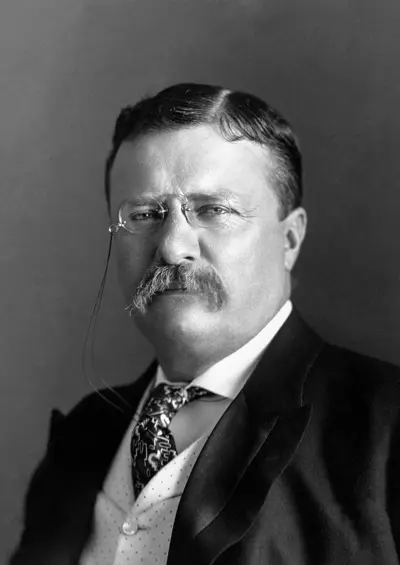
- Born: October 27, 1858
- Died: January 6, 1919
- Nationality: American
- Profession: Nobel Peace Prize
Theodore Roosevelt Jr., often referred to as Teddy or his initials T. R., was an American statesman, conservationist, naturalist, historian, and writer, who served as the 26th president of the United States from 1901 to 1909. He previously served as 33rd governor of New York from 1899 to 1900 and the 25th vice president of the United States from March to September 1901. Roosevelt emerged as a leader of the Republican Party and became a driving force for anti-trust and Progressive policies.
